×

Cameras

The history of the camera goes back much further than that of photography as a form of art and documentation. The first cameras were developed as early as Greek, Roman and Chinese antiquity. The camera obscura, Latin for “darkroom,” projected an image of a scene onto a wall through a tiny hole in a screen. In ancient times, however, this phenomenon was perceived more as a curiosity and did not have much practical application.

Then in the Renaissance, the camera obscura was more widely used, in which painters used the projection as a model for their paintings. It is believed that painters such as Johannes Vermeer, Caravaggio, da Vinci and others used optical devices such as the camera obscura to achieve accurate perspective in their compositions.

It was not until the 19th century that the first “real” cameras were developed. Exactly who was the first is somewhat disputed. In 1816, Nicéphore Niepcé, a French inventor, developed heliography. Using a small homemade camera and a sheet of paper coated with silver chloride, Niepcé was able to take a picture.

Then in 1888, an inventor stepped onto the scene whose name should still be familiar to most photographers and non-photographers today, George Eastman. He presented the first camera with celluloid film. The camera resembled a box and should convince by a simple operating concept. The name of the camera was simply “Kodak”.

With the beginning of the 20th century, the development of cameras began to gain momentum. The world’s first mass-market camera was introduced as early as 1900 by George Eastman, the Brownie. Ten years later, the first developments of a 35mm camera followed by the German engineer Oskar Barnack. These developments resulted in the Leica I in 1925.

Another German development was the first medium format camera with two lenses, the Rolleiflex by Franke & Heidecke, in 1929. This was followed in 1948 by the first single-lens reflex camera with instant-return mirror, Gamma Duflex. This model was built in Hungary. Also in 1948, the first instant camera was introduced. The American Ediwn Land presented the Polaroid SX-70 Land Camera.

The first digital camera system was developed by Kodak engineers in 1975. Of course, digital photography became really popular years later.

Over the decades, more and more innovations and attempts to create the perfect camera followed.

Here you can find an overview of a fraction of these models. Some of them have become legendary, others could not establish themselves in the masses, but they should not be forgotten.

FilmPhotography Camera Illustration

Brands & Manufacturer

Kameras nach Typ

minolta-er-single-lens-reflex-camera-bnv
Minolta ER
The Minolta ER is a 35mm camera with aperture priority for the 35mm format from the 1960s.
minolta-sr-7-slr-camera-japan
Minolta SR-7
The Minolta SR-7 was the Japanese manufacturer's first SLR camera with a built-in light meter.
minolta-sr-3-single-lens-reflex-camera-bnv
Minolta SR-3
The Minolta SR-3 is a single lens reflex camera from the 1960s for the 35mm format.
minolta-sr-1-single-lens-reflex-camera-bnv
Minolta SR-1
The Minolta SR-1 is the second SLR camera for the 35mm format from the Japanese photo giant.
minolta-sr-2-single-lens-reflex-camera-bnv
Minolta SR-2
The Minolta SR-2 was the first SLR camera from the Japanese manufacturer.
Minolta-ALS-Camera-Guide-bnv
Minolta ALS
The Minolta ALS is a rangefinder camera from the 1960s for the 35mm format.
minolta-af-sp-snapshot-camera-bnv
Minolta AF-SP
The Minolta AF-SP is a snapshot camera with built-in flash from the 1980s.
minolta-talker-35mm-camera
Minolta Talker
The Minolta Talker is a camera for 35mm film with a voice output.
minolta-af-sv-snapshot-camera-bnv
Minolta AF-Sv
The Minolta AF-Sv is a compact camera with a special feature.
minolta-af-s-snapshot-camera-bnv
Minolta AF-S
The Minolta AF-S is a simple compact camera from the 1980s with built-in flash.
minolta-af-e-ii-snapshot-camera-bnv
Minolta AF-E II
The Minolta AF-E II is a point-and-shoot camera from the 80s for 35mm format.
minolta-freedom-200-snapshot-camera-bnv
Minolta Freedom 200
The Minolta Freedom 200 is a point-and-shoot camera with built-in flash from the 1980s.
minolta-freedom-dual-35mm-camera-guide
Minolta Freedom Dual
The Minolta Freedom Dual is a compact camera with flash and two focal lengths.
minolta-freedom-dl-snapshot-camera-bnv
Minolta Freedom DL
Minolta Freedom DL is a compact camera for 35mm format with two different focal lengths and flash.
minolta-af-dl-snapshot-camera-bnv
Minolta AF-DL
The Minolta AF-DL is a snapshot camera. It was presented by Minolta in 80s.
Minolta-AF-C-Camera-guide-bnv
Minolta AF-C
The Minolta AF-C is a compact 35mm lens autofocus camera.
minolta-af-101r-35mm-camera
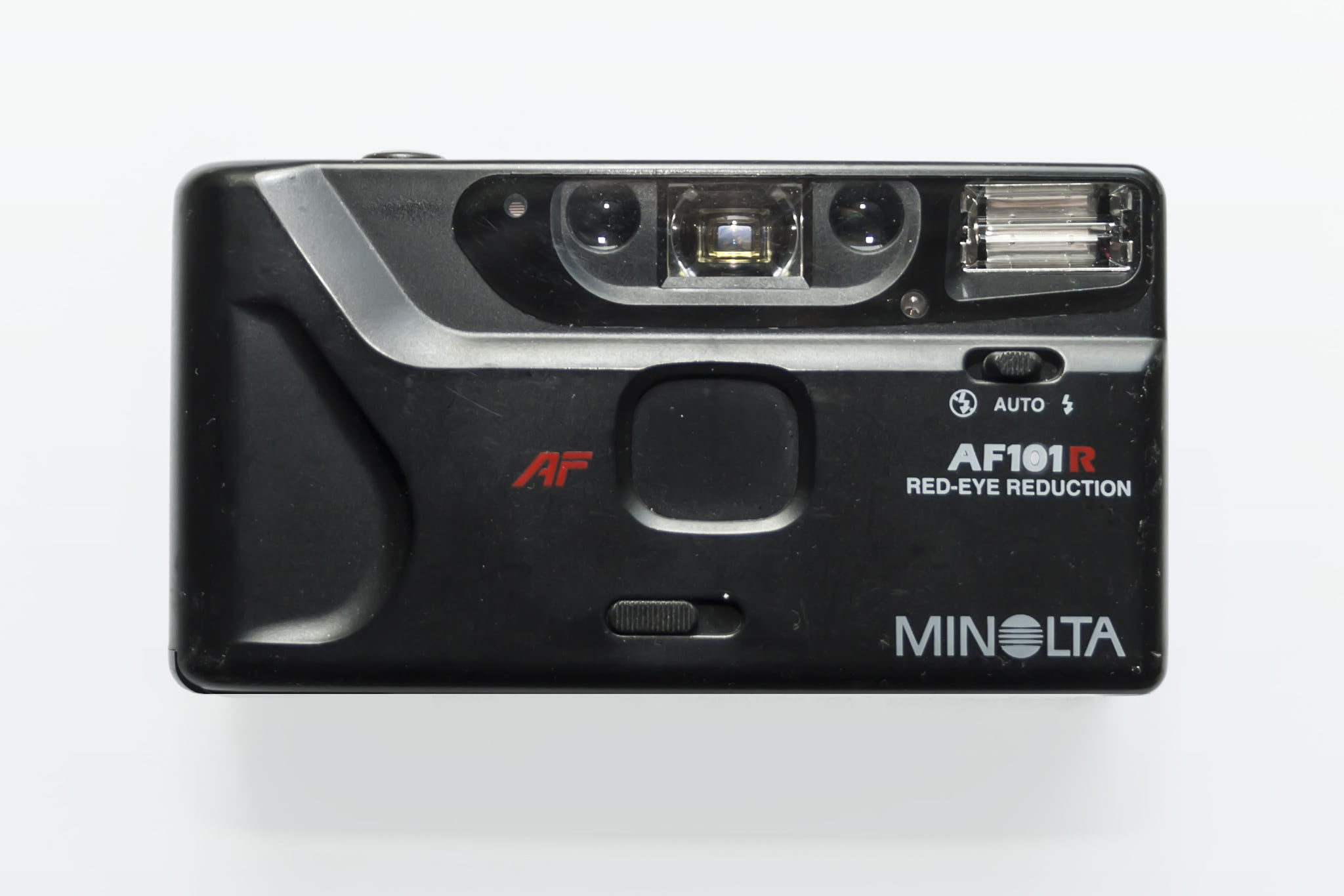
Minolta AF-101R
The Minolta AF-101R is a simple 35mm camera with built-in flash for quick snapshots.
minolta-hi-matic-af2-m-snapshot-camera-bnv
Minolta Hi-Matic AF2-M
The Minolta Hi-Matic AF2-M is Minolta's first near-fully automatic model.
minolta-hi-matic-af2-viewfinder-camera-bnv
Minolta Hi-Matic AF2
The Minolta Hi-Matic AF2 is a 35mm camera of the Hi-Matic series with autofocus and built-in flash.
minolta-hi-matic-af-viewfinder-camera-bnv
Minolta Hi-Matic AF
The Minolta Hi-Matic AF is the first autofocus camera in the Hi-Matic series.
minolta-hi-matic-cs-ii-viewfinder-camera-bnv
Minolta Hi-Matic CS II
The Minolta Hi-Matic CS II is a basic 35mm camera with automatic exposure and a built-in flash.
minolta-hi-matic-sd2-viewfinder-camera-bnv
Minolta Hi-Matic SD2
The Minolta Hi-Matic SD2 is a camera with automatic exposure and data back for 35mm format.
minolta-hi-matic-g2-viewfinder-camera-bnv
Minolta Hi-Matic G2
The Minolta Hi-Matic G2 is a 35mm camera with automatic exposure from Minolta.
minolta-hi-matic-gf-viewfinder-camera-bnv
Minolta Hi-Matic GF
The Minolta Hi-Matic GF is the last model in the Japanese manufacturer's Hi-Matic series.

Kameras nach Eigenschaften