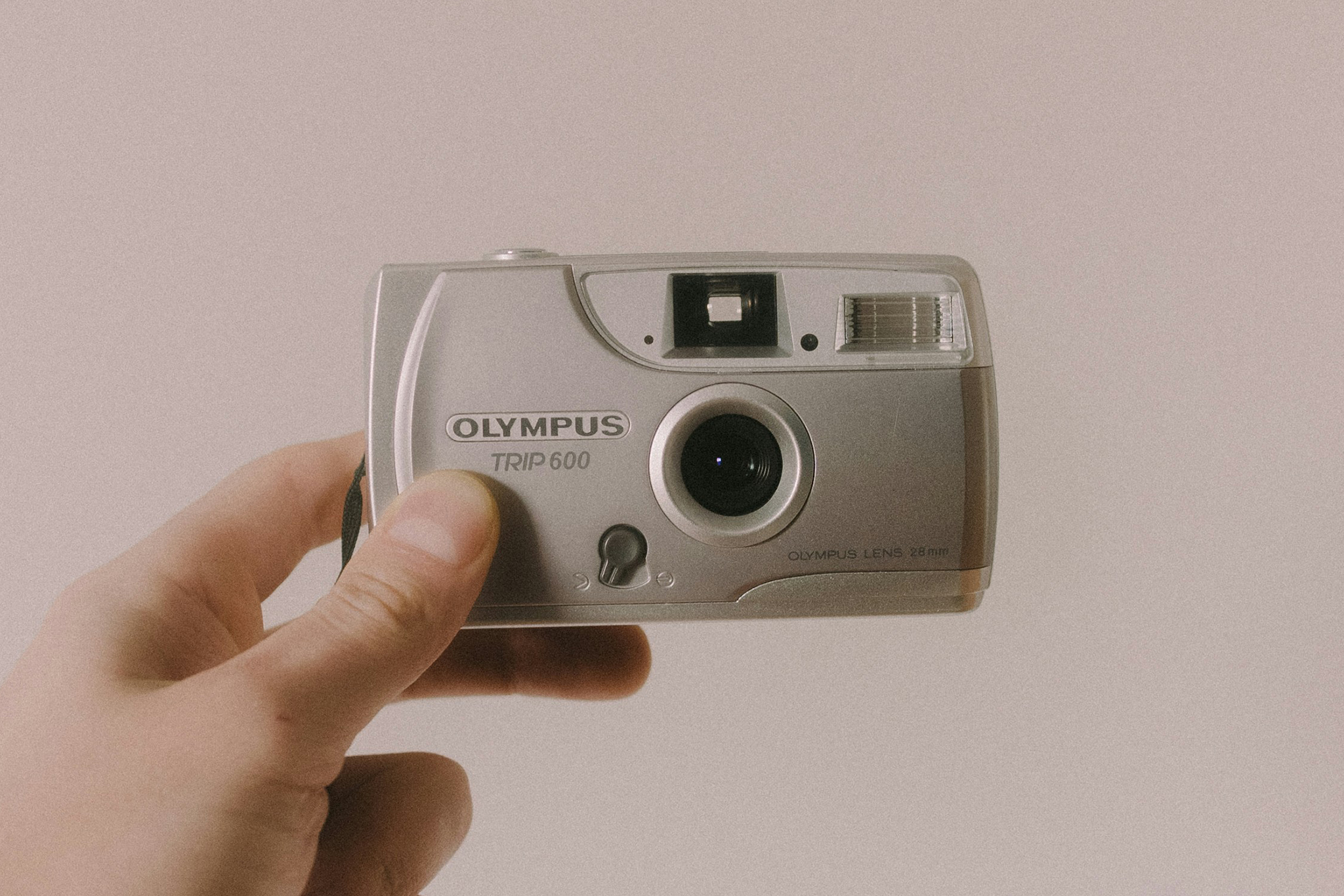
The Olympus Trip 500 is a snapshot camera built by Olympus. The model is very easy to use and is designed for the 35 mm format. Very similar models were sold under the names Olympus Trip AF 50 and Olympus Trip 600. It was built in a factory in China.
The lens of this model is not interchangeable. The focal length is fixed at 28 mm. The maximum aperture is f/6.7. With a focal length of 28 mm, the camera is well suited for snapshots or landscape photography. It is also a good choice for group shots.
The focus on this camera is fixed. It is not possible to set the distance manually. For a sharp and detailed image, a distance of at least 100 cm to the subject is required. Macro shots are therefore not possible with this camera model.
The light meter in the camera ensures correct exposure settings. It is designed for films from ISO 100 to ISO 400. The sensitivity of the film material can be automatically adopted by the camera technology from the coding on the cartridge. The 35mm camera is equipped with automatic exposure, which does not allow the photographer to select the exposure time and aperture manually. The shutter speed is fixed at 1/100 second.
The built-in flash can be used in poor lighting conditions. At a sensitivity of ISO 100, it reaches up to 1.9 metres. A light on the back indicates that the flash is ready. There is a thread for a tripod on the underside of the camera body, which makes group shots easier. This model does not have a self-timer.
The camera requires two AA batteries (eBay / Amazon*), which provide the power for the functions. Rechargeable batteries can of course be used here.
A camera strap can be attached to the side of the camera. The camera housing is made of plastic.
Films for the Olympus Trip 500
What types of film are suitable for the Olympus Trip 500? The camera relies on 35mm film, and despite the digital photography boom, there is still a nostalgic affection for analogue film. This love of the 35mm format means that some manufacturers continue to produce film for it.
For colour shots with the Olympus Trip 500, Kodak Ultramax 400* is recommended as a 35mm film. For black and white shots, on the other hand, the Ilford XP2 Super* can be used. According to various test reports, both films show solid performance in most everyday shooting situations.
The C-41 development process is suitable for processing colour films and is offered by practically every photo lab. In Germany, there is also the option of having colour films developed in large drugstore chains.
The Olympus Trip 500 has an exposure range of 24 mm x 36 mm. Its film transport works automatically, so that the film is automatically rewound to the next image after each release. A window on the back shows the film loaded. Of course, the rear panel must not be opened until the film has been rewound into the cartridge.