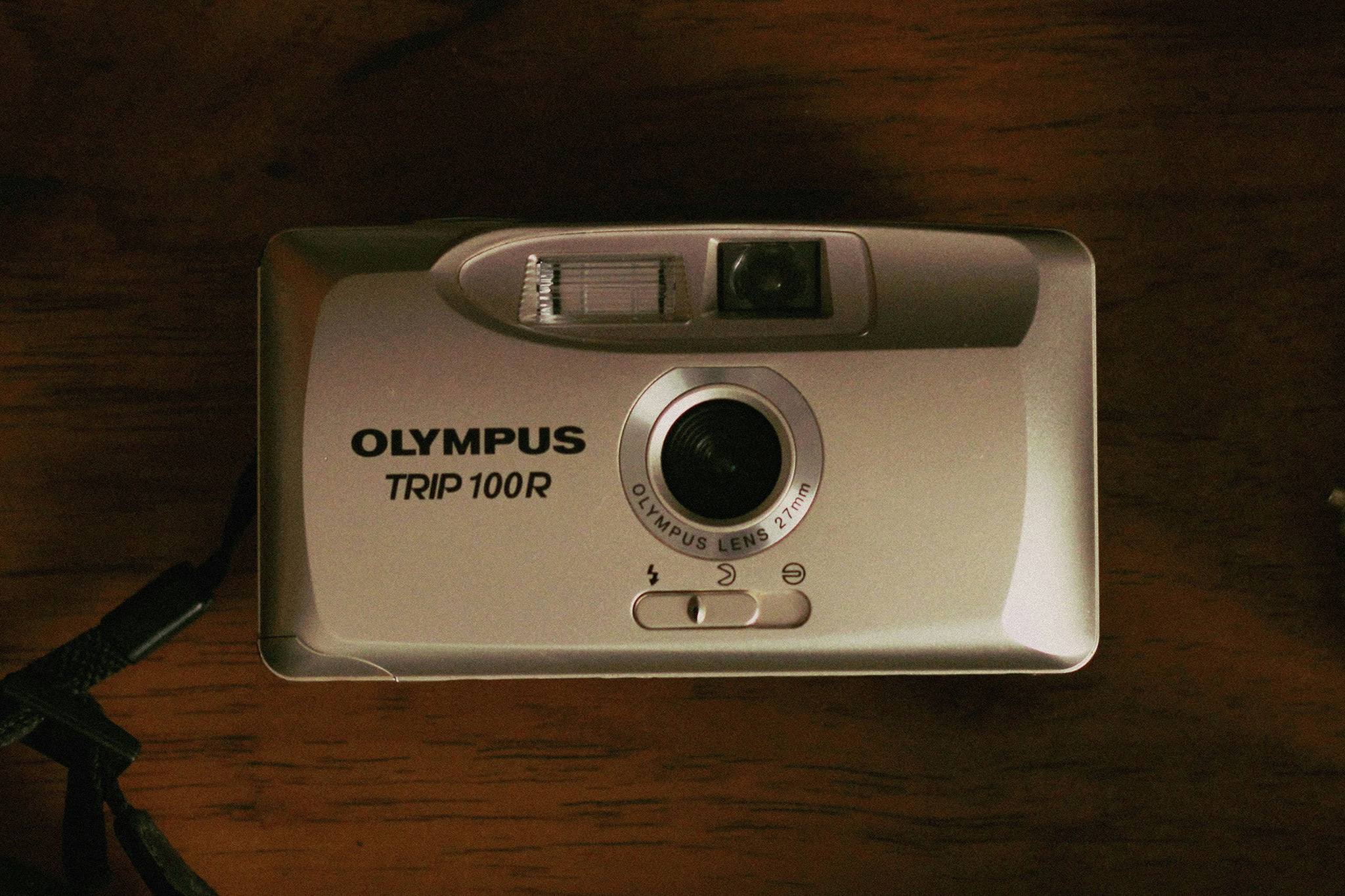
The Olympus Trip 100R was introduced by Olympus in the 1990s as a point-and-shoot camera. Characteristic of the era, it is characterised by its user-friendliness, which makes it particularly attractive for photography novices.
Its body is made of plastic and its production took place in China. It was available in a gold and silver colour version. The Olympus GO 100 is a model with the same functions.
In contrast to other analogue cameras, the Trip 100R has a fixed lens. The lens has a fixed focal length of 27 mm, ideal for everyday photography and spontaneous shots without a zoom function. The focus is fixed. The exposure settings cannot be changed either.
An integrated flash with fill-in function, which fires with every shot, is also part of the equipment. This mode is useful for illuminating foreground subjects brighter than their background.
This model does not offer the option of attaching a tripod, but a camera strap can be attached. The scope of delivery originally included a suitable storage bag.
The Olympus Trip 100R does not have a self-timer function.
The camera uses two AA batteries (eBay / Amazon*) for operation, which also power the automatic film transport. These batteries are very easy to find. You can also use rechargeable ones.
Films for the Olympus Trip 100R
Designed for 35mm 35mm film, as described in the manual, the 35mm format remains a common choice among various manufacturers thanks to its long history and popularity.
Available photo films for the Olympus Trip 100R that are easy to obtain are the Kodak Gold 200* for colour shots and the Kodak T-Max 400* for B&W shots.
As a negative film, the colour film is suitable for the C-41 development process, which is offered by most photo development services. Films can therefore be developed in most drugstores.
The image format of the camera is 24 mm x 36 mm, and one roll of film can usually take about 36 pictures. After each photograph, the camera automatically advances the film and automatically rewinds it at the end of the roll. The rewinding process can be initiated manually via a switch on the underside.
This model does not have a digital display; instead, a frame counter on the top provides information on the number of shots remaining. A small window at the rear allows the inserted film to be checked visually.