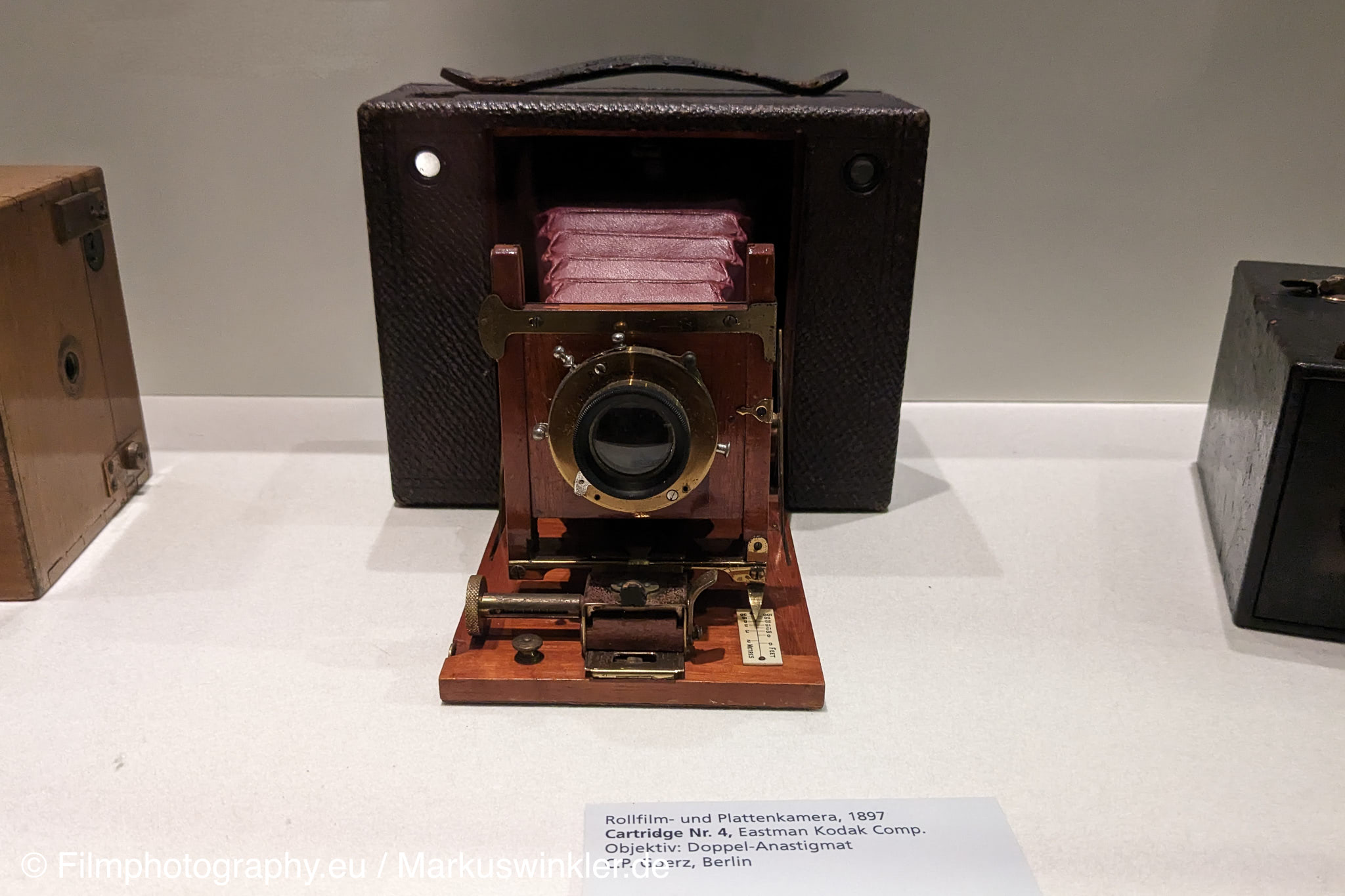
At the end of the 19th century, the Eastman Kodak Company continuously expanded its product range. In addition to simple box models for occasional snapshots, a camera appeared in 1897 that was aimed primarily at ambitious amateurs and traveling photographers. This was the Kodak Cartridge Camera No. 4, usually listed as the No. 4 Cartridge Kodak in catalogs of that time. The model combined the folding design of a bed camera with the negative dimensions of the then-current large format.
The name suffix refers to a central feature of the construction. The camera used the newly introduced roll film of type 104. Thanks to the light-tight protective paper on the back of the film, the camera could be loaded and unloaded in normal daylight. For photographers, this meant saying goodbye to the changing bag or darkroom when changing film outdoors.
With a negative format of 4 by 5 inches, which corresponds to about 10 by 12.5 centimeters, the system delivered images that could be exposed directly as contact prints on paper. Those who didn't fully trust roll film yet or preferred to use glass plates for certain subjects could swap the back for an adapter.
In terms of construction, the camera followed the principle of the classic bed camera. The body was made of wood and covered with black leather on the outside. After unlocking and folding down the front panel, the red leather bellows came into view, framed by the mahogany wood of the interior. In the early versions until autumn 1900, Kodak also made the lens standard from wood and used brass fittings. Later versions received metal lens carriers and nickel-plated functional parts.
The No. 4 offered mechanical adjustment options that were otherwise more commonly known from studio cameras. The lens board could be shifted vertically and laterally. This so-called shift helped to correct converging lines when photographing tall buildings.
Focusing was done manually using a scale on the bed. Two small brilliant finders were available for choosing the image section, one each for landscape and portrait format shots. The camera was usually equipped with a Rapid Rectilinear lens from Bausch and Lomb, combined with pneumatic shutters such as the Eastman Triple Action.
Until the series was discontinued in 1907, more than 90,000 units left the factory in Rochester. At the time, Kodak even advertised the device with special bicycle mounts to appeal to day-trippers.
The Kodak Cartridge Camera No. 4 documents the phase in which roll films gradually replaced glass plates. Today, the construction made of wood, leather, and metal is primarily represented in collections as an illustrative object for photographic technology at the turn of the century.


