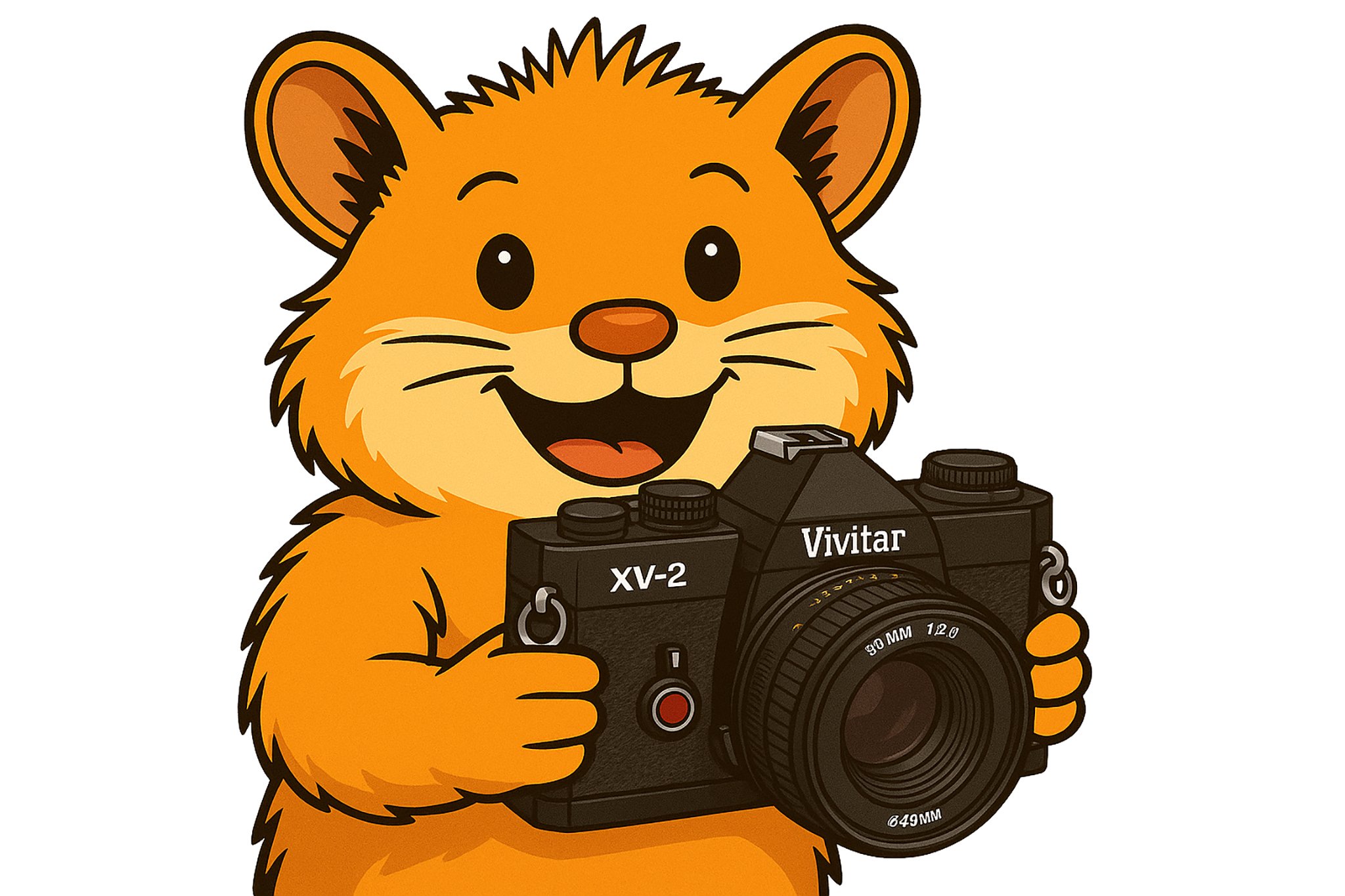
The Vivitar XV-2 is an analog single-lens reflex (SLR) camera for the 35mm format. It was offered in the 1980s.
The camera was manufactured in Japan. Cosina is presumably responsible for production. A corresponding model was available as the Cosina CT-2.
Lens
The Vivitar XV-2 uses a quick-change bayonet mount, allowing for quick and easy lens changes. To attach, a red dot on the lens is aligned with a corresponding red dot on the camera body.
Some Vivitar standard lenses also feature a raised, fluorescent orange index button, which facilitates tactile alignment with the bayonet release button, even in the dark.
The camera was typically offered with a standard lens, with several options available. These included lenses with a focal length of 50mm and different apertures such as f/2.0, f/1.8, f/1.7 (VMC), and f/1.4 (VMC). The minimum focusing distance for these 50mm lenses is 0.5 meters (20 inches). Also available was a 40mm f/2.5 VMC lens with a minimum focusing distance of 0.6 meters (24 inches).
Focusing is done manually using the distance setting ring on the lens. A focusing screen in the viewfinder serves as a focusing aid. It contains a horizontal split-image indicator in the center, surrounded by a microprism ring.
When the focus is correct, the two halves of the image merge into a single clear image in the split-image indicator, and the flickering in the microprism ring disappears.
Compatible lenses feature an aperture setting ring, which allows you to manually select the desired aperture value. The set value is opposite an index mark. Depending on the lens, aperture values range from the largest aperture (e.g., f/1.7) to the smallest aperture (typically f/16, as mentioned in the exposure compensation section).
Many compatible lenses also feature a depth-of-field scale, which, in conjunction with the distance scale on the focusing ring, allows you to estimate the depth of field at the selected aperture. The accessory diameter for filters on standard lenses is 49 mm, and the outer diameter is 51 mm.
Exposure Settings
The Vivitar XV-2’s exposure metering is performed through the lens (TTL) with the aperture open. The system uses center-weighted integral metering, realized by two silicon photocells, one located on each side of the viewfinder eyepiece behind the pentaprism.
The camera’s metering range extends from EV -2 to EV +19 (based on ASA 100 and aperture f/1.4), allowing use in a wide variety of lighting conditions, from low light to bright sunlight.
The camera primarily operates in aperture priority mode (“Auto” on the function dial). In this mode, the photographer preselects the aperture on the lens, and the camera’s electronics calculate and continuously set the appropriate shutter speed automatically. The mode selector also offers the settings “Off,” “X” for flash synchronization (fixed time of 1/85s), and “B” for long exposures (bulb).
The shutter is an electronically controlled Copal FM-591 metal focal plane shutter with vertical travel. In “Auto” mode, it covers a continuously variable range from 8 seconds to 1/1000 of a second.
The operation of the light meter is visualized in the viewfinder. Lightly pressing the two-stage shutter release button activates the exposure meter. A scale on the left edge of the viewfinder displays the shutter speeds, and one of 16 red LEDs lights up to indicate the shutter speed selected by the camera (between 8s and 1/1000s). There are also LEDs for “Over” (top) and “Under” (bottom).
- If the “Over” LED lights up, the selected aperture is too large (too bright); the aperture ring should be turned to a higher aperture value (smaller opening, e.g., f/16) until an LED next to a shutter speed lights up.
- If the “Under” LED lights up, the aperture is too small (too dim); the aperture ring should be turned to a lower aperture value (larger opening, e.g., f/1.7).
- If “Under” is displayed even at the largest aperture, additional light (e.g., flash) is required.
The film speed is set manually using the film speed dial in third-stop increments from ASA 25 to ASA 1600 and aligned with the index mark. Since the dial only displays ASA values, a DIN/ASA comparison table is attached to the back of the camera.
Flash System
The Vivitar XV-2 is prepared for use with flash units. The camera offers X-sync flash synchronization with a fixed shutter speed of 1/85 second. To use the flash, the mode selector must be set to the “X” position.
Two options are available for connecting flash units: a standard accessory shoe on the pentaprism with an integrated center contact for X-sync, and a separate PC-contact sync cable socket, which is also X-sync. This allows the connection of flash units without a center contact via a sync cable. The correct aperture setting for flash exposure must be set manually on the lens according to the instructions for the flash unit used, as the camera does not support TTL flash metering.
Additional Features
In addition to its core functions, the Vivitar XV-2 offers several useful additional features:
- An electronic self-timer is integrated and is activated by sliding the lever from the vertical “Off” position to the horizontal “On” position. It offers a pre-release time of approximately 10 seconds. A flashing LED on the lever serves as a visual countdown indicator. Approximately 2 seconds before the shutter is released, the LED flash frequency increases. The self-timer can be canceled at any time by returning the lever to the “Off” position and works with or without flash.
- A tripod thread is provided for stable shots, especially with longer exposure times or when using the self-timer. It is a standard 1/4-inch thread and is located on the camera’s optical axis.
- Film advance is controlled by a single-stroke rapid-action lever. A built-in double-exposure lock prevents accidental multiple exposures of the same frame.
- The exposure counter counts progressively from “S” (start) to “36” and automatically resets to “S” when the camera back is opened. The exposure markers for 12, 20, 24, and 36 exposures are highlighted in red for easy identification.
- The camera back features a memo holder into which the film wrapper tab can be inserted to record the film type and cassette length. The DIN/ASA comparison table is attached next to it.
- The film rewind crank is used in conjunction with the film rewind button and the rewind release button on the bottom of the camera to rewind the film.
- Eyelets for attaching a carrying strap are also provided.
- A film plane reference mark indicates the exact position of the film plane, which can be relevant for close-ups.
- The easy film loading is supported by a slotted take-up spool and film transport gears.
Dimensions and Weight
The dimensions of the Vivitar XV-2, for the body only without a lens, are: 133 mm wide, 85 mm high, and 48 mm deep. The weight of the camera body alone is approximately 450 grams (15.87 ounces). These dimensions underscore the camera’s claim to be a comparatively compact and lightweight SLR camera.
Power supply
The Vivitar XV-2 requires two 1.5 volt silver oxide batteries (eBay / Amazon*) to operate the electronic shutter and exposure metering system.
Compatible types include the Eveready S-76, Mallory MS-76, Ray-O-Vac RC-76, or the Japanese G-13, as well as comparable models.
The batteries are inserted into the battery compartment on the bottom of the camera, the lid of which can be opened with a coin. When inserting them, ensure that the positive (+) pole of both batteries faces inward, toward the camera contact. The positive contact in the camera is marked with a “+” symbol for orientation. A battery check can be performed by turning on the camera (function selector set to “Auto”) and lightly pressing the shutter button. If one of the LEDs in the viewfinder lights up, the battery voltage is sufficient.
If the camera is not going to be used for an extended period, we recommend removing the batteries to avoid damage from leaking batteries.
Film Recommendations
The Vivitar XV-2 uses standard 35mm film (eBay / Amazon*). The camera supports a wide range of film speeds, adjustable from ASA 25 to ASA 1600 in 1/3-stop increments using the control dial.
There is no DX code recognition; film speed must always be set manually. The table on the back is used to convert DIN values, which are indicated on some film packages.
The camera’s continuous shutter speed control in automatic mode helps to precisely adjust the exposure to the selected film speed and the lighting conditions.
Quick Operation Guide
- First, two suitable 1.5V silver oxide batteries are correctly inserted into the battery compartment.
- Then, a 35mm film cartridge is inserted into the film cartridge chamber, the film leader is guided over the film pressure plate and the shutter blades to the slotted take-up spool, and secured there. The perforation must engage with the film advance gears.
- After closing the camera back, the film advance lever is pulled and released until the frame counter reads “1”.
- The correct ASA sensitivity of the film is now set using the control dial.
- The function selector is set to “Auto”.
- The subject is aimed through the viewfinder and focused using the focus ring on the lens (split image/use microprisms).
- The desired aperture is selected using the lens aperture ring.
- Lightly pressing the shutter button activates the exposure metering; the LED in the viewfinder displays the selected shutter speed. If necessary (displayed as “Over” or “Under”), the aperture is corrected.
- To release the shutter, press the shutter button all the way down.
- After each shot, the film is advanced using the film advance lever.
- When the film is full, press the rewind release button on the bottom and rewind the film completely into the cartridge using the fold-out rewind crank before opening the camera back.
Technical datasheet
| Attribute | Specification |
|---|---|
| Type of Camera | Single lens reflex camera |
| Film format | 35mm |
| Film transport | Manual |
| Film transport mechanism | Quick release lever |
| Picture format | 24 mm x 36 mm |
| Lens mount | Pentax K lens mount |
| Focus | Manual |
| Viewfinder | Pentaprism finder |
| Exposure times | 1/1000 second to 8 seconds, Bulb |
| Bulb mode | Yes |
| Light meter | Yes |
| Supported film speeds | ISO 25 to 1600 |
| Exposure modes | Aperture priority |
| Auto DX (Film sensitivity) | No |
| Date imprinting | No |
| Double and/or multiple exposure function | No |
| Built-in flash | No |
| Flash Connection | Hot Shoe, PC-Flash |
| Flash sync speed | 1/85 s |
| Tripod mount | Yes |
| Cable release thread | Yes |
| Self-timer | Yes, Self-timer function with 10 seconds lead time |
| Connection for camera strap | Yes |
| Power supply | 2x S76 batteries |
| Size | 13,3 x 8,5 x 4,8 cm |
| Dimensions in inches | 5.24 x 3.35 x 1.89 inches |
| Weight | 450 Grams |
| Manufacturer | Cosina |
| Country of production | Japan |