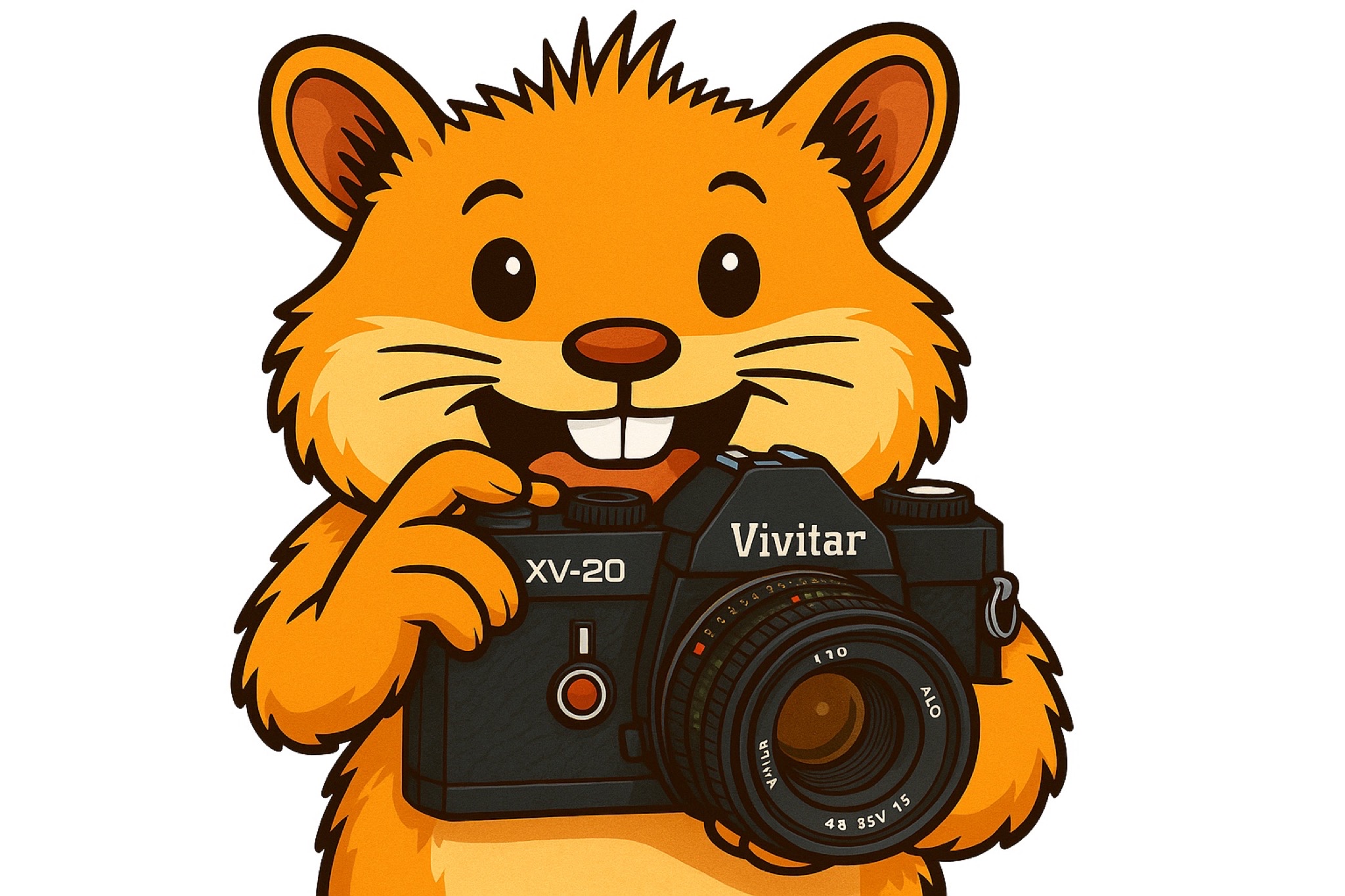
The Vivitar XV-20 is a 35mm analog single-lens reflex (SLR) camera designed for photographers who value automatic exposure control in a compact and robust body.
This model was sold in the 1980s. It was produced by the company Cosina. A functionally identical model was sold by the Japanese company under the name Cosina CT-2.
Lens
The Vivitar XV-20 is typically offered with several standard lenses, including variants with a focal length of 50mm and apertures such as f/2.0, f/1.8, f/1.7 (VMC), or f/1.4 (VMC), as well as a 40mm f/2.5 VMC option.
The minimum focusing distance for the 50mm lenses is typically 0.5 meters (20 inches), while for the 40mm lens it is 0.6 meters (24 inches).
The camera features a Pentax K bayonet mount, which allows for easy interchangeability of compatible lenses. To change, press the lens release button and turn the lens counterclockwise.
To mount, align the red dot on the lens with the corresponding dot on the camera body and turn the lens clockwise until it audibly clicks into place.
Focusing is done manually using the focus ring on the lens. Focus is controlled in the viewfinder via a central horizontal split-image indicator and a surrounding microprism ring on a Fresnel lens.
For precise focusing, align the split image with a vertical edge of the subject until the two halves are aligned, or observe the microprism ring until flicker disappears and the image appears clear.
The lenses feature an aperture ring for manually adjusting the aperture (f-stop), as well as a distance scale and a depth of field scale. This scale allows the photographer to estimate the depth of field at a given aperture and focus setting, facilitating techniques such as zone focusing.
Exposure Settings
The Vivitar XV-20 features a TTL (Through The Lens) exposure metering system that operates at wide apertures.
Metering is performed using a center-weighted average metering system, which is performed by two silicon photodiodes, each located next to the viewfinder, behind the pentaprism. This system measures the light entering the lens and calculates the correct exposure.
The exposure range is from EV -2 to EV +19 (at ASA 100 and f/1.4).
The camera primarily offers the Aperture Priority (“Auto”) mode. In this mode, the photographer selects the desired aperture using the lens’s aperture ring, and the camera’s electronics automatically set the corresponding, continuously variable shutter speed in the range from 8 seconds to 1/1000 second.
In addition to the “Auto” mode, there are the settings “Off” (camera off and shutter release locked), “X” for flash synchronization at a fixed shutter speed of 1/85 second, and “B” (Bulb) for long exposures, where the shutter remains open as long as the shutter release is pressed (preferably using a cable release).
Shutter speeds are controlled by an electronically controlled Copal FM-591 focal plane shutter with vertically running metal blades.
The exposure meter is activated by lightly tapping the two-stage shutter release button. The shutter speed determined by the camera is displayed in the viewfinder on a scale with 16 red LEDs. This scale ranges from 8 seconds to 1/1000 of a second.
There are also indicators for overexposure (“Over” at the top of the scale) and underexposure (“Under” at the bottom). If an LED lights up next to a time indication, the exposure is correct. If the “Over” LED lights up, a smaller aperture (higher f-number) must be selected.
If the “Under” LED lights up, a larger aperture (smaller f-number) must be selected or additional light (e.g., a flash) must be used. For each f-stop by which the aperture is closed, the LED lights up at a correspondingly slower shutter speed.
For shutter speeds below 1/30 of a second, the use of a tripod is recommended to avoid camera shake.
Flash System
The Vivitar XV-20 is designed for flash photography with a fixed sync speed of 1/85 second. To use flash photography, the mode dial must be set to the X” position.
The camera offers two flash connection options: a built-in “X”-synced hot shoe on the pentaprism and a separate “X”-synced PC socket on the front of the body. Both connectors provide the necessary sync signal.
When using a flash, the aperture and, if applicable, the flash output must be set manually according to the flash manufacturer’s instructions or by calculation, as the camera does not offer automatic exposure control for the flash in “X” mode.
Additional Features
Beyond the basic functions, the Vivitar XV-20 offers several useful additional features. This includes an electronic self-timer, activated by a lever on the front of the camera (horizontally “On” position).
After pressing the shutter button, there is a delay of approximately 10 seconds before the picture is taken. A built-in flashing LED confirms the countdown; the flashing frequency increases approximately 2 seconds before the picture is taken. The self-timer can be canceled by returning the lever to the vertical “Off” position.
For stable shots, especially at slow shutter speeds or when using the self-timer, the camera features a standard 1/4-inch tripod socket on the bottom, located on the optical axis.
The shutter button has a thread for a mechanical cable release, which is useful for long exposures in “B” mode and to prevent camera shake. Robust strap eyelets are located on the sides of the body.
The camera back hinges open and features an integrated film reminder disc holder, into which the film pack tab can be inserted to remind you of the film type and film speed. This holder also includes a DIN/ASA conversion table.
The film advance lever allows for fast film advance with a single movement (single-stroke) and features a built-in lock to prevent accidental double exposures.
Dimensions and Weight
The dimensions of the Vivitar XV-20 camera body (without lens) are 133 mm in width, 85 mm in height, and 48 mm in depth (equivalent to 5.32 x 3.40 x 1.92 inches). The body alone weighs approximately 450 grams (15.87 ounces).
Power Supply
The Vivitar XV-20’s electronic exposure metering system and electronic shutter are powered by two 1.5-volt silver oxide batteries (eBay / Amazon*). Compatible battery types include the Mallory MS-76, Eveready S-76, Ray-O-Vac RC-76, and the Japanese G-13, as well as equivalent models.
The batteries are inserted into the battery compartment on the bottom of the camera, observing the correct polarity (+). A built-in battery check function uses the LED indicators in the viewfinder: If none of the LEDs light up when you lightly press the shutter button, the batteries must be checked and replaced if necessary.
It is recommended to remove the batteries if the camera will not be used for an extended period of time to avoid damage from battery leakage.
Film Recommendations
The Vivitar XV-20 uses commercially available 35mm film (Type 135) (eBay / Amazon*). The films are available in standard cartridges with capacities for 12, 24, or 36 exposures.
The camera does not have automatic DX code recognition. Therefore, the film speed must be set manually using the film speed dial (ASA scale). The adjustable range is from ASA 25 to ASA 1600 in 1/3 increments.
The choice of film depends on the subject and the lighting conditions. Low-speed films (e.g., ASA 25-100) are well-suited for shooting in bright light, offering fine grain and high sharpness, ideal for landscape photography or portraits rich in detail.
Medium-speed films (e.g., ASA 200-400) are versatile for changing lighting conditions. High-speed films (e.g., ASA 800-1600) are designed for low-light, indoor shooting without flash, or for sports photography with fast shutter speeds, but exhibit more visible grain. Color negative, color slide, and black-and-white films can be used.
Quick Operation Guide
- First, insert the two silver oxide batteries correctly into the battery compartment.
- Then open the camera back (by pulling up the rewind knob), insert the film cartridge into the film chamber, and thread the film leader over the film guide into a slot on the take-up spool.
- Pull the film advance lever to ensure that the perforation engages, then close the back.
- Pull the film advance lever twice and press the shutter button to advance the unexposed film leader until the frame counter reaches “1”.
- Now manually set the correct film speed (ASA value of the film) using the ASA dial.
- Turn the mode dial to Auto.
- Look through the viewfinder, focus on the subject Compose and focus using the split-image or microprism indicator on the lens focus ring.
- Select the desired aperture on the lens aperture ring.
- Lightly press the shutter button to activate the exposure metering and check the camera’s selected shutter speed using the LED display in the viewfinder.
- If necessary, adjust the aperture to obtain a suitable shutter speed or correct over/underexposure.
- Press the shutter button all the way down to take the shot.
- Pull the film advance lever all the way to advance the film to the next shot.
- After all images have been exposed, press the rewind release button on the bottom of the camera and rewind the film completely into the cartridge using the rewind handle.
- Only then open the camera back and insert the film remove.
Technical datasheet
| Attribute | Specification |
|---|---|
| Type of Camera | Single lens reflex camera |
| Film format | 35mm |
| Film transport | Manual |
| Film transport mechanism | Quick release lever |
| Picture format | 24 mm x 36 mm |
| Lens mount | Pentax K lens mount |
| Focus | Manual |
| Viewfinder | Pentaprism finder |
| Exposure times | 1/1000 second to 8 seconds, Bulb |
| Bulb mode | Yes |
| Light meter | Yes |
| Supported film speeds | ISO 25 to 1600 |
| Exposure modes | Aperture priority |
| Auto DX (Film sensitivity) | No |
| Date imprinting | No |
| Double and/or multiple exposure function | No |
| Built-in flash | No |
| Flash Connection | Hot Shoe, PC-Flash |
| Flash sync speed | 1/85 s |
| Tripod mount | Yes |
| Cable release thread | Yes |
| Self-timer | Yes, Self-timer function with 10 seconds lead time |
| Connection for camera strap | Yes |
| Power supply | 2x S76 batteries |
| Size | 13,3 x 8,5 x 4,8 cm |
| Dimensions in inches | 5.24 x 3.35 x 1.89 inches |
| Weight | 450 Grams |
| Manufacturer | Cosina |
| Country of production | Japan |