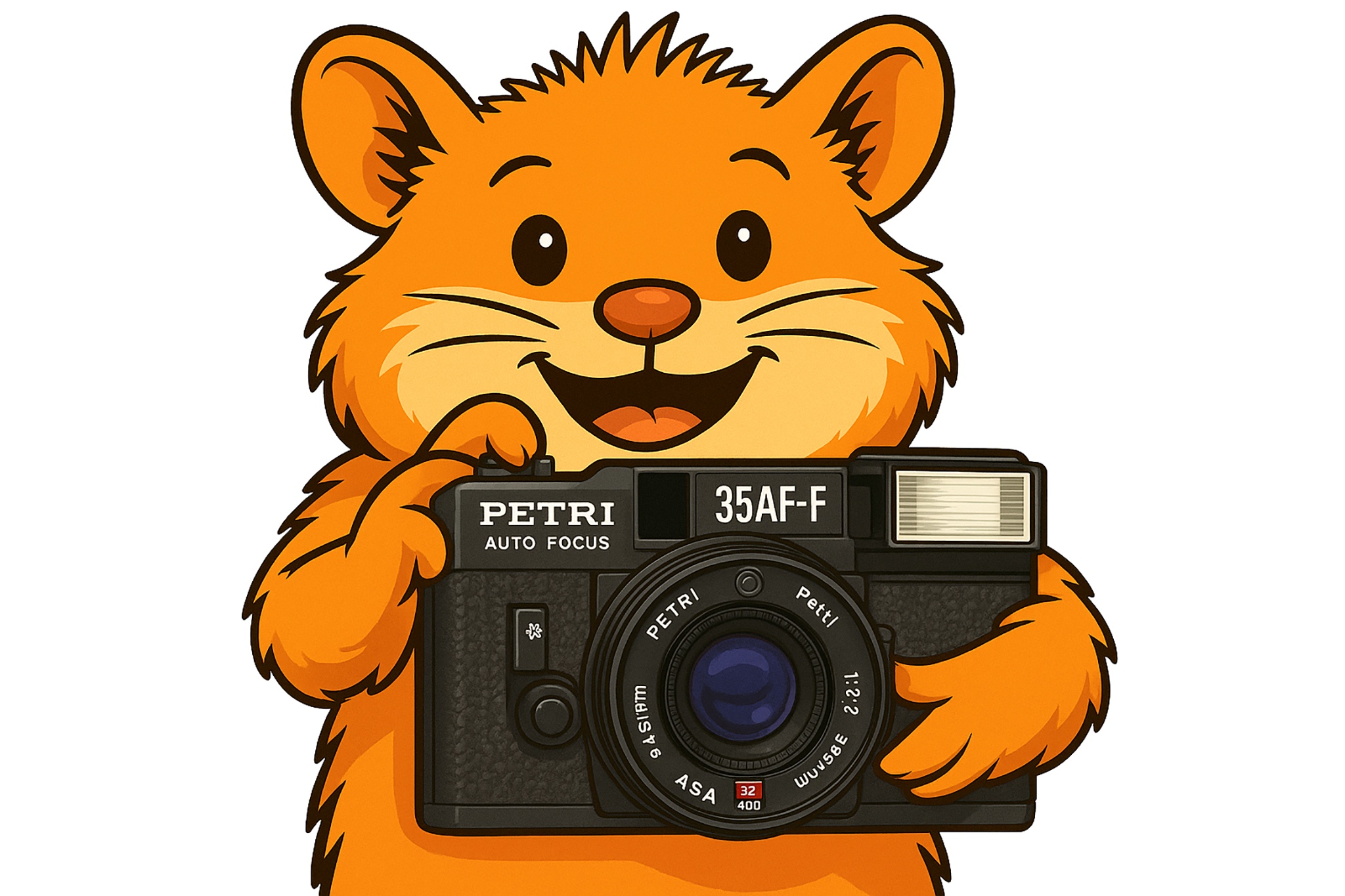
The Petri 35 AF-F established itself as a viewfinder camera for 35mm film, featuring both automatic focusing and an integrated electronic flash. It was launched in the late 1970s. This model was manufactured in a Japanese factory. A technically identical sister model existed under the name Cosina AF-35.
Lens
A fixed Cosinon 38mm f/2.7 lens forms the optical heart of the Petri 35 AF-F. Its construction comprises four lens elements in three groups, complemented by a multi-coated coating that reduces reflections and optimizes contrast and color reproduction.
A focal length of 38mm opens up a moderate wide-angle spectrum, which proves advantageous for a wide variety of shooting situations, from landscapes and snapshots to group portraits.
Focusing is primarily achieved using an automatic focusing system (Honeywell system). The camera automatically adjusts the focus to the area centrally positioned in the viewfinder image.
To activate autofocus, the viewfinder must first be unfolded using the “pop-up” button. The user points to the desired subject and lightly presses the shutter button, after which the camera adjusts the focus.
The camera also offers manual focus adjustment via zones. This proves useful if the main subject is off-center or with low-contrast subjects such as snowfields, where autofocus might reach its limits.
In manual mode, the photographer estimates the distance to the subject and adjusts the focus ring based on the scale, starting at the autofocus mark indicated by an arrow symbol.
A mark for parallax compensation is integrated within the viewfinder. When shooting close-ups of less than 1.5 meters, this must be taken into account for accurate image composition.
The autofocus working range is limited to distances between one and five meters when using a flash.
The lens has a connection thread for filters with a diameter of 46 mm (pitch P = 0.75 mm). Attaching filters is straightforward; since the filter also covers the CdS measuring cell, exposure is automatically adjusted. A suitable lens hood requires a diameter of 48 mm.
Exposure Settings
Exposure is controlled by a programmed automatic exposure system (Programmed EE). This system uses a CdS (cadmium sulfide) photocell to detect the available ambient light.
The camera automatically determines the appropriate combination of aperture and shutter speed for correct exposure. The shutter acts as a programmed automatic shutter and covers a shutter speed range from 1/60 second to 1/360 second.
With a film speed of ASA 100, the automatic exposure range (EE coupling range) extends from EV 9 (equivalent to f/2.7 at 1/60s, or 1/64s according to the specifications) to EV 17 (equivalent to f/19 at 1/360s).
The film speed is set manually using a ring on the lens, which supports a range from ASA 25 to ASA 400. It is important to select only the click-locked increments.
A red warning light in the viewfinder indicates impending underexposure. If this light appears when the shutter button is half-pressed, the ambient light is insufficient for a correct shot without flash assistance.
The camera features an exposure lock function: Half-pressing the shutter button locks the measured exposure value. This is particularly advantageous in backlit situations.
The photographer can measure the exposure in an area without strong backlight (for example, by tilting the camera downward or moving closer to the subject), hold the shutter button halfway down, recompose the image, and then fully release the shutter to use the adjusted exposure.
The CdS cell is located on the front of the camera near the lens and is also covered when a filter is used, enabling automatic exposure compensation.
Flash System
The Petri 35 AF-F is equipped with a built-in electronic flash. This system, called the “Auto Flashmatic System,” operates automatically when activated, presumably in conjunction with the focus, to achieve adequate flash exposure at close range.
Activating the flash requires first unfolding the viewfinder (pop-up) and then moving the flash switch on the front of the camera to the “On” position (indicated by an arrow symbol). The flash switch can only be operated when the viewfinder is unfolded.
A green ready lamp in the lower part of the viewfinder indicates that the charged flash is ready for use. With new batteries, the charging time (flash rate) is approximately 8 seconds. This time increases as the battery power decreases. If the charging time exceeds 30 seconds, a battery change is recommended.
The effective focus range of the autofocus when using the flash is between one and five meters. Shots taken within this distance should be sharp and correctly lit. Be careful not to cover the flash reflector with your fingers.
After taking the shot, the flash should be deactivated to conserve battery life. Folding in the pop-up viewfinder also automatically deactivates the flash. If the flash switch is accidentally left in the “On” position, this will quickly drain the batteries.
Additional Features
In addition to the core functions of autofocus, automatic exposure, and built-in flash, the Petri 35 AF-F offers other practical features. These include a mechanical self-timer. It is activated by turning the self-timer lever on the front of the camera all the way to the left. After the shutter button is fully pressed, approximately 8 seconds pass before the picture is taken.
It is advisable to secure the camera on a tripod during self-timer activation and while it is running, and to avoid standing directly in front of the lens, as this could affect the exposure metering and focusing.
For stable tripod mounting, the camera has a tripod mount thread (standard 1/4 inch). Attachment eyelets for a carrying strap are provided on the side of the body.
The fold-out viewfinder not only serves as a point-and-shoot, but also as a trigger for activating the flash system.
The camera also features a quick-action film advance lever with a 20-degree detent for rapid readiness for use, as well as an automatically resetting frame counter. Film rewinding is performed manually using a fold-out crank on the rewind knob.
Dimensions and Weight
The external dimensions of the Petri 35 AF-F are 135 mm wide, 82 mm high, and 52 mm deep. Without batteries, the camera weighs 386 grams. These values characterize it as a comparatively compact, yet noticeably solid camera in its category.
Power Supply
The Petri 35 AF-F requires two AA batteries (eBay / Amazon*) to operate its electronic components.
These batteries provide power for the electronic shutter mechanism, the autofocus module, the built-in electronic flash, and the exposure meter. The battery compartment is located on the bottom of the camera and is secured by a battery compartment door. Batteries must be inserted observing the polarity markings (+ and -) inside the compartment.
A battery test button on the top of the camera checks the charge level. When pressed, a red indicator light next to it illuminates if the batteries have sufficient capacity. This test also verifies the functionality of the automatic exposure, autofocus, and flash system. If the red lamp lights up but the flash doesn’t charge (the green ready indicator in the viewfinder remains dark), the batteries may be too weak and need to be replaced.
We recommend cleaning the battery contacts with a dry cloth before inserting them and removing the batteries from the camera if it will not be used for an extended period to prevent damage from leakage. Carrying spare batteries is recommended.
Film Recommendations
The Petri 35 AF-F uses standard 35mm film (eBay / Amazon*) in cartridges for 20 or 36 exposures. The camera is designed for film with a sensitivity of ASA 25 to ASA 400 (equivalent to ISO 25 to 400).
The film speed must be set manually using the sensitivity selection ring on the lens by turning the ring so that the correct ASA value is opposite the index. The camera does not have DX code scanning; manual configuration is therefore essential to ensure correct exposure.
Quick Operation Guide
- Connecting the power supply: Open the battery compartment on the bottom and insert two AA batteries, observing the correct polarity. Then close the compartment and check the batteries using the test button.
- Loading film: Open the camera back. Lift the rewind knob and position the 35mm film cartridge. Lower the rewind knob again. Guide the film tongue toward the take-up spool and insert the end into one of the slots. Pull the film advance lever once to ensure the perforation engages correctly with the advance gears. Close the back.
- Advancing the film to start: Gently turn the rewind knob in the direction of the arrow until you feel a slight pull. Alternately press the film advance lever and the shutter release button until the frame counter indicates “1”.
- Adjusting the film speed: Turn the film speed ring on the lens until the ASA value of the loaded film matches the index point.
- Preparing to shoot: Remove the lens cap. Open the viewfinder by pressing the pop-up button. Aim at the subject through the viewfinder, keeping the main subject in the center for autofocus.
- Focusing and metering: Press the shutter button halfway. The camera adjusts the focus and meters the exposure. If the red warning light in the viewfinder does not light up, the exposure is adequate. Press the shutter button all the way down to take the photo and hold it down until the shutter is released.
- Using the flash: If the red warning light lights up or the lighting conditions are insufficient, set the flash switch to the “On” position. Wait until the green flash-ready indicator appears in the viewfinder. Then take the photo as described in step 6. After use, deactivate the flash or close the viewfinder.
- Advancing the film: After each exposure, move the film advance lever all the way to advance the film for the next frame and cock the shutter.
- Rewinding the film: When the film is fully exposed (20 or 36 on the counter), press the film rewind button on the bottom of the camera. Extend the crank on the rewind button and turn it in the direction of the arrow until the film is completely rewound into the cartridge (indicated by the decreasing resistance). Open the camera back and remove the film cartridge.
Technical datasheet
| Attribute | Specification |
|---|---|
| Type of Camera | Viewfinder camera |
| Film format | 35mm |
| Film transport | Manual |
| Film transport mechanism | Quick release lever |
| Picture format | 24 mm x 36 mm |
| Lens name | Cosinon f=38mm F=2.7 |
| Focal length | 38 mm |
| Widest aperture | f/2.7 |
| Smallest aperture | f/19 |
| Minimum focus distance | 100 cm / 3.28 ft |
| Focus | Autofocus |
| Filter thread | 46 mm |
| Lens design | 4 elements in 3 groups |
| Exposure times | 1/360 second to 1/60 second |
| Light meter | Yes |
| Supported film speeds | ISO 25 to 400 |
| Exposure modes | Program automatic |
| Manual exposure settings | No |
| Auto DX (Film sensitivity) | No |
| Date imprinting | No |
| Double and/or multiple exposure function | No |
| Flash | Integrated flash |
| Flash range | 1 to 5 Meter / 3.28 to 16.4 Feet |
| Tripod mount | Yes |
| Cable release thread | Yes |
| Self-timer | Yes, Self-timer function with 8 seconds lead time |
| Connection for camera strap | Yes |
| Power supply | 2x AA batteries |
| Size | 13,5 x 8,2 x 5,2 cm |
| Dimensions in inches | 5.31 x 3.23 x 2.05 inches |
| Weight | 386 Grams |
| Manufacturer | Cosina |
| Country of production | Japan |