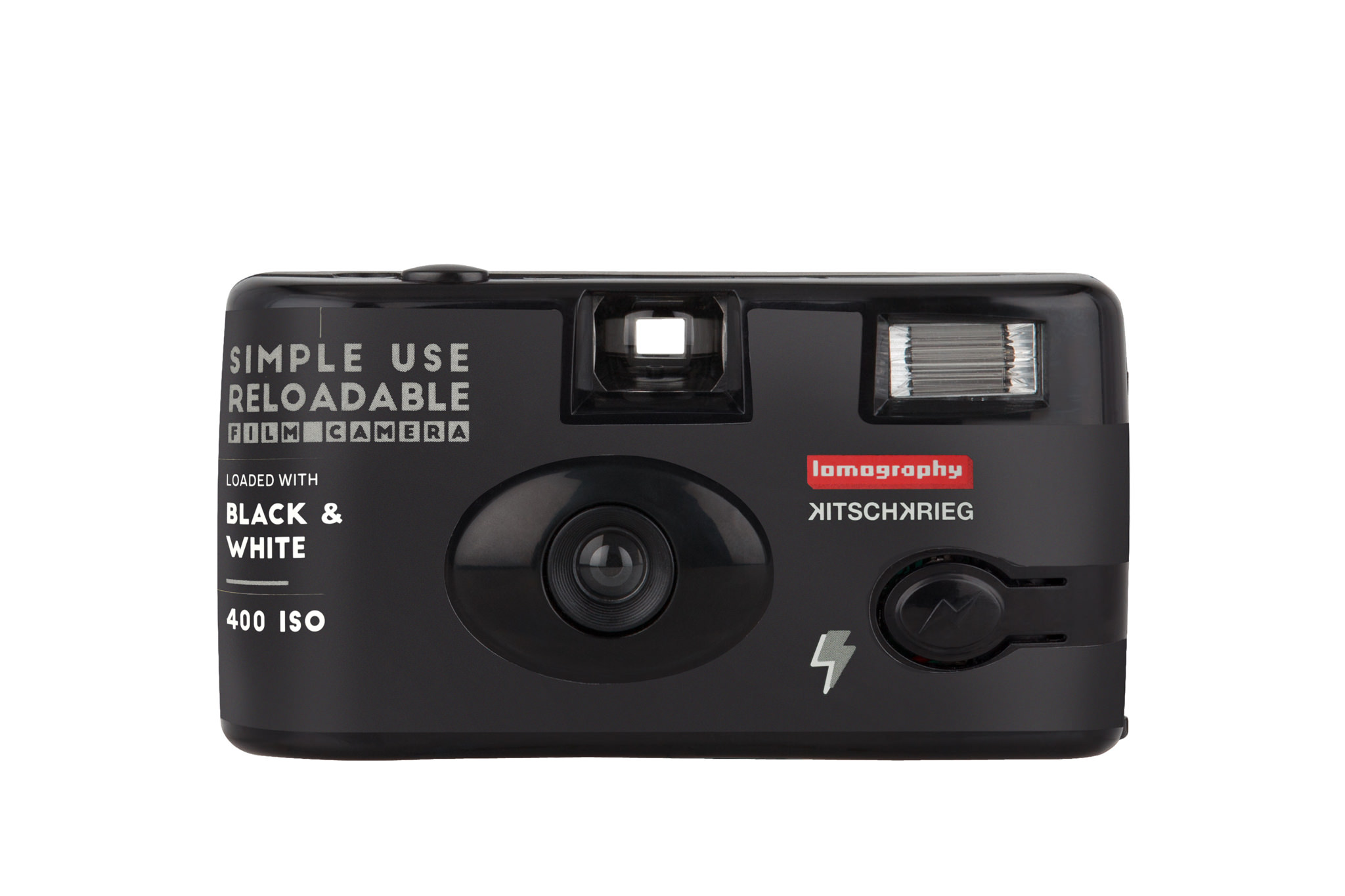
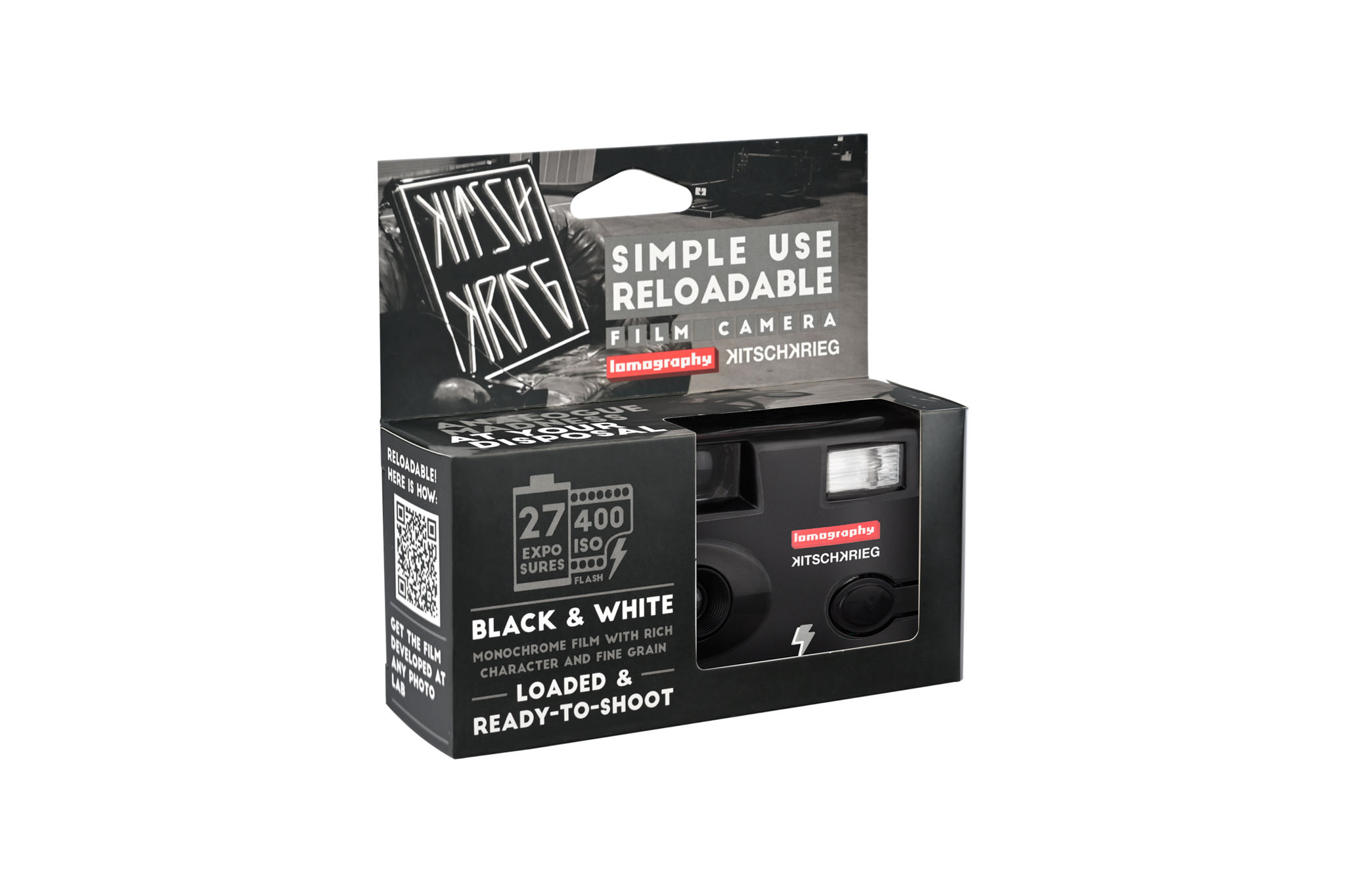
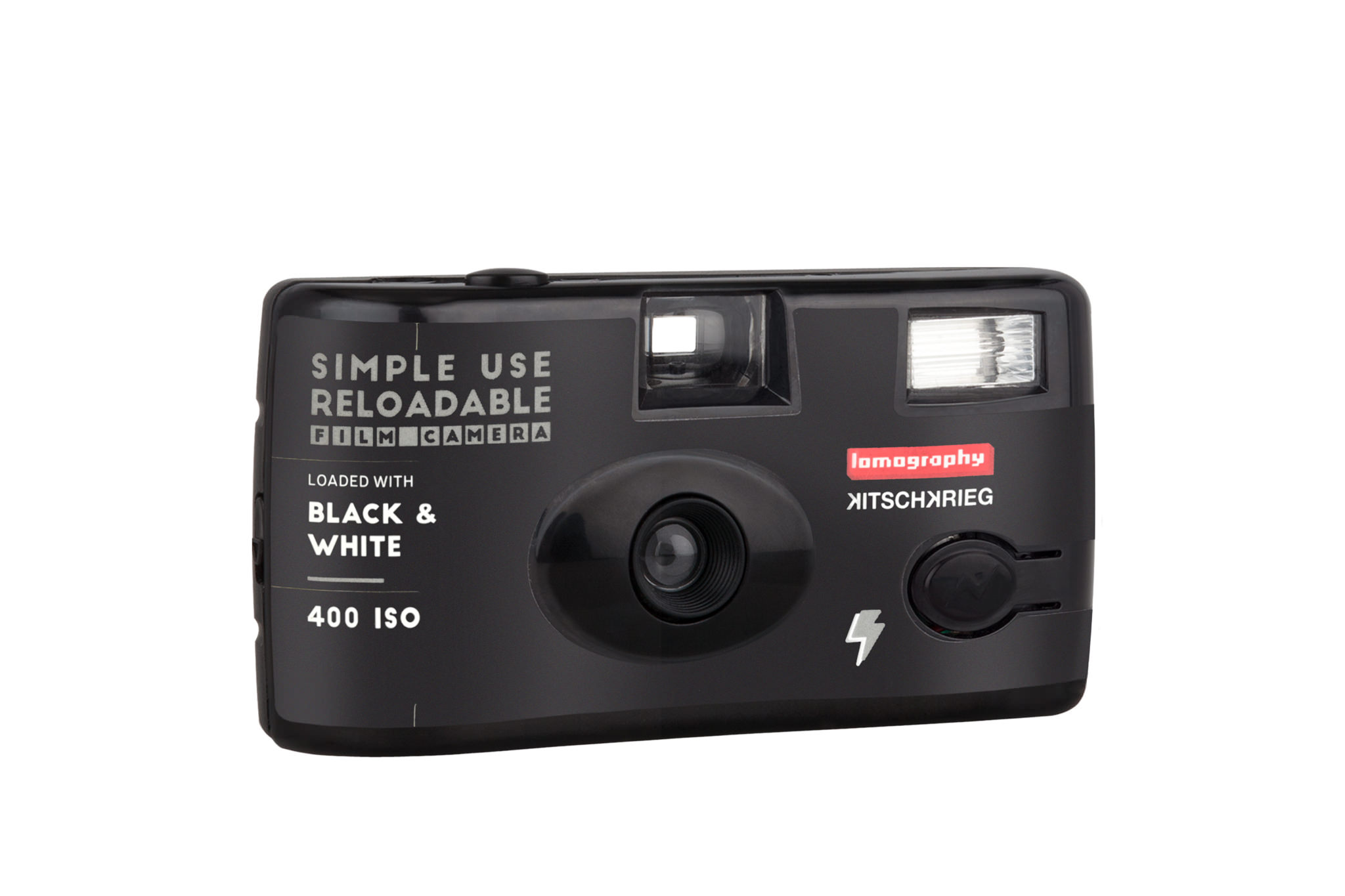
The Lomography Simple-Use Film Camera Kitschkrieg Edition is a special edition of the disposable camera from Lomography. The edition was presented to the public on 20.10.2021. The variant was created in collaboration with Kitchkrieg.
Kitschkrieg are a trio of music producers from Berlin-Kreuzberg. It is composed of Christoph Erkes (Fizzle), Christian Yun-Song Meyerholz (Fiji Kris) and Nicole Schettler (°awhodat°). The team has already worked with Trettmann, Nena, Peter Fox, Marteria, Bonez MC, Cro and AnnenMayKantereit.
In the camera is a roll of Lomography Lady Grey 400 35mm. The film is a black and white film. More precisely a “real” black and white film, which has to be processed in a suitable developer and cannot be developed in C-41. For example, Rodinal or D-76 can be used for development. The film has space for 36 pictures.
The disposable camera is equipped with a 31 mm plastic lens. The lens is fixed and cannot be focused (1 meter to infinity). The shutter speed (1/120 s) and aperture (f/9) cannot be changed either. The dimensions of the disposable camera are 115 x 60 x 33 mm. The housing is made of plastic.
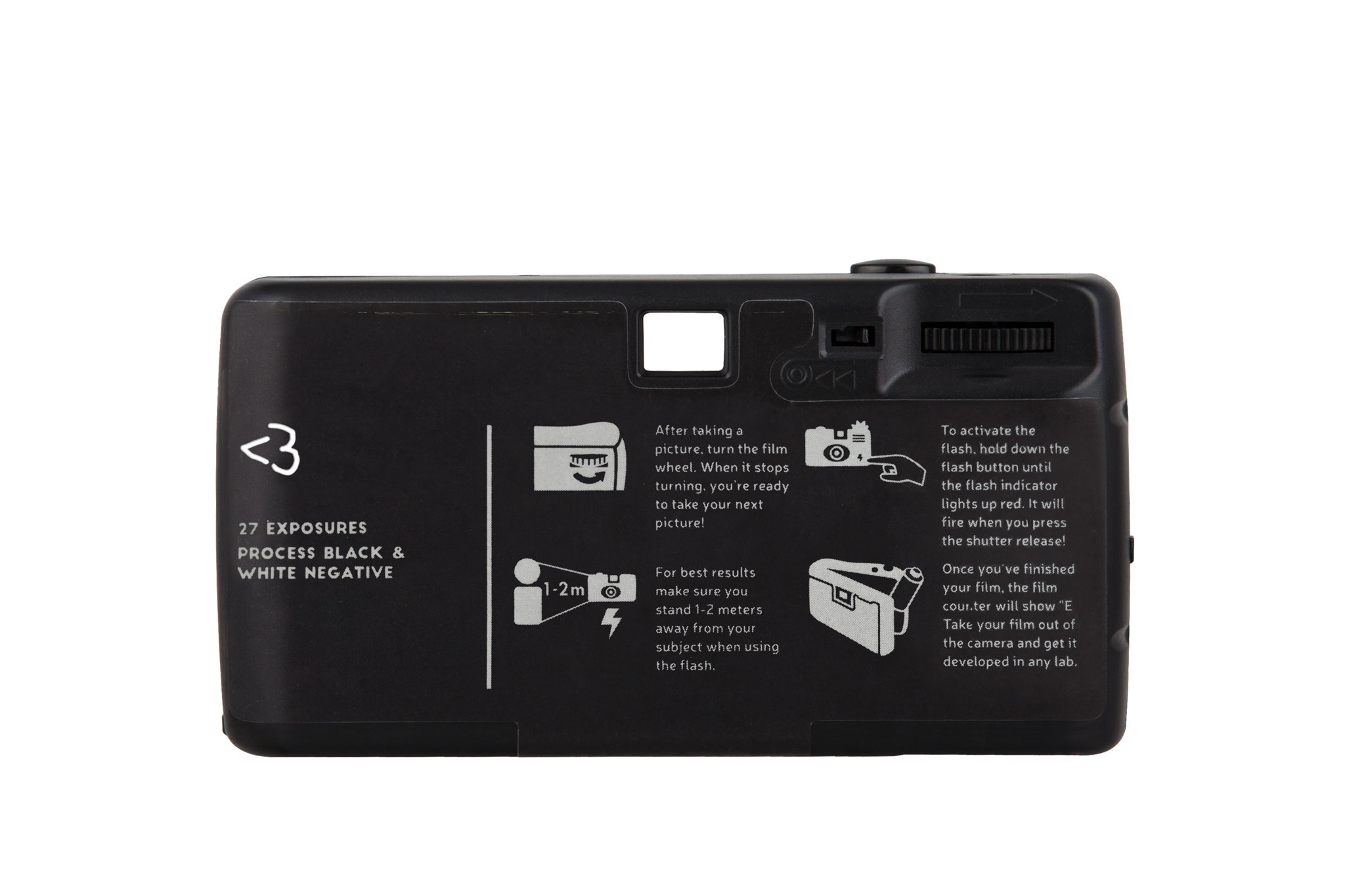
A built-in flash provides sufficient illumination. However, one should not be too far away from the subject. The flash has a charging time of fifteen seconds and is powered by one AA battery. For more creativity, there are three color filters for the flash.
When the roll is full, the film can be removed. If you want, you can then load the camera with a new roll of 35mm film so you can use the camera even more.
The disposable camera can be developed in a photo lab or LomoLab. The color film is developed using the C-41 process. This process is offered by most photo labs. The camera can be sent to DM and Rossmann for development. Development with prints usually costs less than five euros.
A manual for operation is not absolutely necessary. As with all disposable cameras, it is very easy to use. Therefore, the camera is well suited for weddings and parties to capture beautiful moments in memories.
Technical datasheet
| Attribute | Specification |
|---|---|
| Type of Camera | Single-use camera |
| Film format | 35mm |
| Film transport | Manual |
| Film transport mechanism | Thumbwheel |
| Picture format | 24 mm x 36 mm |
| Focal length | 31 mm |
| Widest aperture | f/9 |
| Minimum focus distance | 100 cm / 3.28 ft |
| Focus | Fixed |
| Exposure times | 1/120 second |
| Manual exposure settings | No |
| Date imprinting | No |
| Flash | Integrated flash |
| Flash sync speed | 1/120 s |
| Tripod mount | No |
| Cable release thread | No |
| Self-timer | No |
| Power supply | 1x AA battery |
| Country of production | China |
FAQ about the Lomography Simple-Use Filmkamera Kitschkrieg Edition
What kind of film does the Lomography Simple-Use Film Camera Kitschkrieg Edition use, and how many pictures can I take with it?
The camera comes pre-loaded with Lomography Lady Grey 400, a black and white 35mm film. This film has enough for 36 exposures, so you can capture plenty of memories.
I'm new to film photography. Is this disposable camera easy to use?
Yes, the Kitschkrieg Edition is designed for simplicity. It's point-and-shoot, with no focusing or adjustments needed. Just like other disposable cameras, it's perfect for capturing moments at parties or weddings without any fuss.
Does this camera have a flash? What about low light situations?
The camera includes a built-in flash powered by a single AA battery to help in low-light. Keep in mind that the flash is most effective at closer ranges, and it takes about 15 seconds to recharge between uses. There are also colored flash filters included for creative effects.
What are the lens specifications for the Kitschkrieg Edition?
It has a fixed-focus 31mm plastic lens with an aperture of f/9 and a shutter speed of 1/120s. You don't need to worry about adjusting anything; it's ready to shoot right out of the box.
Where can I get the film developed from this point-and-shoot camera, and how much does it cost?
You can have the film developed at most photo labs or a LomoLab. The black and white film requires special processing, but labs like DM and Rossmann can handle it. Development with prints typically costs less than five euros.