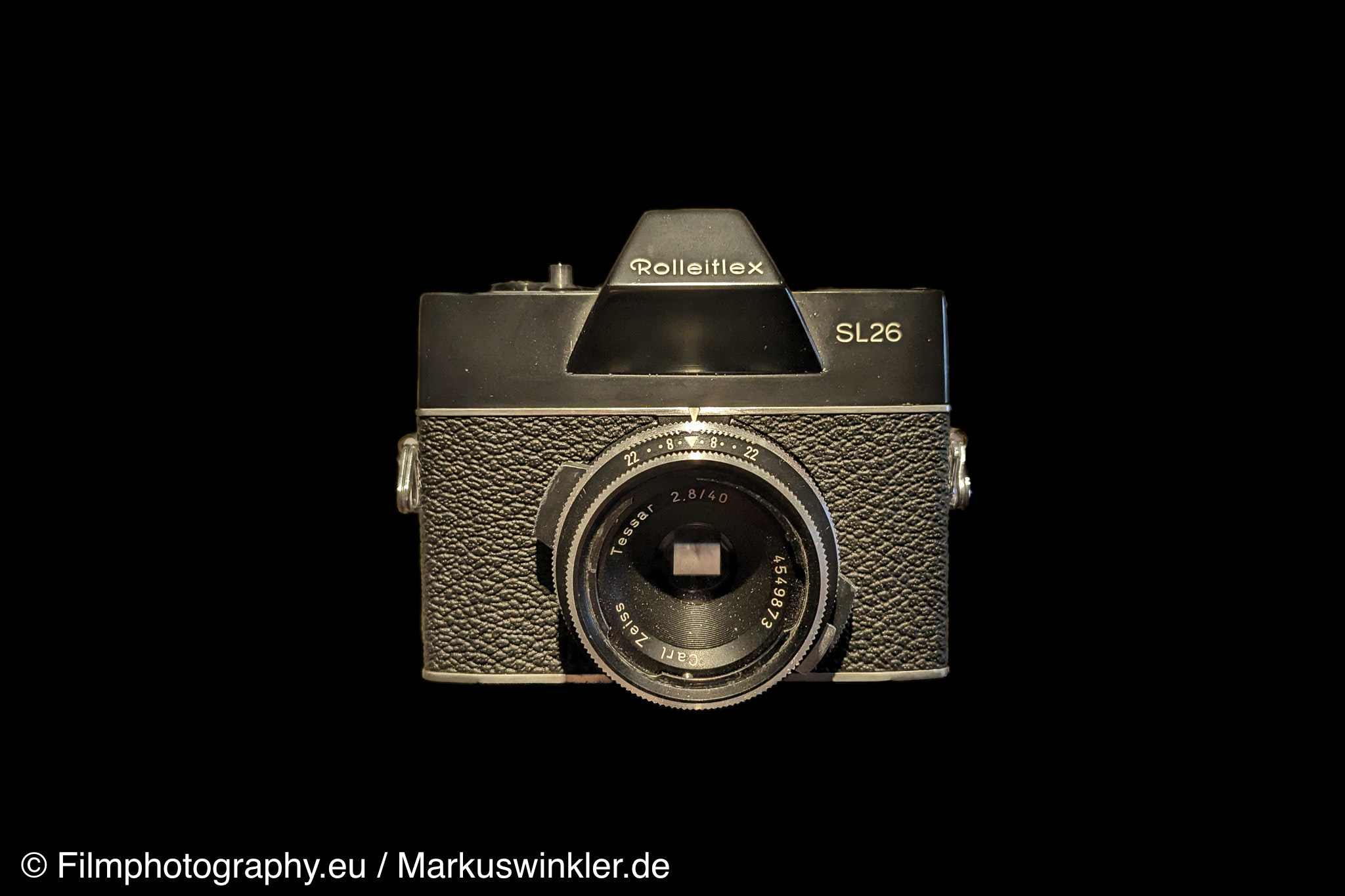
The Rolleiflex SL26, manufactured in the period between 1968 and 1973, marked a special milestone in the history of cameras, especially in the field of 126 film format cameras. Conceived by the renowned German camera engineer Heinz Waaske, this camera embodied an exquisite blend of technology and innovation that makes it a remarkable specimen in the history of photography, despite its limited production number of 28,570.
With its dimensions and design, the SL26 appears both small and boxy, yet offers a robust metallic structure that proves very handy and functional. One of its striking features is the simple “match-needle” metering, which makes it much easier for the user to set the correct exposure.
The lens system is remarkably versatile, with three interchangeable lenses, all based on the Tessar design. The standard lens supplied is a Zeiss Tessar 40mm f/2.8 (4 elements in 3 groups), but users also had the option of equipping their camera with a 28mm wide-angle or an 80mm portrait Pro-Tessar lens, which were separate add-ons.
The camera offers a simple film advance mechanism that does not require film to be rewound, ensuring a clean surface. Nevertheless, the film advance is quite powerful and requires a long pull. One of the advantages of this system is the inclusion of a quick-reverse mirror, a feature not found in many German cameras of the time.
The SL26 also offers a reasonable variety of shutter speeds, with speeds from 1/2 second to 1/500 second plus a B setting for longer exposures. The system is purely mechanical, which means that even if the battery dies, the camera will continue to function. This is particularly remarkable as the camera uses a 625 mercury cell, which was later replaced by a zinc-air battery.
Despite its compact size, the camera has a bright viewfinder with a central split-image focusing aid surrounded by a generous ground glass aperture on a fine Fresnel screen, making focusing much easier.
The Rolleiflex SL26, despite its compact and robust design, does not come without its drawbacks. The availability of 126 film and processing capabilities can be considered limited, an aspect that could potentially limit ease of use. In addition, the volume of the shutter, especially for a camera with a leaf shutter, can be considered quite loud.
In terms of price range, the SL26 originally sold for DM 628 (equivalent to about USD 299.50), making it the most expensive camera for this format. A complete set, which included additional accessories such as UV filters, extra lenses and rubber shutters, could be stored in a special bag, which was also available in an always handy field case.
Technical datasheet
| Attribute | Specification |
|---|---|
| Type of Camera | Single lens reflex camera |
| Film format | 126 |
| Film transport | Manual |
| Film transport mechanism | Quick release lever |
| Picture format | 28 mm x 28 mm |
| Lens mount | SL26 lens mount |
| Focus | Manual |
| Exposure times | 1/500 second to 1/2 second, Bulb |
| Bulb mode | Yes |
| Light meter | Yes |
| Exposure modes | Manual mode |
| Date imprinting | No |
| Double and/or multiple exposure function | No |
| Built-in flash | No |
| Flash Connection | Hot Shoe |
| Tripod mount | Yes |
| Cable release thread | Yes |
| Self-timer | No |
| Connection for camera strap | Yes |
| Power supply | 1x PX625 battery |
| Size | 11,2 x 9,1 x 7 cm |
| Dimensions in inches | 4.41 x 3.58 x 2.76 inches |
| Weight | 540 Grams |
| Company name of the brand | Rollei-Werke Franke & Heidecke Braunschweig |
| Country of production | Germany |
| End of production | 1973 |
| Production duration | 5 years |
| Estimated value / Used price | 160,32 Euro Estimate based on used prices of 7 offers (possibly with different scope of delivery and/or condition). As of June 15, 2026 |
| Average used price in the year 2023 | 128,65 Euro (138.55 US-Dollar) |
| Average used price in the year 2024 | 199,33 Euro (215.40 US-Dollar) |
| Average used price in the year 2025 | 169,58 Euro (182.93 US-Dollar) |
FAQ about the Rolleiflex SL26
What type of film does the Rolleiflex SL26 use, and are there any limitations associated with it?
The Rolleiflex SL26 uses 126 film. A potential drawback is the limited availability of 126 film and processing options compared to more common formats.
Describe the focusing mechanism of this particular 126 camera model.
The SL26 features a bright viewfinder with a central split-image focusing aid surrounded by a microprism focusing screen, making focusing easier.
How does the camera's shutter mechanism work, and what happens if the battery dies?
The SL26 has a purely mechanical shutter system. Even with a dead battery (a 625 mercury cell, later replaced by a zinc-air battery), it remains fully functional.
What are some of the key features that distinguish this Rolleiflex model from other cameras of its time?
Its features include a quick-return mirror, a robust metal construction, and a simple 'match-needle' exposure metering system. The three interchangeable lenses, all based on the Tessar design, are also noteworthy.
What was the original price of the Rolleiflex SL26, and what accessories were available?
The Rolleiflex SL26 originally cost DM 628 (approximately $299.50 USD). Accessories included extra lenses, UV filters, and lens hoods, which could be stored in a special case.