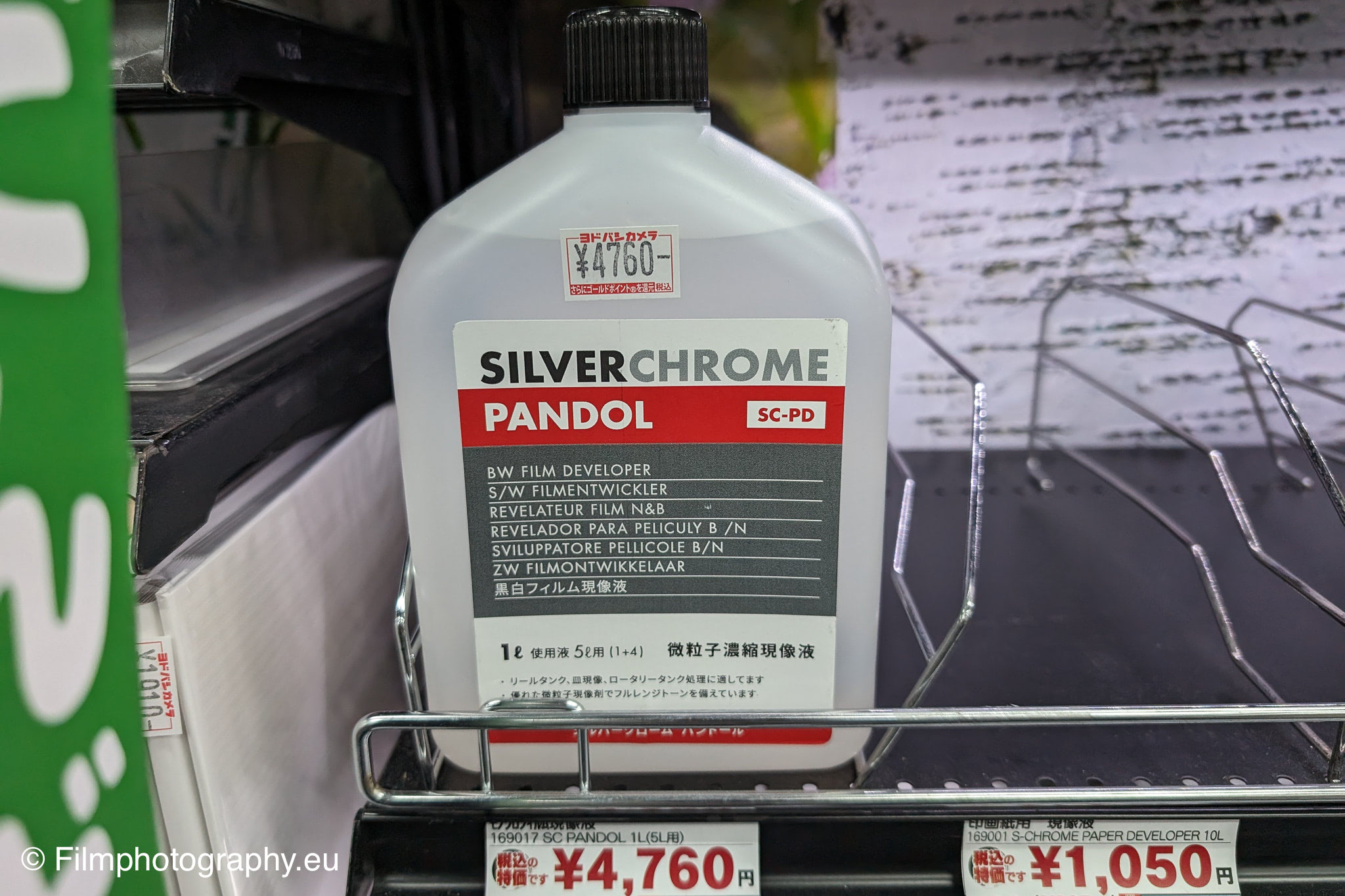
Rodinal is a name that every photography enthusiast knows, especially those involved with analog photography. Rodinal is one of the oldest and most widely used black-and-white film developers in the world. Since its introduction in the late 19th century, it has stood the test of time and technological progress, and remains a preferred developer for many photography enthusiasts and professionals alike.
The History of Rodinal
The Rodinal formula was first patented on January 27, 1891, by Dr. Momme Andresen for Agfa, a German film and camera company. It is considered the first product commercially sold for film development, and was originally named "Rodigal". However, shortly after its market introduction, it was renamed to "Rodinal".
Rodinal is known for its longevity, as it is still manufactured and used even in the digital age. This is primarily due to it being a highly concentrated liquid developer, which is less susceptible to oxidation compared to many other developers, therefore having a significantly longer shelf life.
Distinctive Characteristics of Rodinal
Rodinal is known for its unique development characteristics that give the photos developed by it a very special quality. One of these characteristics is that it tends to exaggerate grain, resulting in images that have a coarser, textured aesthetic. This characteristic may be seen as a disadvantage by those who seek smoother, less grainy images. However, for photographers who appreciate a "grainy" aesthetic, Rodinal is an excellent choice.
In addition, Rodinal provides excellent sharpness and high acutance. "Sharpness" is a term used in photography to describe the perceived sharpness of an image, which is typically enhanced by edge contrast. This edge effect is particularly pronounced in Rodinal, leading to images that appear very sharp, even when the grain is more noticeable.
Use of Rodinal
A unique feature of Rodinal is that it works as a "one-shot" developer. Each time a film is developed, a new batch is mixed, typically at a ratio of 1:25 to 1:100. Due to its high concentration, a small amount of Rodinal can develop a large amount of film, making it economical for photographers who develop sporadically.
When using Rodinal, it is important to consider the film to be developed, the desired aesthetic, and the ratio of developer to water. A lower ratio (e.g., 1:25) results in stronger grain and higher contrast, while a higher ratio (e.g., 1:100) results in less grain and weaker contrast. The development time also depends on the type of film and the developer ratio.
Although Rodinal is a highly concentrated developer, it is not toxic. However, as it is strongly alkaline, precautions should be taken to avoid skin and eye contact. It is recommended to develop film in a well-ventilated room and to wear appropriate protective clothing.
Availability
Adox Adonal by the German company Adox is based on the last known Agfa Rodinal original formula from 2005. Compard R09 One Shot is also produced according to the original Rodinal formula. However, Adonal is characterized by improved fine grain.
Development times for various films
| Film | Dilution | ISO | Time | Temperature |
|---|---|---|---|---|
| Adox CHS 100 II | 1+25 | ISO 100 | 5:30 - 6 min | 20 °C |
| Adox CHS 100 II | 1+50 | ISO 100 | 12:30 - 13:30 min | 20 °C |
| Adox Silvermax | 1+25 | ISO 100 | 8 min | 20 °C |
| Adox Silvermax | 1+50 | ISO 100 | 12 min | 20 °C |
| Agfa APX 100 | 1+25 | ISO 100 | 8 min | 20 °C |
| Agfa APX 100 | 1+50 | ISO 100 | 13 min | 20 °C |
| Agfa APX 100 | 1+50 | ISO 200 | 21:30 min | 20 °C |
| Agfa APX 100 | 1+50 | ISO 400 | 29 min | 20 °C |
| Agfa APX 400 | 1+25 | ISO 320 | 10 min | 20 °C |
| Agfa APX 400 | 1+50 | ISO 320 | 30 min | 20 °C |
| AgfaPhoto APX 100 | 1+25 | ISO 100 | 8 min | 20 °C |
| AgfaPhoto APX 100 | 1+50 | ISO 100 | 13 min | 20 °C |
| AgfaPhoto APX 100 | 1+50 | ISO 200 | 21:30 min | 20 °C |
| AgfaPhoto APX 100 | 1+50 | ISO 400 | 29 min | 20 °C |
| AgfaPhoto APX 100 New | 1+25 | ISO 100 | 5:30 min | 20 °C |
| AgfaPhoto APX 100 New | 1+50 | ISO 100 | 10 min | 20 °C |
| AgfaPhoto APX 400 | 1+25 | ISO 320 | 10 min | 20 °C |
| AgfaPhoto APX 400 | 1+50 | ISO 320 | 30 min | 20 °C |
| AgfaPhoto APX 400 New | 1+25 | ISO 400 | 7:30 min | 20 °C |
| AgfaPhoto APX 400 New | 1+50 | ISO 400 | 20 min | 20 °C |
| Arista EDU Ultra B&W 100 | 1+25 | ISO 100 | 4 min | 20 °C |
| Arista EDU Ultra B&W 100 | 1+50 | ISO 100 | 8-9 min | 20 °C |
| Arista EDU Ultra B&W 200 | 1+25 | ISO 200 | 5 min | 20 °C |
| Arista EDU Ultra B&W 200 | 1+50 | ISO 200 | 8 min | 20 °C |
| Arista EDU Ultra B&W 400 | 1+25 | ISO 400 | 5:30 min | 20 °C |
| Arista EDU Ultra B&W 400 | 1+50 | ISO 400 | 11 min | 20 °C |
| ars-imago IMAGO 320 | 1+25 | ISO 320 | 7:30 min | 20 °C |
| ars-imago IMAGO 320 | 1+50 | ISO 320 | 13 min | 20 °C |
| Bergger Pancro 400 | 1+25 | ISO 400 | 8 min | 20 °C |
| Bergger Pancro 400 | 1+50 | ISO 400 | 22 min | 20 °C |
| Bones B&W Film | 1+50 | ISO 100 | 1 min | 20 °C |
| Bones B&W Film | 1+50 | ISO 400 | 2:30 min | 20 °C |
| Bones B&W Film | 1+50 | ISO 800 | 3:30 min | 20 °C |
| Bones B&W Film | 1+50 | ISO 1600 | 4 min | 20 °C |
| Bones B&W Film | 1+50 | ISO 3200 | 5 min | 20 °C |
| CFP Kiki Pan 320 | 1+25 | ISO 100 | 8:30 min | 20 °C |
| CFP Kiki Pan 320 | 1+25 | ISO 100 | 6:15 min | 24 °C |
| CFP Kiki Pan 320 | 1+50 | ISO 100 | 21:00 min | 20 °C |
| CFP Kiki Pan 320 | 1+50 | ISO 100 | 16:00 min | 24 °C |
| Dubblefilm Glitch | 1+50 | ISO 200 | 8-10 min | 20 °C |
| Ferrania Orto 50 | 1+50 | ISO 50 | 14 min | 20 °C |
| Ferrania P30 Alpha | 1+50 | ISO 80 | 14 min | 20 °C |
| Flic Film UltraPan 100 | 1+50 | ISO 2 | 8:30 min | 20 °C |
| Flic Film UltraPan 100 | 1+100 | ISO 1 | 18 min | 20 °C |
| Flic Film UltraPan 200 | 1+25 | ISO 200 | 3:30 min | 20 °C |
| Flic Film UltraPan 200 | 1+50 | ISO 200 | 8:30 min | 20 °C |
| Flic Film UltraPan 200 | 1+100 | ISO 200 | 18 min | 20 °C |
| Flic Film UltraPan 400 | 1+50 | ISO 400 | 11:45 min | 20 °C |
| Flic Film UltraPan 400 | 1+100 | ISO 400 | 30 min | 20 °C |
| Flic Film Wolfen 100 | 1+25 | ISO 100 | 6:30 min | 20 °C |
| Flic Film Wolfen 100 | 1+50 | ISO 100 | 8-10 min | 20 °C |
| Flic Film Wolfen 100 | 1+100 | ISO 100 | 25 min | 20 °C |
| Fomapan 100 | 1+25 | ISO 100 | 4 min | 20 °C |
| Fomapan 100 | 1+50 | ISO 100 | 8-9 min | 20 °C |
| Fomapan 200 | 1+25 | ISO 200 | 5 min | 20 °C |
| Fomapan 200 | 1+50 | ISO 200 | 8 min | 20 °C |
| Fomapan 400 | 1+25 | ISO 400 | 5:30 min | 20 °C |
| Fomapan 400 | 1+50 | ISO 400 | 11 min | 20 °C |
| Fotoimpex CHM 100 Universal | 1+50 | ISO 100 | 9 min | 20 °C |
| Fotoimpex CHM 400 Universal | 1+25 | ISO 400 | 7:30 min | 20 °C |
| Fotoimpex CHM 400 Universal | 1+50 | ISO 400 | 20 min | 20 °C |
| Fujifilm Neopan 100 Acros | 1+25 | ISO 100 | 7 min | 20 °C |
| Fujifilm Neopan 100 Acros II | 1+25 | ISO 100 | 7 min | 20 °C |
| Fujifilm Neopan 100 Acros II | 1+50 | ISO 100 | 16 min | 20 °C |
| Holga 400 | 1+25 | ISO 400 | 5:30 min | 20 °C |
| Holga 400 | 1+50 | ISO 400 | 11 min | 20 °C |
| Ilford Delta 100 | 1+25 | ISO 50 | 7 min | 20 °C |
| Ilford Delta 100 | 1+50 | ISO 50 | 10 min | 20 °C |
| Ilford Delta 100 | 1+25 | ISO 100 | 9 min | 20 °C |
| Ilford Delta 100 | 1+50 | ISO 100 | 14 min | 20 °C |
| Ilford Delta 3200 | 1+25 | ISO 400 | 5:30 min | 20 °C |
| Ilford Delta 3200 | 1+25 | ISO 800 | 7 min | 20 °C |
| Ilford Delta 3200 | 1+25 | ISO 1600 | 9 min | 20 °C |
| Ilford Delta 3200 | 1+25 | ISO 3200 | 11 min | 20 °C |
| Ilford Delta 400 | 1+25 | ISO 200 | 6:30 min | 20 °C |
| Ilford Delta 400 | 1+50 | ISO 200 | 11 min | 20 °C |
| Ilford Delta 400 | 1+25 | ISO 400 | 9 min | 20 °C |
| Ilford Delta 400 | 1+50 | ISO 400 | 20 min | 20 °C |
| Ilford FP4 Plus | 1+25 | ISO 125 | 9 min | 20 °C |
| Ilford FP4 Plus | 1+50 | ISO 125 | 15 min | 20 °C |
| Ilford FP4 Plus | 1+25 | ISO 200 | 13 min | 20 °C |
| Ilford FP4 Plus | 1+50 | ISO 200 | 20 min | 20 °C |
| Ilford HP5 Plus | 1+25 | ISO 400 | 6 min | 20 °C |
| Ilford HP5 Plus | 1+50 | ISO 400 | 11 min | 20 °C |
| Ilford HP5 Plus | 1+25 | ISO 800 | 8 min | 20 °C |
| Ilford Pan F Plus | 1+25 | ISO 50 | 6 min | 20 °C |
| Ilford Pan F Plus | 1+50 | ISO 50 | 11 min | 20 °C |
| JCH Street Pan 400 | 1+25 | ISO 400 | 10:30 min | 20 °C |
| JCH Street Pan 400 | 1+50 | ISO 400 | 22 min | 20 °C |
| Kentmere 100 | 1+50 | ISO 100 | 9 min | 20 °C |
| Kentmere 400 | 1+25 | ISO 400 | 7:30 min | 20 °C |
| Kentmere 400 | 1+50 | ISO 400 | 20 min | 20 °C |
| Kodak Eastman Double-X 5222 | 1+25 | ISO 250 | 5:30 min | 20 °C |
| Kodak Eastman Double-X 5222 | 1+50 | ISO 250 | 9 min | 20 °C |
| Kodak T-Max 100 | 1+25 | ISO 100 | 6 min | 20 °C |
| KONO! Monolith 64 | 1+25 | ISO 64 | 6 min | 20 °C |
| KONO! Monolith 64 | 1+50 | ISO 64 | 10 min | 20 °C |
| KONO! Rekorder 100-200 | 1+25 | ISO 100 | 6 - 6:30 min | 20 °C |
| KONO! Schwarz-Weiß 100 | 1+25 | ISO 100 | 8 - 9 min | 20 °C |
| Kosmo Foto Mono 100 | 1+25 | ISO 100 | 3:30 min | 20 °C |
| Kosmo Foto Mono 100 | 1+50 | ISO 100 | 8-9 min | 20 °C |
| Lomography Black and White Berlin 400 120 | 1+50 | ISO 400 | 17:30 min | 20 °C |
| Lomography Black and White Fantôme 8 35mm | 1+50 | ISO 8 | 8 min | 20 °C |
| Lomography Earl Grey B&W 100 120 | 1+25 | ISO 100 | 4 min | 20 °C |
| Lomography Earl Grey B&W 100 120 | 1+50 | ISO 100 | 8 min | 20 °C |
| Lomography Earl Grey B&W 100 35mm | 1+25 | ISO 100 | 4 min | 20 °C |
| Lomography Earl Grey B&W 100 35mm | 1+50 | ISO 100 | 8 min | 20 °C |
| Lomography Lady Grey B&W 400 120 | 1+25 | ISO 400 | 5 min | 20 °C |
| Lomography Lady Grey B&W 400 120 | 1+50 | ISO 400 | 10 min | 20 °C |
| Lomography Lady Grey B&W 400 35mm | 1+25 | ISO 400 | 5 min | 20 °C |
| Lomography Lady Grey B&W 400 35mm | 1+50 | ISO 400 | 10 min | 20 °C |
| Lomography Orca B&W 100 110 | 1+50 | ISO 100 | 9 min | 20 °C |
| Lomography Orca B&W 100 110 | 1+100 | ISO 100 | 25 min | 20 °C |
| Lucky SHD 100 New | 1+25 | ISO 100 | 6:30 min | 20 °C |
| Lucky SHD 100 New | 1+100 | ISO 100 | 60 min | 20 °C |
| Maco ORT 25c | 1+25 | ISO 25 | 4 min | 20 °C |
| Marix Ortho 400 | 1+50 | ISO 100 | 7 min | 20 °C |
| Marix Ortho 400 | 1+50 | ISO 200 | 11 min | 20 °C |
| Marix Ortho 400 | 1+25 | ISO 400 | 5:30 min | 20 °C |
| Marix Ortho 400 | 1+50 | ISO 400 | 11 min | 20 °C |
| Marix Ortho 400 | 1+25 | ISO 800 | 10 min | 20 °C |
| Marix Ortho 400 | 1+50 | ISO 800 | 19 min | 20 °C |
| Marix Ortho 400 | 1+25 | ISO 1600 | 20 min | 20 °C |
| Marix Ortho 400 | 1+50 | ISO 1600 | 24 min | 20 °C |
| Marix Ortho 400 | 1+25 | ISO 3200 | 25 min | 20 °C |
| Marix Ortho 400 | 1+50 | ISO 3200 | 52 min | 20 °C |
| ORWO UN 54 | 1+25 | ISO 100 | 6:30 min | 20 °C |
| ORWO UN 54 | 1+50 | ISO 100 | 8-10 min | 20 °C |
| ORWO UN 54 | 1+100 | ISO 100 | 25 min | 20 °C |
| Polypan F | 1+25 | ISO 50 | 6 min | 20 °C |
| Polypan F | 1+50 | ISO 50 | 6 min | 20 °C |
| Polypan F | 1+50 | ISO 100 | 17 min | 20 °C |
| Rollei Ortho 25 | 1+25 | ISO 25 | 4 min | 20 °C |
| Rollei Ortho 25 | 1+50 | ISO 25 | 6 min | 20 °C |
| Rollei R3 | 1+25 | ISO 400 | 12 min | 20 °C |
| Rollei Retro 100 | 1+25 | ISO 100 | 8 min | 20 °C |
| Rollei Retro 100 | 1+50 | ISO 100 | 13 min | 20 °C |
| Rollei Retro 100 | 1+50 | ISO 200 | 21:30 min | 20 °C |
| Rollei Retro 100 | 1+50 | ISO 400 | 29 min | 20 °C |
| Rollei Retro 100 Tonal | 1+50 | ISO 100 | 13 min | 20 °C |
| Rollei Retro 400 | 1+25 | ISO 320 | 10 min | 20 °C |
| Rollei Retro 400 | 1+50 | ISO 320 | 30 min | 20 °C |
| Rollei Retro 400S | 1+25 | ISO 400 | 10:30 min | 20 °C |
| Rollei Retro 400S | 1+50 | ISO 400 | 22 min | 20 °C |
| Rollei Retro 400S | 1+100 | ISO 400 | 60 min | 20 °C |
| Rollei Retro 80S | 1+50 | ISO 80 | 14 min | 20 °C |
| Rollei RPX 100 | 1+25 | ISO 50 | 7 min | 20 °C |
| Rollei RPX 100 | 1+25 | ISO 100 | 9 min | 20 °C |
| Rollei RPX 100 | 1+25 | ISO 200 | 13 min | 20 °C |
| Rollei RPX 100 | 1+50 | ISO 100 | 18 min | 20 °C |
| Rollei RPX 100 | 1+50 | ISO 200 | 20:30 min | 20 °C |
| Rollei RPX 25 | 1+25 | ISO 25 | 6 min | 20 °C |
| Rollei RPX 25 | 1+50 | ISO 25 | 11 min | 20 °C |
| Rollei RPX 400 | 1+25 | ISO 400 | 8 min | 20 °C |
| Shanghai GP3 100 | 1+25 | ISO 100 | 10 min | 20 °C |
| Shanghai GP3 100 | 1+50 | ISO 50 | 15 min | 20 °C |
| Silberra PAN100 | 1+25 | ISO 100 | 6 min | 20 °C |
| Silberra PAN200 | 1+25 | ISO 200 | 8 min | 20 °C |
| Silberra U200 | 1+50 | ISO 200 | 9 min | 20 °C |
| Silberra U400 | 1+50 | ISO 400 | 7:30 min | 20 °C |
| Silberra ULTIMA100 | 1+25 | ISO 100 | 6 min | 20 °C |
| Silberra ULTIMA200 | 1+25 | ISO 200 | 8 min | 20 °C |
| Street Candy ATM 400 | 1+25 | ISO 400 | 6 min | 20 °C |
| Washi A 12 | 1+50 | ISO 12 | 12 min | 20 °C |
| Washi B 125 | 1+25 | ISO 125 | 6 min | 20 °C |
| Washi D 500 | 1+25 | ISO 500 | 6 min | 20 °C |
| Washi F | 1+25 | ISO 100 | 9 min | 20 °C |
| Washi G 80 | 1+25 | ISO 80 | 5:30 min | 20 °C |
| Washi I | 1+63 (H) | ISO 80 | 6 min | 20 °C |
| Washi K 100 | 1+25 | ISO 100 | 6 min | 20 °C |
| Washi P | 1+25 | ISO 100 | 9 min | 20 °C |
| Washi S 50 | 1+25 | ISO 50 | 11 min | 20 °C |
| Washi V | 1+25 | ISO 100 | 9 min | 20 °C |
| Washi Z 400 | 1+25 | ISO 400 | 7 min | 20 °C |
| WonderPan 400 | 1+25 | ISO 400 | 14 min | 20 °C |