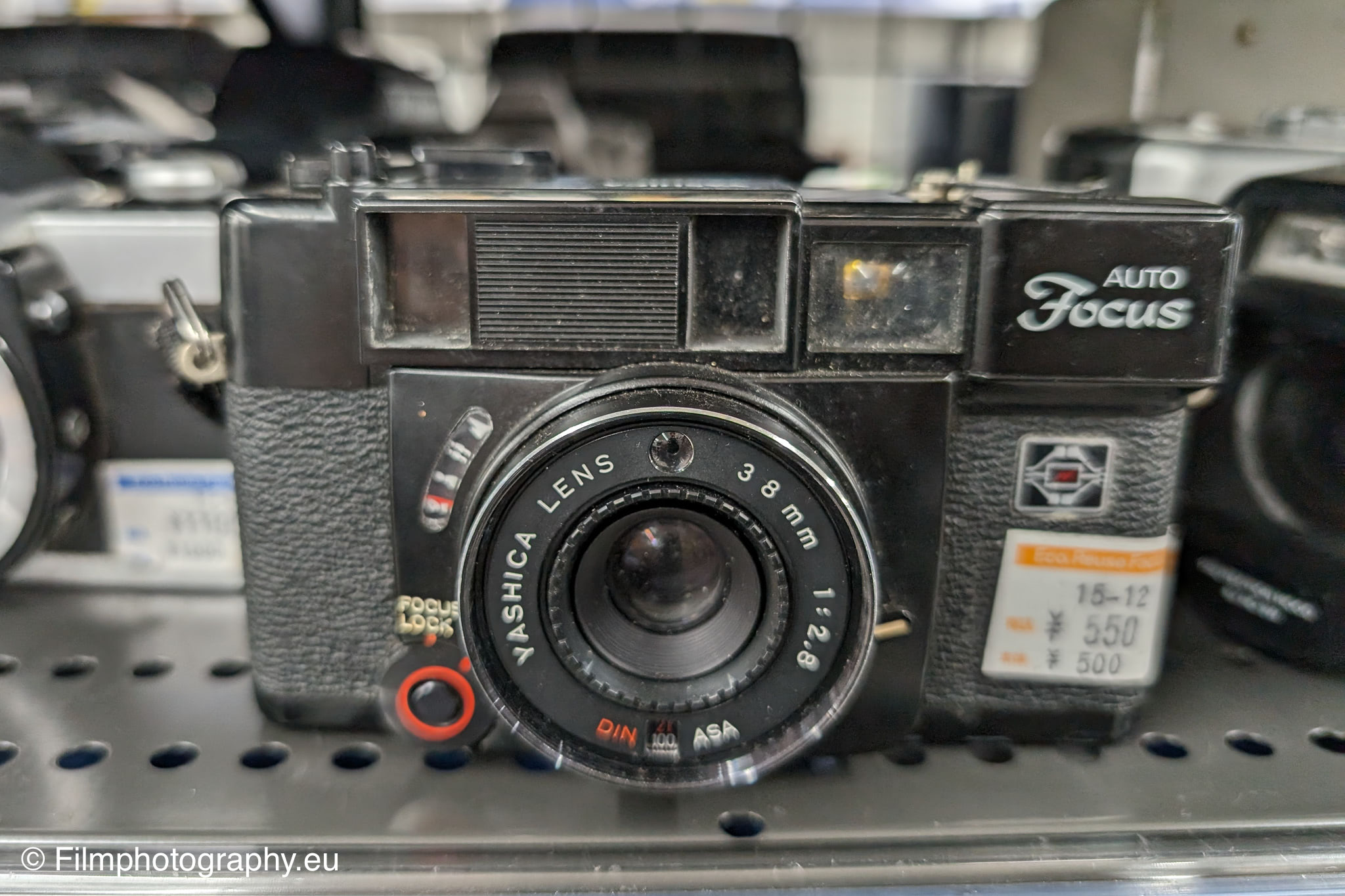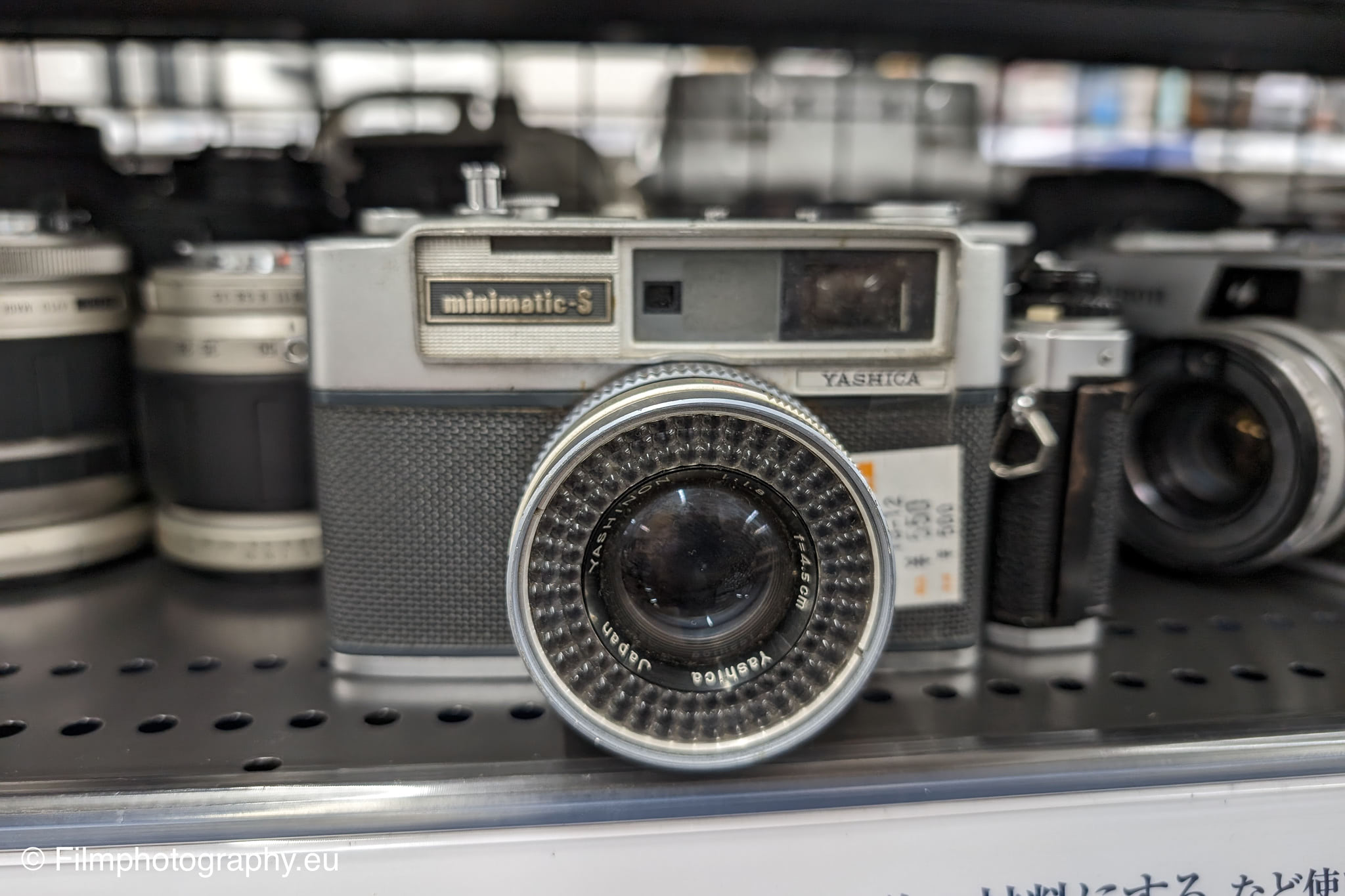
The Yashica Minimatic-S is a rangefinder camera introduced in February 1963 by the Japanese manufacturer Yashica for the 35mm format. It belongs to a series of fully automatic viewfinder cameras that Yashica brought to market in the 1960s to make it easier for amateurs to get into photography through straightforward exposure control. The camera features a fast lens and an exposure-meter-controlled automatic system that operates entirely without external battery power.
Development History and Naming
In the early 1960s, the market for compact rangefinder cameras was characterized by intense competition among Japanese manufacturers. Yashica had already established itself with models such as the Minister and Lynx series. The name "Minimatic" was coined from the terms "Minister" and "Automatic." Conceptually, the Minimatic-S was intended as a fully automatic variant of the Minister series.
In contrast to the Lynx models, which offered the photographer largely manual control over aperture and shutter speed, the Minimatic-S was aimed at users who valued quick, automated snapshot photography. In addition to the Minimatic-S, this series also included the Minimatic-C variant with a slower f/2.8 lens, as well as the later Minimatic-EL.
Lens and Exposure Control
The camera's optical system is based on a fixed Yashinon lens with a focal length of 45mm (often indicated as 4.5cm on the barrel) and a maximum aperture of f/1.8. The aperture can be stopped down to f/16 in manual mode. Focusing is manual via a coupled split-image rangefinder. The focus range extends from a close-up limit of approximately 0.8 meters (2.6 feet) to infinity.
Exposure control operates as true program auto exposure (Program AE). The sensor is a ring-shaped selenium photocell arranged directly around the front lens of the objective. This design has the advantage that screwed-on filters are automatically included in the exposure metering. Since selenium cells generate a small electrical voltage themselves when exposed to light, the camera requires no batteries for the exposure meter or the automatic system.
The system controls both aperture and shutter speed fully automatically via the mechanical Copal-Unique leaf shutter. Film speed can be set on the lens barrel in a range from ASA 10 to ASA 400.
The camera's optical viewfinder features a bright frame with integrated markings for parallax compensation in the close-up range. On the right side of the viewfinder image, there is a needle display for exposure. If the needle moves into the red warning zone, it signals to the photographer an impending under- or overexposure. The camera has no automatic shutter release lock in the red zone, so the user must intervene manually or use a flash in such cases.
Flash Operation and Manual Settings
Although the camera is primarily designed for automatic operation, it has a manual mode primarily intended for flash photography. On the lens ring, there is an aperture scale for flash operation. As soon as a manual aperture value is set, the camera switches to flash mode, in which the leaf shutter operates at a fixed sync speed.
For connecting flash units, the body features an X-sync socket (PC socket) on the front and a simple accessory shoe (cold shoe) on the top of the body. For delayed shots, a mechanical self-timer with a delay of approximately ten seconds is integrated into the body.
Films for the Yashica Minimatic S
The Yashica Minimatic S is designed for the 35mm format. Despite competition from digital photography, the 35mm format retains its place in the photography world, which explains why there are still some manufacturers producing for this format.
Recommended for color images with this camera is Kodak Gold 200*, while for black-and-white shots, Ilford XP2 Super* is recommended. Test reports show that both films are suitable for a wide range of applications.