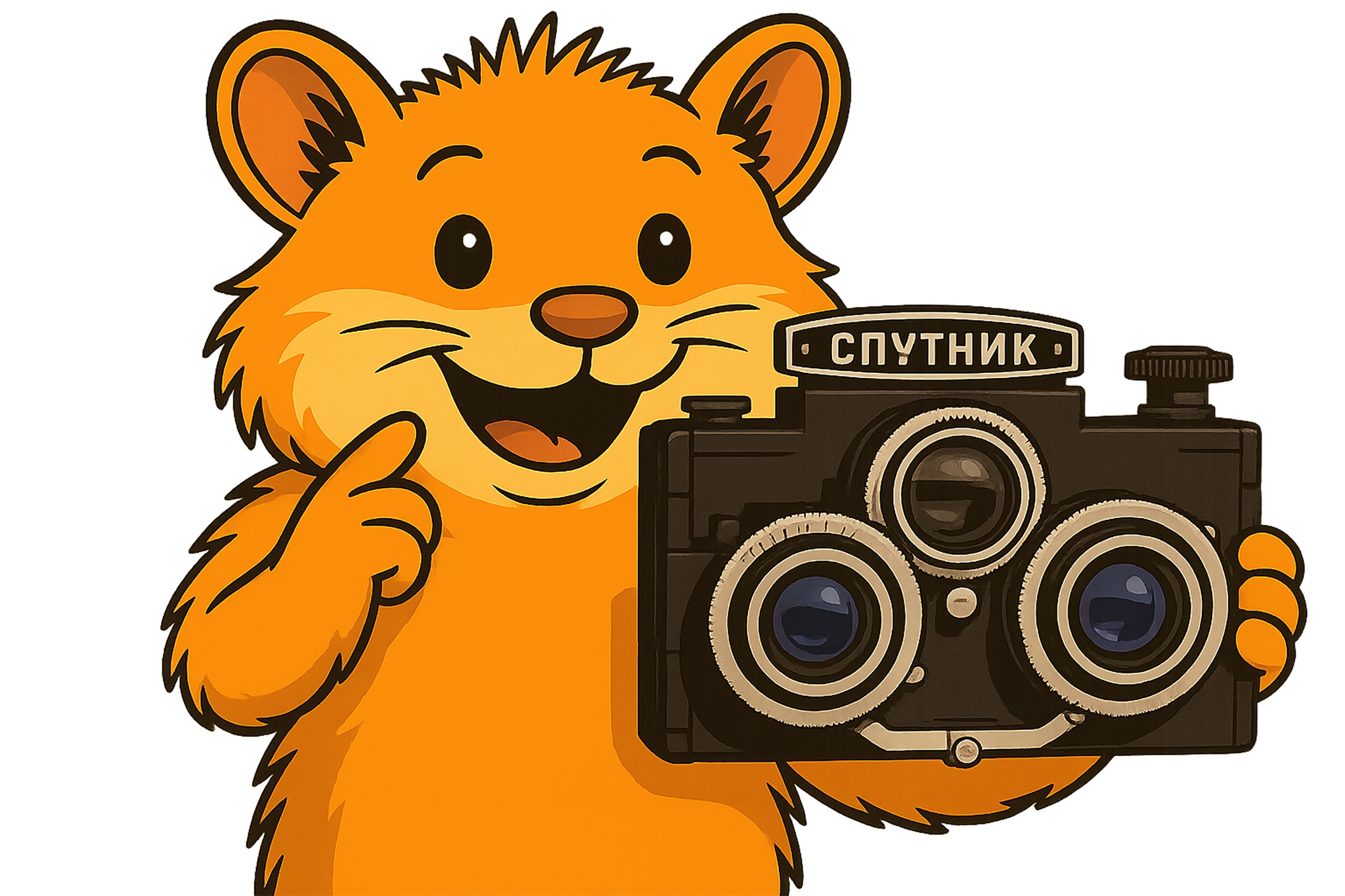
The Sputnik is a stereo camera for medium format film. It was built from 1954 to 1974 by GOMZ in Leningrad (later St. Petersburg). Meanwhile, the name of the Soviet company changed from GOMZ to Loomp and then to Lomo. The Cyrillic name of the camera is "Спутник". The housing of the camera is made of bakelite. A successor for the camera named "Sputnik-2" was announced at the "Brussels Universal and International Exibition" in 1958, but it did not get beyond a prototype status.
The lens of the Sputnik is fixed. The name of the lens is "Triplet-22". The lens has a maximum aperture of f/4.5 and the focal length is 75 mm. There is no autofocus with the medium format camera. You have to focus on the subject by hand. The close-up limit of this lens is 1.3 m.
The Sputnik does not have a built-in light meter. The aperture and exposure time can be selected by the photographer as desired. In later models, the shortest exposure time was changed to 1/125 second and the longest to 1/15 second.
Bulb mode is available for long exposures. In this mode, the shutter will open as long as the shutter release button is pressed. An external flash can be used via the PC flash socket.
Films for the Sputnik
Without 120 films, the Sputnik does not work. The production of 120 films has not yet been finished and you can still find them. Possible films for the Sputnik are the Fujifilm PRO 400H* for color images and the Ilford HP5* for black and white shots.
You have to think square with Sputnik. It takes pictures in 6x6 format. Twelve is the number of possible images per film at this size or six stereo images. The film in the camera must be rewound manually as there is no automatic film transport.
The medium format camera has a built-in self-timer. In addition, there is a connector for a cable release and a thread for a tripod. The camera weighs 809 grams and the dimensions are 15,41 x 10,12 x 9,34 cm. The medium format camera does not need electricity to take pictures.