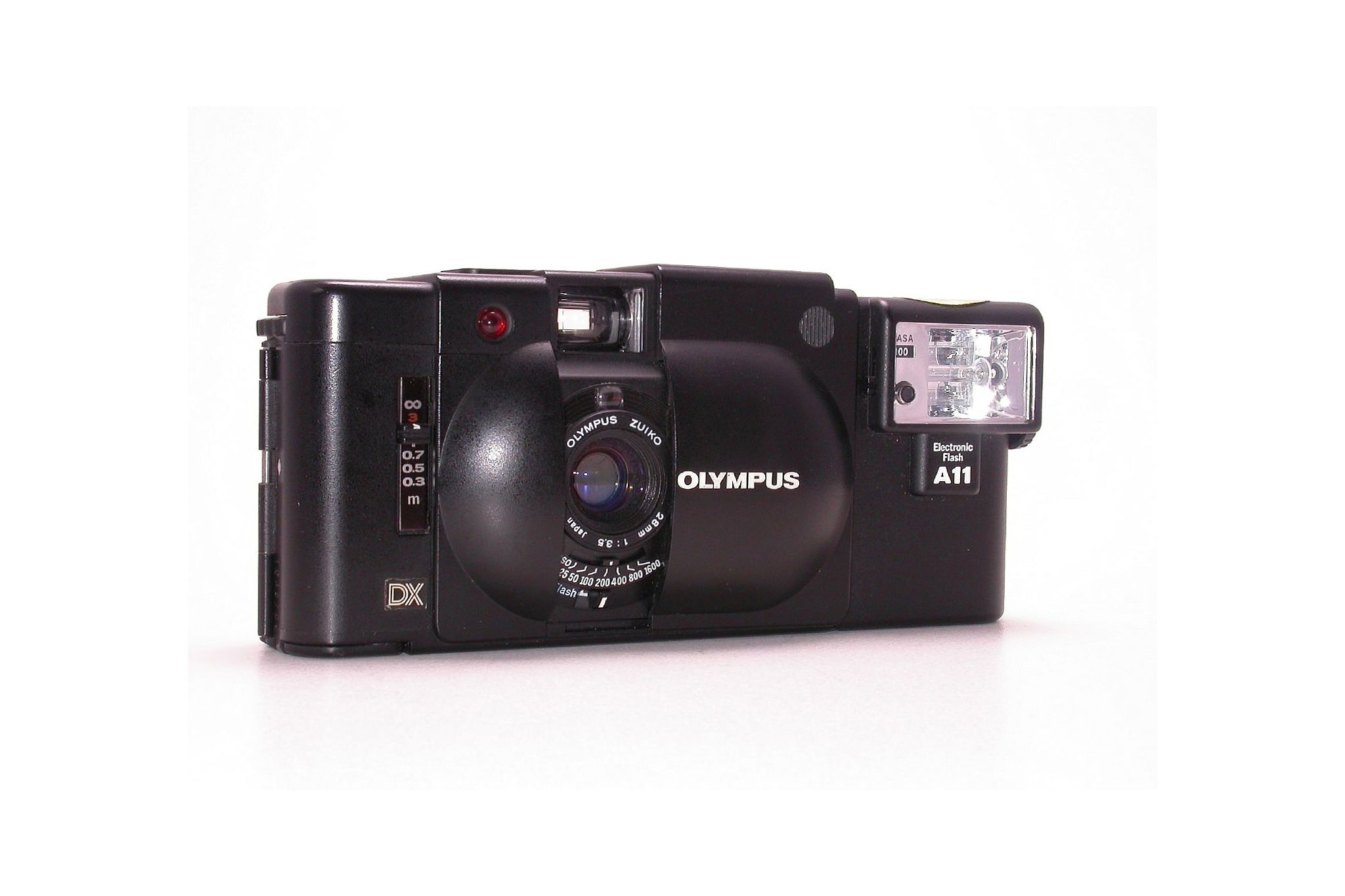
The Olympus XA4 (Macro) is a 35mm camera produced by Olympus in the 1980s. It is the last camera of the XA series from Olympus. Due to the fact that it was only built for a short time, there are only a few corresponding models, which makes it rare and drives up the used prices.
The design of the black camera resembles that of the Olympus XA, but otherwise they are actually completely different devices.
For example, it has a 28 mm lens built into it and not an optic with a focal length of 35 mm. The rangefinder of the original XA is also missing. Instead, there is a zone focus system (0.3 meters, 0.5 meters, 0.7 meters, 3 meters and infinity). When the cover is closed, the setting resets to 3 meters. Because of the low closest focusing distance, the XA4 carried the epithet "Macro" in its name.
The camera sets the exposure itself using its light meter, which is powered by two SR44 cell (eBay / Amazon*). At the same time, the DX encoding of the film allows the camera to automatically select the sensitivity (ISO 25 to ISO 1600).
A flash can be used with the Olympus XA4, but the connector on the side only allows the use of flash units for this camera series.
Films for the Olympus XA4
The Olympus XA4 is a compact camera specifically designed for use with 35mm film. Although digital cameras are becoming increasingly popular, 35mm film is still in use and can be easily developed by many photo labs.
There is a wide variety of 35mm film available, including the Kodak Gold 200* and the Ilford Delta 100*, which were specifically designed for use in 35mm compact cameras from Japan. Other manufacturers such as Foma, Adox and Rollei also offer a wide range of 35mm films suitable for various applications.
Color films are usually developed using the C-41 process, which is offered by most photo labs. Many photo labs also offer the possibility of directly making photographic prints of the shots, so that one can have the pictures, for example from the last vacation or trip, immediately in hand. In addition, it is possible to digitize the negatives in order to edit or archive them on the computer.
Black and white films require a different development process, with different options depending on the film. Black and white film development is also offered by most professional photo labs.