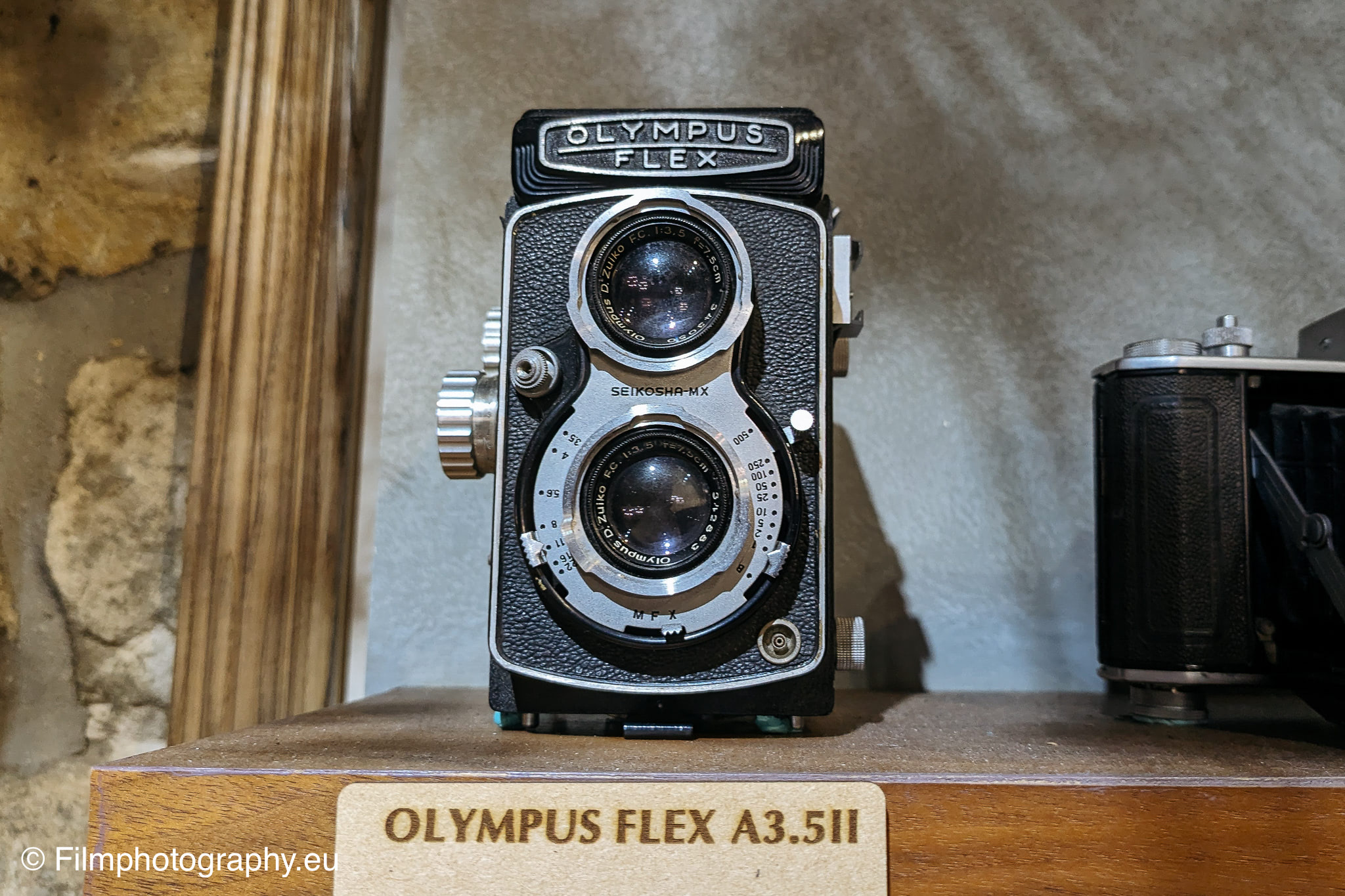
The Olympus Flex A 3.5 is a twin lens reflex camera (TLR). It was introduced in the mid-1950s. It was offered as a cheaper version of the Olympus Flex camera. The new price at that time was 23,000 yen. About half of the first Olympus Flex model. The price was equivalent to about 3 average monthly salaries in Japan.
The lens has a maximum aperture of f/3.5 and the focal length is 75 mm. The manufacturer's name for the lens is Zuiko 75mm f/3.5. You have to focus the lens manually.
The exposure is not measured by the medium format camera. You have to measure them with an external light meter. You can then freely adjust the exposure values on the camera. Shutter speeds from 1/500 second to 1 second are available. The aperture values range from f/3.5 to f/22.
The camera also has a bulb mode. In this shutter speed mode, the shutter opens for a variable duration. It closes when the trigger is released. In this mode you can capture some long exposures on the film material.
The Olympus Flex A 3.5 has a thread for a tripod and cable release. It a flash can be connected.
Does the camera need batteries? No, all functions are mechanical. Batteries are not required for the Japanese camera.
Films for the Olympus Flex A 3.5
Medium format films are exposed in the Olympus Flex A 3.5. There are still a few manufacturers that produce films for the camera. For color recordings there is the Kodak Portra 400*. One option for black and white images is the Ilford XP2 Super*. Of course there are other manufacturers, such as Foma, Rollei or Fujifilm. Lomography also offers suitable photo films for this Japanese camera.
The Olympus Flex A 3.5 exposes the film in 6x6 format. With this film format, twelve images fit on one roll of film. The films can be developed at most photo laboratories.