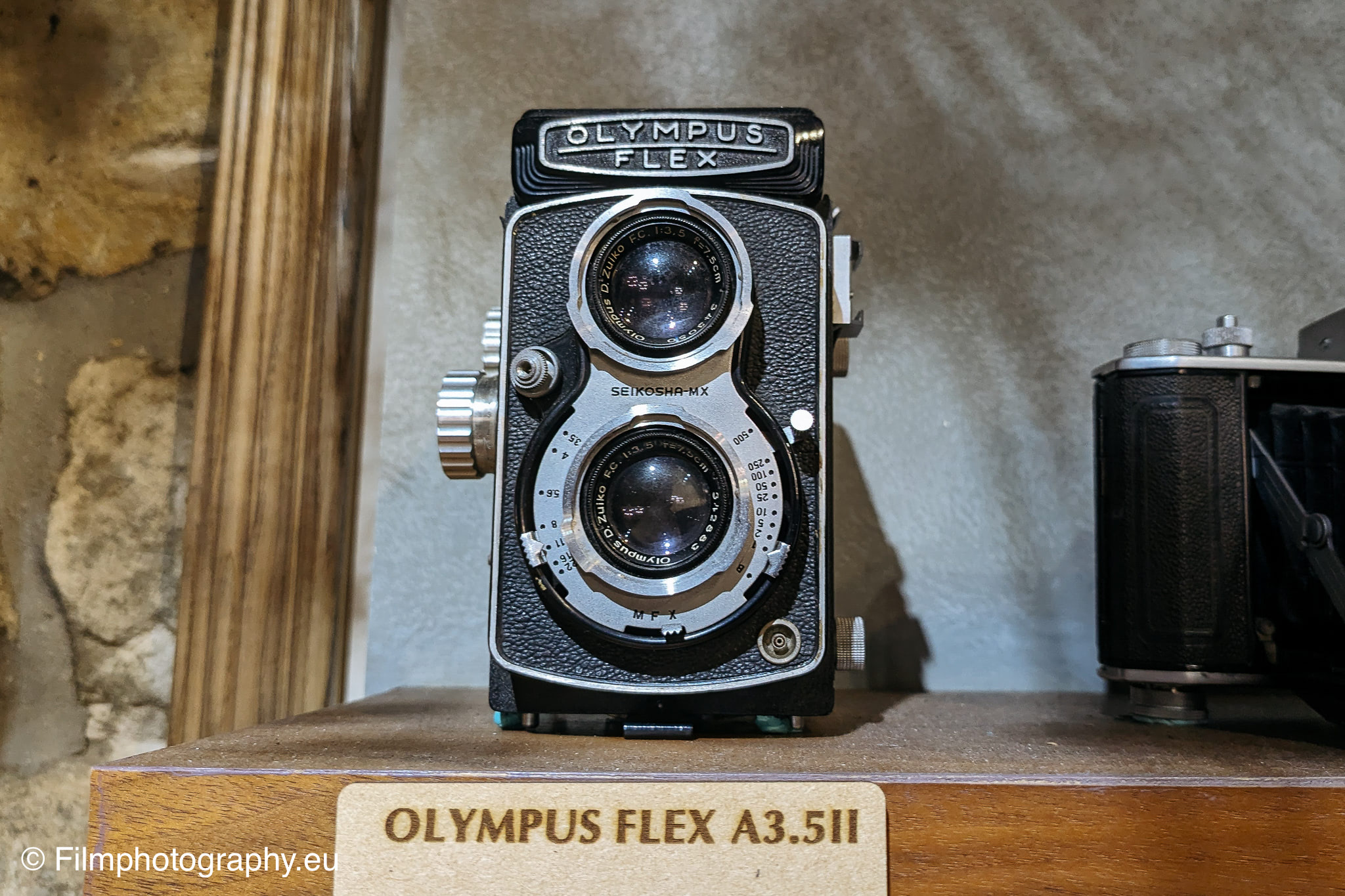
The Olympus Flex B I is a TLR camera from Olympus. It was introduced in 1952. At that time only the name Olympus Flex was used.
The introductory price at that time was 48,000 yen. This price was roughly equivalent to an average salary for six months of work. Later, a cheaper version of the camera with the Olympus Flex A 3.5 was offered.
To keep them apart, the model was then referred to as the Olympus Flex B II, with this model being slightly different from the original 1952 model. Among other things, it has a magnifying glass in the viewfinder and the aperture and shutter speed settings.
The name of the lens is “Zuiko 75 mm f/2.8”. The focal length is 75 mm and the maximum aperture is f/2.8. The lens is made up of 6 elements in 4 groups. The lens is focused manually. The Olympus Flex B I does not have autofocus.
The exposure must be measured externally. The medium format camera does not have a light meter. The shutter speed and aperture can be freely adjusted manually. When it comes to the shutter speed, you can choose from values from 1/400 second to 1 second.
The camera has a bulb mode. With the bulb setting, it remains open as long as the photographer keeps the shutter button pressed. The use of a flash is possible via the socket.
The Olympus Flex B I offers the option of connecting a cable release. If you want, you can mount the camera on a tripod. This is particularly useful when using bulb mode for long exposures.
Films for the Olympus Flex B I
The Olympus Flex B I is loaded with medium format films. There are still a few producers for this film format. One option for color images is the Kodak Portra 160* and the Kodak TRI-X 400* for black and white photos. Both films deliver good results in test reports. Of course there are other manufacturers of medium format films.
The film is exposed in 6x6 format. This format fits approximately twelve photos on one roll of film. The photographer must manually advance to the next image.