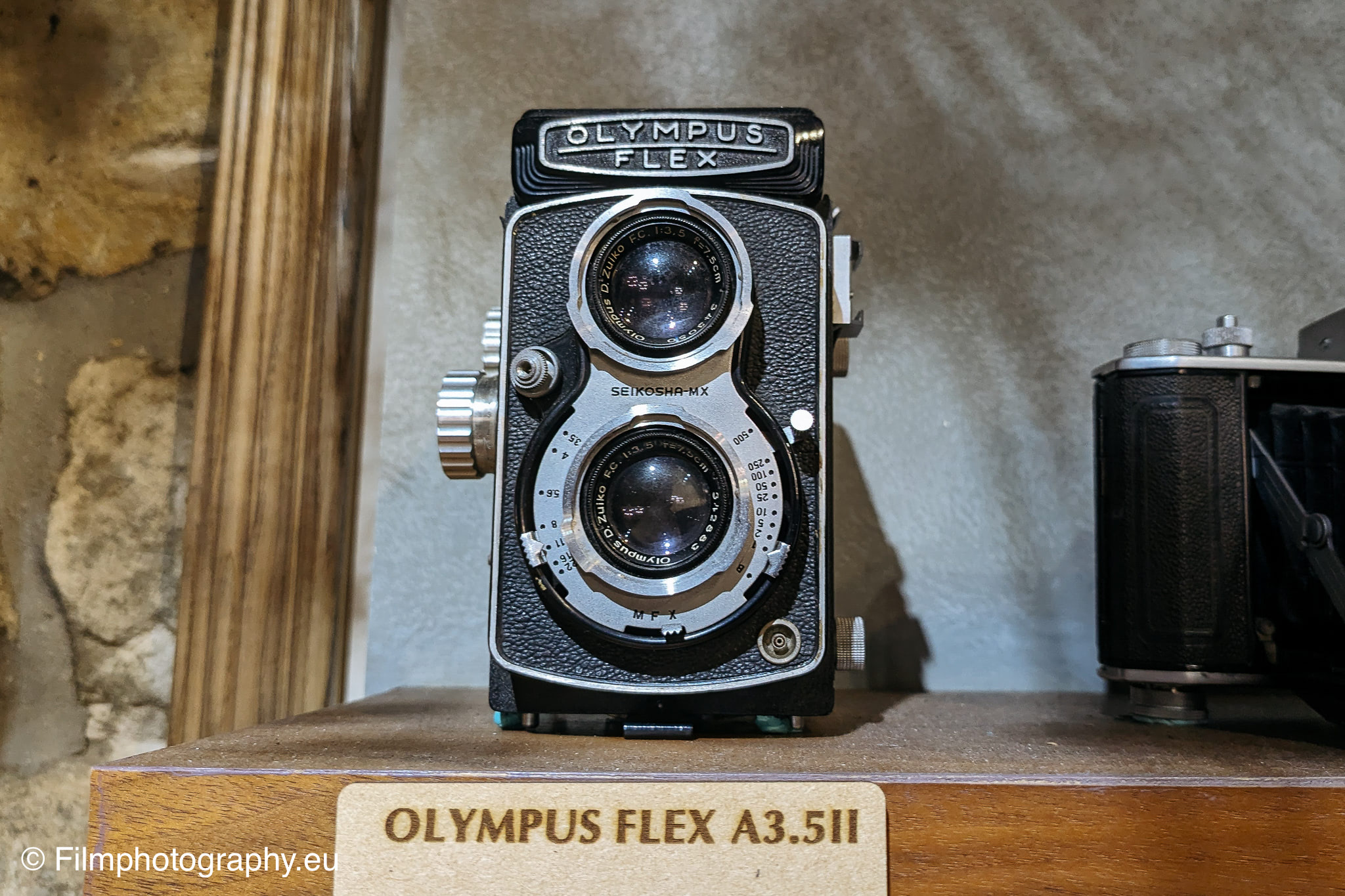
The Olympus Flex A 3.5 II is a twin-lens reflex camera. It was manufactured by Olympus in Japan from 1956. It is the successor to the Olympus Flex A 3.5. The new price at that time was 29,000 yen.
The model is very similar to its predecessor. The biggest difference is the M-F-X switch for the flash.
The camera houses a manual focus lens known as the Zuiko 75mm f/3.5. With a maximum aperture of f/3.5 and a focal length of 75mm, it allows photographers to take clear shots.
One of the special features of this model is that the exposure is not measured internally. Instead, users must use an external light meter to individually adjust exposure values on the camera. The available settings vary from shutter speeds between 1/500 second to 1 second and aperture values from f/3.5 to f/22.
For creative experiments, Bulb mode is available, in which the shutter remains open for a flexible period of time and only closes when the shutter button is released. This allows for interesting long exposure effects on the footage.
The Olympus Flex A 3.5 II offers a wealth of additional features, including a tripod and cable release thread and the option to connect a flash. Despite the variety of functions, the camera does not require batteries because all processes are mechanical.
Film options for the Olympus Flex A 3.5 II
The Olympus Flex A 3.5 II works with medium format films, which are still produced by a handful of manufacturers. For example, color photographs can be taken with the Kodak Portra 400*, while the Ilford XP2 Super* is ideal for black and white photographs. Additional alternatives are offered by manufacturers such as Foma, Rollei or Fujifilm, as well as Lomography, all of which offer compatible films for this particular Japanese camera model.
The camera exposes the film in a square 6x6 format, with each roll of film offering space for twelve exposures. The films can be easily developed in most photo laboratories.