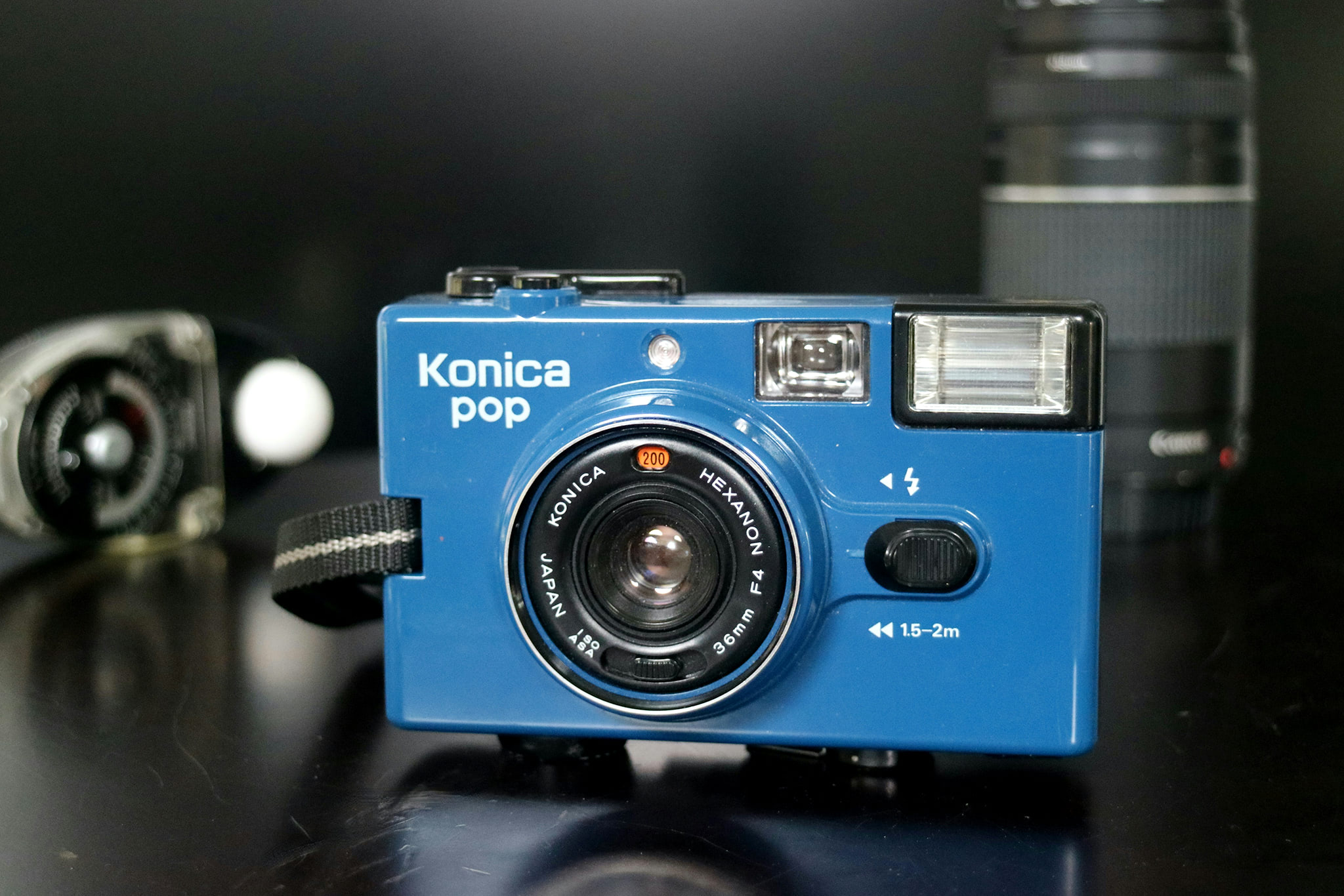
The Konica POP is an iconic compact camera for the 35mm film format, launched in the 1980s. It was specifically designed for hobbyist photographers and beginners seeking an uncomplicated and stylish camera for everyday snapshots.
The camera’s popularity was so enormous that over 1.5 million units were sold by 1985, and it remained on the market in several slight model iterations over a decade.
One variant, the Konica EFJ, is technically almost identical but additionally offers a practical date function for imprinting on the film, making it particularly attractive for documenting events and travel.
Lens
The camera is equipped with a permanently installed 36mm wide-angle Hexanon lens with an aperture of f/4. The name “Hexanon” characterized Konica’s higher-quality lens coating on early models produced between 1982 and 1985.
Later models omitted this designation. The optical construction of the lens consists of four elements arranged in four groups. This configuration allowed for surprisingly good image quality for a camera of this class, with pleasing contrast and vibrant colors.
As it is a fixed-focus lens, there is no need for manual focusing, which significantly simplifies operation. The lens is focused at a fixed distance of 2.8 meters. The relatively small initial aperture results in sufficient depth of field, allowing subjects from about 1.5 meters to infinity to be captured sharply.
The camera does not have a filter thread and does not offer the possibility to attach interchangeable lenses, which aligns with its character as an uncomplicated point-and-shoot camera.
Exposure Settings
The Konica POP features fully automatic exposure control, taking the technical decisions away from the photographer. The camera independently selects the appropriate exposure for each shot. The shutter speed is fixed at 1/125 second, a speed well-suited for most daylight situations and minimizing motion blur.
Exposure metering is done via a CdS cell, discreetly placed above the lens, which measures ambient brightness. Based on this measurement and the manually set film sensitivity, the camera’s electronics automatically select a suitable aperture from the available settings of f/4, f/5.6, f/8, f/11, and f/16. For the most common film sensitivities of ASA/ISO 100, 200, or 400, corresponding settings are available via a slider directly on the lens.
As a useful aid, the camera has an underexposure warning light, a red LED next to the viewfinder that lights up when the available light is insufficient and flash use is recommended.
Flash System & Batteries
A key feature of the camera is its integrated, pop-up electronic flash. This also gave the camera its name “POP,” as it springs out resiliently (“pops up”) at the push of a button. The flash is manually activated by pressing a button on the front of the camera and then automatically extends, ready for use in darker environments.
The guide number of the flash is 14 (at ISO 100 in meters), providing a typical range of two to five meters, making it ideal for portraits or small groups. A clearly visible orange indicator light next to the viewfinder signals flash readiness once the capacitor is charged.
In later models from 1985 onwards, the flash charging time was noticeably improved. For close-up shots in the range of 1.5 to 2 meters, there is also a special button that adjusts the aperture to prevent overexposure. The flash is powered by two standard AA batteries (eBay / Amazon*).
Additional Features
Although the Konica POP is reduced to the essentials, it offers some thoughtful details. It has a tripod thread on the bottom. Even though the camera lacks long exposure functionality or a self-timer, which somewhat limits the practical use of the thread, it still allows for stable positioning.
A rather unusual design feature is the folding film rewind crank, also located on the bottom of the camera. Film transport is traditionally manual via a thumb lever on the top, giving the photographer a tactile sense of film consumption.
Dimensions and Weight
With its compact dimensions, the Konica POP was a very handy camera that was easy to transport. The exact dimensions are 116 x 70 x 47 mm, and the weight without the required batteries is a feather-light 270 grams.
Films for the Konica POP
The Konica POP uses standard 35mm film (eBay / Amazon*) and supports the three most common film sensitivities: ISO 100, 200, and 400. A crucial point in operation is that the camera does not have automatic DX code recognition. Therefore, the sensitivity of the loaded film must always be set correctly manually via a selector switch on the lens for accurate exposure metering.
The choice of the right film is of great importance for good results, as the exposure latitude is limited by the fixed shutter speed and automatic aperture selection. For sunny days and outdoor shots with plenty of light, a film with ISO 100 is an excellent choice.
In cloudy weather, in shady environments, or for indoor shots with flash, a film with ISO 400 should be preferred to avoid underexposed images. The camera is designed for standard film rolls of up to 36 exposures.
Technical datasheet
| Attribute | Specification |
|---|---|
| Type of Camera | Viewfinder camera |
| Film format | 35mm |
| Film transport | Manual |
| Film transport mechanism | Quick release lever |
| Picture format | 24 mm x 36 mm |
| Lens name | Hexanon 36 mm f/4 |
| Focal length | 36 mm |
| Widest aperture | f/4 |
| Smallest aperture | f/16 |
| Minimum focus distance | 150 cm / 4.92 ft |
| Focus | Fixed |
| Lens design | 4 elements in 4 groups |
| Exposure times | 1/125 second |
| Date imprinting | No |
| Double and/or multiple exposure function | No |
| Flash | Integrated flash |
| Flash range | 2 to 5 Meter / 6.56 to 16.4 Feet |
| Flash recycle time | circa 9 seconds |
| Tripod mount | Yes |
| Cable release thread | No |
| Self-timer | No |
| Connection for camera strap | Yes |
| Power supply | 2x AA batteries |
| Size | 11,6 x 7 x 4,7 cm |
| Dimensions in inches | 4.57 x 2.76 x 1.85 inches |
| Weight | 270 Grams |
| Estimated value / Used price | 52,61 Euro Estimate based on used prices of 93 offers (possibly with different scope of delivery and/or condition). As of May 18, 2026 |
| Average used price in the year 2025 | 51,14 Euro (55.20 US-Dollar) |