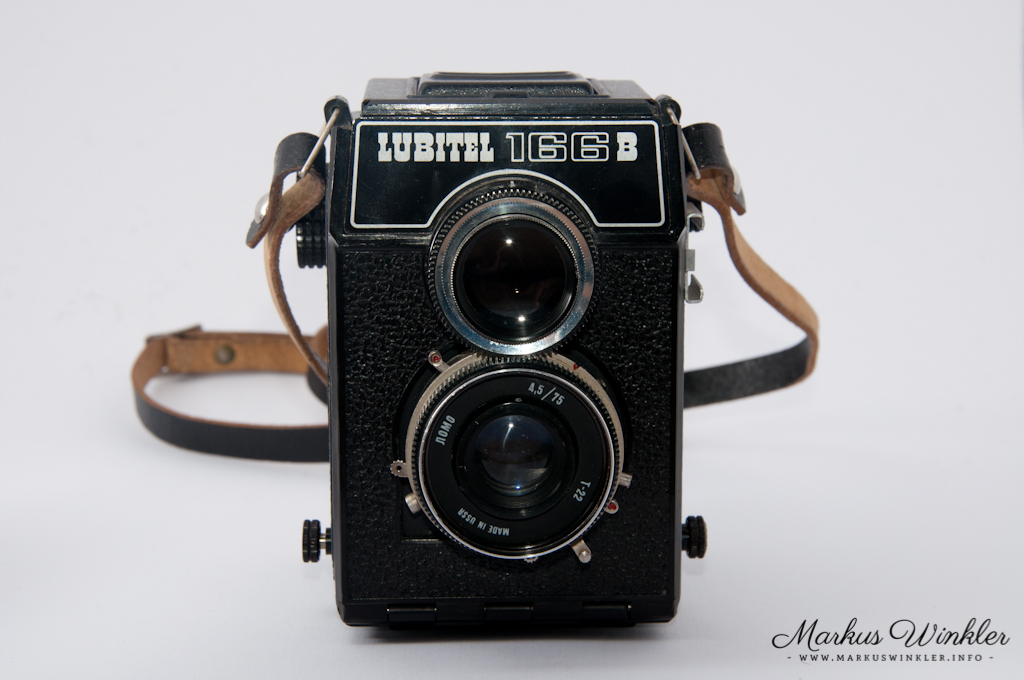
The Lubitel 166B is a medium format camera. It dates from the 80s. The TLR was manufactured by Lomo in Russia (USSR). The camera itself is mainly black.
The Lubitel 166B is a TLR (= Twin Lens Reflex) or two lens reflex camera. This means that you have two identical lenses that are arranged on top of each other on the camera. The upper lens is connected to the viewfinder and the lower lens takes the picture itself.
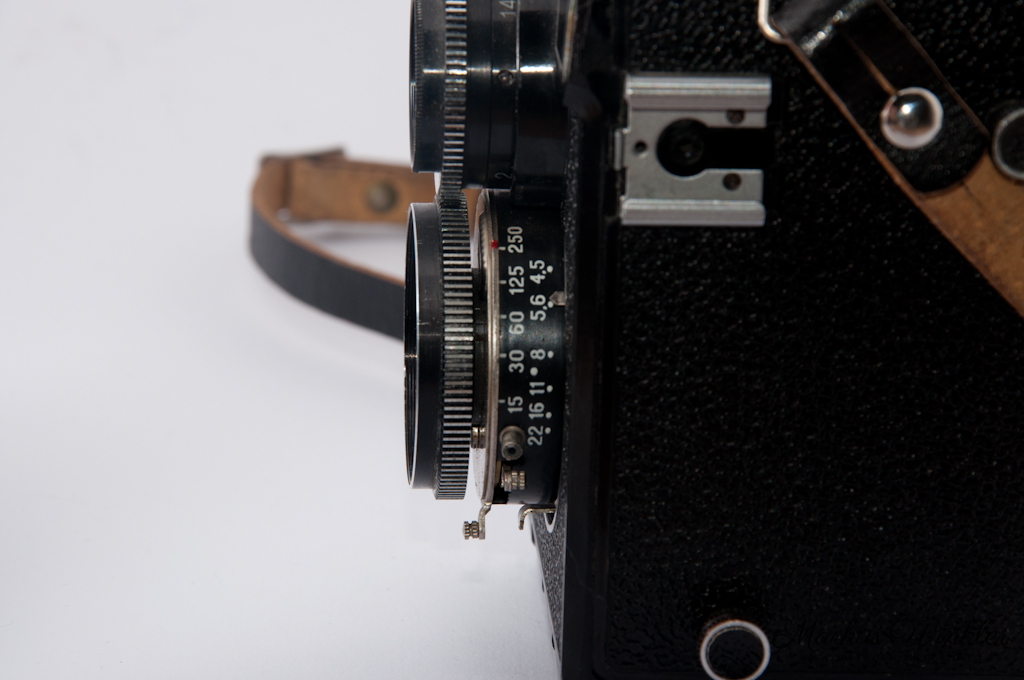
The Lubitel has a “Triplet 22” lens with a focal length of 75 mm. The widest aperture is f/4.5, and it can be stopped down to f/22. The fastest exposure time is 1/250 seconds, and there is also a bulb mode.
The Lubitel 166B is completely manual and does not need batteries. But this also means that you have to measure the exposure yourself. For this, you can either use an external light meter, a light meter app for your smartphone, or simply estimate it. Once the exposure time, focus and aperture have been set, the shutter still has to be cocked and then a photo can be taken.
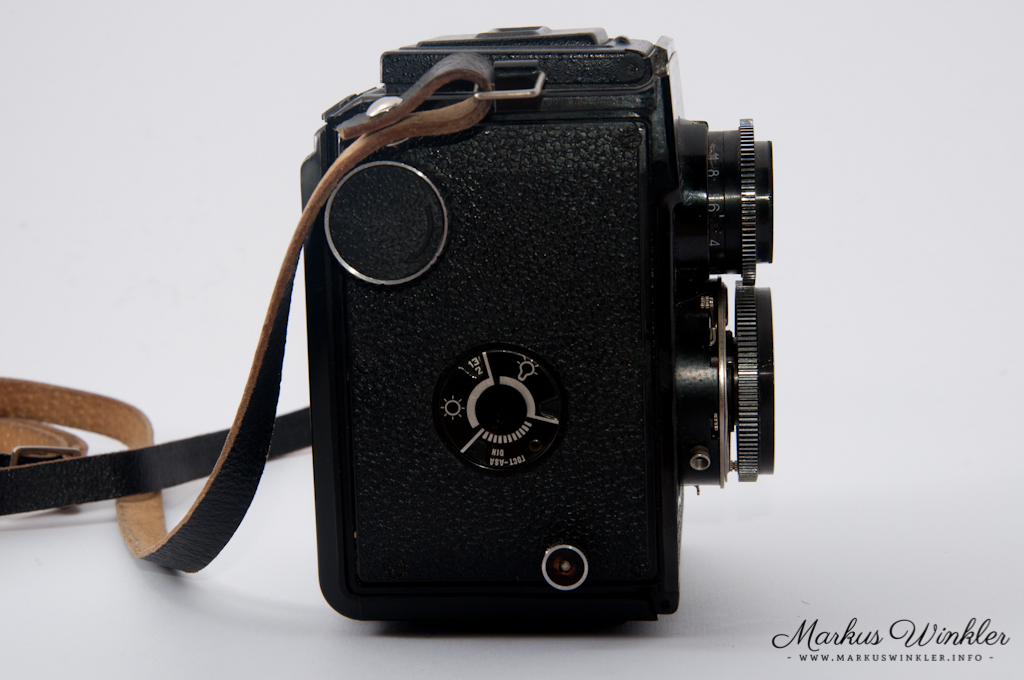
The Lubitel 166B exposes 6×6 images, square images, on medium format film. There is a wheel on the side of the camera to remember the sensitivity of the loaded film.
The viewfinder of the model is a shaft viewfinder, which means that you look through the viewfinder from above. For this reason, you also hold the camera at chest to belly level and get a different perspective than when you hold the camera up to your eye. A small magnifying glass in the viewfinder, which can be folded in when needed, is supposed to help with manual focusing.
The Lubitel 166B has a connection for a tripod and a cable release. The medium format camera also has a self-timer. A flash can also be used with the model.
If you want a Lubitel today but don’t want an old one, you can buy the Lubitel 166+ from Lomography.
Technical datasheet
| Attribute | Specification |
|---|---|
| Type of Camera | Twin-lens reflex camera |
| Film format | 120 |
| Film transport | Manual |
| Picture format | 60 mm x 60 mm |
| Focal length | 75 mm |
| Widest aperture | f/4.5 |
| Focus | Manual |
| Viewfinder | Waist-level finder |
| Exposure times | 1/250 second to 1/15 second, Bulb |
| Bulb mode | Yes |
| Date imprinting | No |
| Built-in flash | No |
| Flash Connection | PC-Flash |
| Tripod mount | Yes |
| Cable release thread | Yes |
| Self-timer | Yes |
| Power supply | Not necessary |
| Country of production | Soviet Union (USSR) |
| Estimated value / Used price | 86,67 Euro Estimate based on used prices of 28 offers (possibly with different scope of delivery and/or condition). As of May 18, 2026 |
| Average used price in the year 2023 | 84,97 Euro (90.92 US-Dollar) |
| Average used price in the year 2024 | 92,69 Euro (99.58 US-Dollar) |
| Average used price in the year 2025 | 89,19 Euro (96.33 US-Dollar) |
FAQ about the Lubitel 166B
Is the Lubitel 166B a difficult camera to use?
It's fully manual, so it requires you to set the aperture, shutter speed, and focus yourself. There's no automation, but with a little practice, it's straightforward to use. You'll also need to measure the light exposure separately.
What kind of film does this Russian camera use?
The Lubitel 166B uses 120 roll film, producing 6x6cm square images. This is a medium format film, giving you larger negatives and therefore potentially better image quality.
How do I take a picture with the twin lens reflex camera?
After setting the aperture, shutter speed, and focus, you need to wind the film advance lever to cock the shutter. Then press the shutter release button to take the picture. It's a purely mechanical process.
Does the Lubitel 166B need batteries?
No, the Lubitel 166B is entirely mechanical. It doesn't require batteries for operation. This makes it very reliable and easy to maintain.
What is special about the viewfinder on this camera?
It has a waist-level viewfinder, meaning you look down into the top of the camera to compose your shot. This gives a different perspective compared to eye-level viewfinders of other cameras.