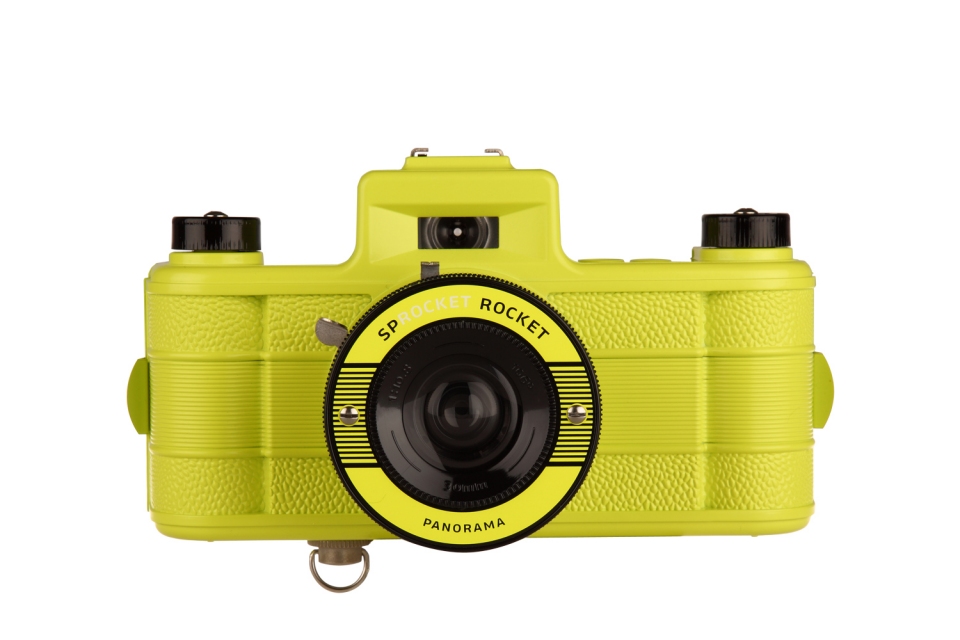
The yellow Sprocket Rocket was introduced in July 2011 with the Sprocket Rocket SUPERPOP! Blue, Sprocket Rocket SUPERPOP! Orange and Sprocket Rocket SUPERPOP! Green from Lomography.
The Sprocket Rocket with the usual features in a yellow plastic body. The buttons for winding the film are black.
The functions of the Sprocket Rocket camera
The Sprocket Rocket camera uses a super wide angle lens to expose the film including the perforation. Each photo taken with this camera is approximately equivalent to two normal shots. Therefore, with a 36 frame 35mm film, approximately 18 images can be taken with the Sprocket Rocket camera.
The lens of the Sprocket Rocket camera is made of plastic and has a focal length of 30 mm and a maximum aperture of f/10.8 (almost f/11). The characteristic corners of the pictures occur due to strong vignetting and decreasing sharpness.
For panorama shots, the camera offers two exposure times: 1/100 second and Bulb for long exposures. There is no shutter lock, so multiple exposures are possible by releasing the shutter several times. The film can be fast-forwarded and rewound at will. There are two distance settings: one for close-ups (0.6 meter to 1 meter) and one for everything else (1 meter to infinity).
The camera has a hot shoe for connecting an external flash and a thread for a tripod on the bottom of the camera.
Photofilms for the Sprocket Rocket Camera
There is still a good selection of photo films offered in 35mm format that are well suited for the panoramic camera. A recommended film for the Sprocket Rocket camera is the Kodak Ultramax 400*. This film is versatile and makes for beautiful shots.
Development of Sprocket Rocket films
When developing Sprocket Rocket films, it is important to be careful not to cut the film, as this can result in cut images. It is difficult to get prints from the Sprocket Rocket camera because most labs do not make prints with the Sprockets on them. A good solution is to scan the images yourself and then send them to a lab to have them printed.
Technical datasheet
| Attribute | Specification |
|---|---|
| Type of Camera | Panorama camera |
| Film format | 35mm |
| Film transport | Manual |
| Film transport mechanism | Rotary knob |
| Focal length | 30 mm |
| Widest aperture | f/10.8 |
| Minimum focus distance | 60 cm / 1.968 ft |
| Focus | Fixed |
| Exposure times | 1/100 second, Bulb |
| Bulb mode | Yes |
| Auto DX (Film sensitivity) | No |
| Date imprinting | No |
| Double and/or multiple exposure function | Yes |
| Built-in flash | No |
| Flash Connection | Hot Shoe |
| Flash sync speed | 1/100 s |
| Tripod mount | Yes |
| Cable release thread | No |
| Self-timer | No |
| Power supply | Not necessary |
| Country of production | China |
FAQ about the Sprocket Rocket SUPERPOP! Yellow
What kind of lens does the yellow Sprocket Rocket camera have?
It uses a super wide-angle lens that captures the film including the sprocket holes. This results in each photo being roughly equivalent to two normal shots, making a 36-exposure roll yield around 18 pictures.
How many pictures can I take with one roll of 35mm film?
A standard 36-exposure 35mm film will allow you to take approximately 18 pictures with the Sprocket Rocket. The wide lens captures more of the film's area per shot.
Can I use a flash with this camera?
Yes, the Sprocket Rocket features a hot shoe, enabling the use of an external flash. This allows for additional lighting options for various shooting conditions.
What are the shutter speeds available on the camera?
The Sprocket Rocket offers two shutter speeds for panorama shots: 1/100 of a second and bulb mode for longer exposures. Bulb allows for creative long exposure photography.
Is it easy to get prints developed from this camera?
It can be challenging to get prints from the Sprocket Rocket at most labs because of the sprocket holes on the pictures. It is often easier to scan your film yourself and then print from digital files.