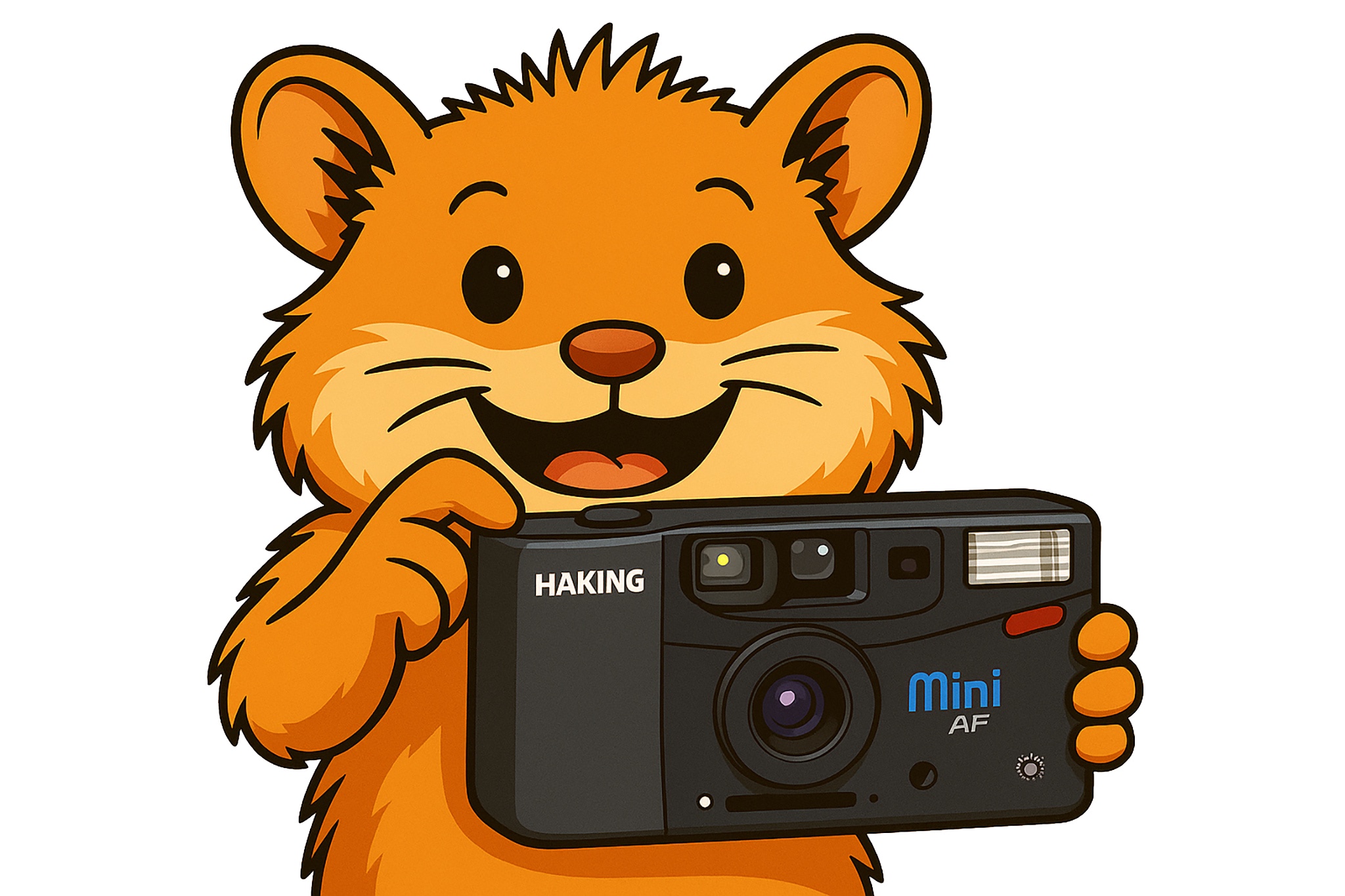
The Haking Mini AF presents itself as an affordable pocket camera with automatic functions. It is a product of the Haking company and was most likely made in a Hong Kong manufacturing facility in the 1990s. This camera is an excellent option for beginners and proves to be a reliable companion for celebrations, weddings and travel.
Camera features
The Haking Mini AF is equipped with a permanently installed 35mm lens, which has an estimated focal length between 28mm and 35mm. The focus is set using the built-in autofocus system. A sliding door is used to protect the lens from potential damage and contamination.
The camera is equipped with a built-in exposure meter that works in harmony with the automatic film sensitivity detection enabled by the film cassette. This eliminates the need for manual adjustments to aperture and exposure time.
In addition, it has a built-in flash. The camera also offers other features, including the option to activate a self-timer of your choice and the ability to attach a tripod.
The Haking came with a matching pouch and wrist strap. A remote control was also included. The camera can be triggered via a wireless connection.
The camera is powered by CR123A batteries (eBay / Amazon*). This type of battery is very easy to find online and is also very inexpensive.
Suitable film types for the Haking Mini AF
According to the manual, the Haking Mini AF accepts conventional 35mm film. These are still available from various providers and can be developed without difficulty.
Among the films recommended for this compact camera are Kodak Ultramax 400* for color photography and Ilford Delta 400* for monochrome photography. However, there are other well-known suppliers such as Lomography, Fujifilm, Rollei, Adox and Foma who provide suitable films.
The Haking Mini AF negatives are 24mm x 36mm. An automatic system ensures film advance after each exposure, while a counter on the top shows the number of exposures already taken.
After the film is fully exposed, it is automatically rewound back into its cassette. Only at this point should the housing be opened to remove the film for development. To prevent damage from exposure to light, the camera should under no circumstances be opened until the film has been completely rewound.
Technical datasheet
| Attribute | Specification |
|---|---|
| Type of Camera | Snapshot camera |
| Film format | 35mm |
| Film transport | Automatic |
| Film transport mechanism | Motor |
| Picture format | 24 mm x 36 mm |
| Focal length | - |
| Widest aperture | - |
| Focus | Autofocus |
| Light meter | Yes |
| Auto DX (Film sensitivity) | Yes |
| Manual exposure settings | No |
| Date imprinting | No |
| Double and/or multiple exposure function | No |
| Flash | Integrated flash |
| Flash modes | Red-eye reduction |
| Tripod mount | Yes |
| Cable release thread | No |
| Self-timer | Yes |
| Wireless remote control | Yes |
| Connection for camera strap | Yes |
| Power supply | 1x CR123A battery |
| Country of production | Hong Kong |
FAQ about the Haking Mini AF
What type of lens does the Haking Mini AF possess, and how does it focus?
It features a built-in 35mm lens with a focal length estimated between 28mm and 35mm. Focusing is achieved through an integrated autofocus system, simplifying the shooting process.
Does this affordable point-and-shoot camera offer any automatic exposure settings?
Yes, the camera incorporates a built-in light meter working in conjunction with automatic film speed detection. This eliminates the need for manual adjustments to aperture and shutter speed.
What kind of film does the compact camera use and how are the images saved?
It uses standard 35mm film, easily available from various suppliers. The negatives have dimensions of 24mm x 36mm, and the camera automatically winds the film after each shot.
Besides the auto-focus, what other features enhance usability?
The Haking Mini AF includes a built-in flash, a self-timer, a tripod mount, and even came with a remote control for wireless shooting.
What power source does the camera use and how easy is it to acquire?
The camera uses readily available and inexpensive CR123A batteries; these are commonly found online and in most electronics stores.