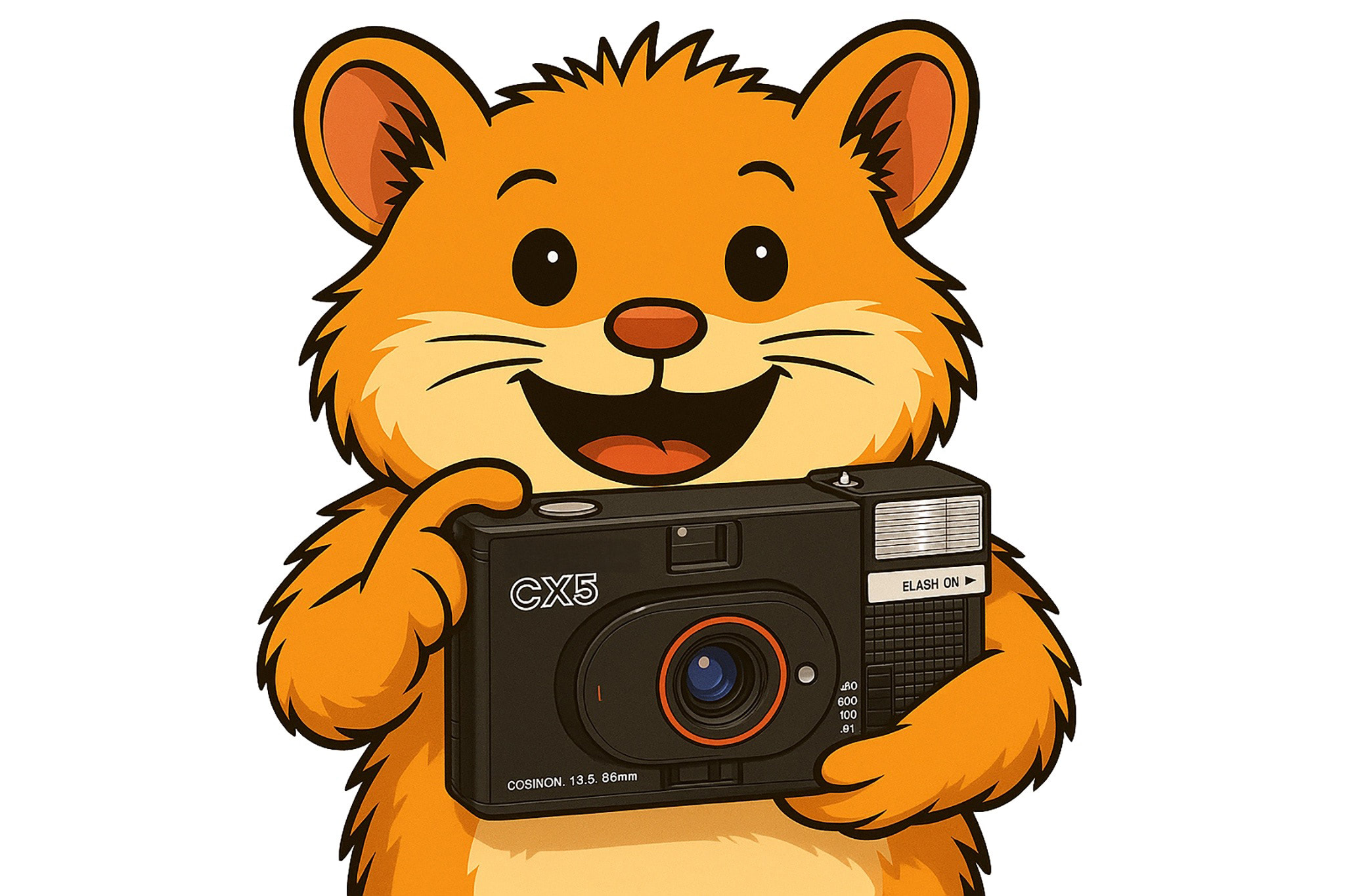
The Cosina CX5 is a very compact 35mm AE camera that was launched in the early 1980s. It is characterized by its ease of use, integrated electronic flash, and fixed lens.
Designed as a point-and-shoot camera with some manual settings, it was aimed at amateur photographers looking for a straightforward camera for snapshots.
This model was also offered under the name Petri PX5. A slimmed-down version, the Petri PX5F and the Cosina CX5F, was also available. These two models offer fewer ISO settings and have a fixed focus setting. All four models were produced by the Japanese company Cosina.
Lens
The Cosina CX5 is equipped with a fixed COSINON 1:3.8 lens. The focal length is 33 mm, which corresponds to a slight wide angle and is well suited for general photography, landscape shots, and snapshots.
The optical design consists of 4 elements in 3 groups. Since this is a fixed lens, changing lenses is not possible.
Focusing is done manually via a zone focus system, which is operated by a small lever (focus lever) on the front of the lens. There are three focus markings (focus symbols): a person symbol for close-up portraits (approx. 1.1 m), a circle symbol (often interpreted as a group symbol) for general snapshots and the main focus area (approx. 2.7 m), and a mountain symbol for landscapes (infinity). When set to 2.7 m, a large depth of field (pan-focus effect) is achieved, ensuring that most subjects are sharply captured in typical snapshot situations.
There is no filter thread. A special feature is the integrated lens cover, a rotating “blink” aperture (lens cover) that protects the lens when closed and simultaneously locks the shutter release to prevent accidental exposures.
Exposure Settings
The Cosina CX5’s exposure is controlled automatically via a programmed automatic exposure (AE) system. The system uses a photodiode as a light sensor to measure the subject’s brightness. Based on the measurement and the set film speed, the camera automatically selects an appropriate combination of shutter speed and aperture.
The working range of the automatic exposure system extends from EV 8.6 to EV 17 (based on ISO 100). The user can manually adjust the film speed using a slider on the front of the camera.
Films with sensitivities of ISO 64, 100, 200, and 400 are supported. For intermediate values, the nearest value should be selected. Manual selection of aperture or exposure time is not possible.
There is a red warning LED in the viewfinder. This LED flashes when the measured light is too weak for handheld shooting (corresponding to an exposure time of approximately 1/30 second or longer). The same LED also serves as a battery check.
Flash System
The Cosina CX5 features a built-in automatic electronic flash. This is designed as a pop-up flash and pops up from its recessed position by pressing a slider (flash on button) on the front of the camera.
As soon as the flash is extended, charging begins automatically. A flash-ready lamp next to the viewfinder eyepiece lights up when the flash is fully charged and ready for use.
The flash’s guide number is 12 (at ISO 100, given in meters). The recycling time, or the time it takes for the flash to recharge, is approximately 7 seconds. The flash duration is very short, approximately 1/1000 of a second.
The effective flash range is between 0.9 and 3 meters at ISO 100.
The red warning LED in the viewfinder alerts the user when ambient light is too low and the flash should be used. When the flash is no longer needed, it should be manually pushed back into the housing until it clicks into place to conserve battery power.
Additional Functions
In addition to the basic functions, the Cosina CX5 offers several additional features.
The viewfinder is a bright frame type with a magnification of 0.5x. It contains markings for parallax compensation, which help you correctly frame the image when shooting close-ups (set to 1.1 m), as the view through the viewfinder differs slightly from that through the lens.
The previously mentioned red LED in the viewfinder serves both as a warning against excessively long exposure times and as a battery check.
The film advance is controlled manually via a thumbwheel on the back of the camera. A full 360° rotation advances the film by one frame. A built-in mechanism prevents double exposures.
The film counter counts forward and automatically resets to “S” (start) when the back is opened. The numbers 12, 20, 24, and 36 are marked in orange to indicate the end of common film lengths. The film rewind is also manual. After pressing the film rewind button on the bottom of the camera, the film is rewound into the cartridge using the fold-out film wind crank.
A strap hole for attaching a wrist strap is also provided. A self-timer is not listed in the specifications and is therefore not included. There is also no tripod thread.
Dimensions and Weight
The Cosina CX5 is a very compact camera. Its dimensions are 117 mm wide, 67.5 mm high, and 42 mm deep. The camera weighs 230 grams without batteries. With batteries, the weight increases slightly. These compact dimensions and low weight make it an easily transportable camera for on-the-go use.
Power Supply
The Cosina CX5 is powered by two 1.5V AAA alkaline-manganese batteries (eBay / Amazon*).
The batteries are inserted into a compartment on the bottom of the camera, which is closed by a sliding cover (battery compartment cover). The correct polarity (+) and (-) is marked in the battery compartment and must be observed when inserting them.
The camera has a battery control function, which is controlled by the red LED in the viewfinder. To check, open the lens cap, cover the light sensor (photosensor eye) with your finger, and lightly press the shutter button. If the red LED in the viewfinder flashes, the battery voltage is sufficient. If the LED does not light up, the batteries must be replaced or checked for correct insertion. When the lens cap is closed, the shutter button is mechanically locked to prevent power consumption from accidental pressing.
Film Recommendations
The Cosina CX5 is designed for use with 35mm film (24×36 mm format). The film speed must be set manually using the ASA/ISO selector, as the camera does not have DX code recognition. Films with ASA/ISO 64, 100, 200, and 400 can be used.
The choice of film speed depends on the intended use and lighting conditions:
- ISO 100 or 200: These are good all-around speeds for outdoor daylight photography, such as landscape photography or general snapshots in good weather. ISO 200 offers a little more flexibility under overcast skies or in the shade.
- ISO 400: This film is better suited for lower-light conditions, such as indoors (especially with flash), at dusk, or for fast-moving subjects (sports photography), as it allows for shorter exposure times.
- ISO 64: This low-sensitivity film potentially offers the finest grain and highest sharpness, but requires very bright lighting conditions, such as sunny days at the beach or in the snow.
Various manufacturers still produce film. For color photography, there is the Kodak Gold 200*. One option for obtaining black-and-white images is the Ilford Delta 400*. Other manufacturers include Fujifilm, Foma, and Lomography.
The film counter displays the number of images taken and marks the common lengths of 12, 20, 24, or 36 exposures per film roll. Color negative film (for prints) or black-and-white film are equally suitable. Slide film can also be used, but places greater demands on the camera’s exposure accuracy.
Quick Operation Guide
- Inserting Batteries: Open the battery compartment on the bottom and insert two AAA alkaline batteries, observing the correct polarity.
- Loading Film: Open the camera back using the back cover open knob. Insert the film cartridge into the film chamber. Pull the film leader over the film guide rail and insert it into a slot on the film take-up spool.
- Starting Film Advance: Close the back cover. Turn the film advance wheel 360°, press the shutter button, and repeat this until the film counter reaches “1.”
- Set the film speed: Set the ASA/ISO value of the loaded film using the film speed selector.
- Prepare the camera to shoot: Turn the lens cover sideways to expose the lens and release the shutter button.
- Set the focus: Use the focusing lever to select the appropriate distance (1.1m, 2.7m, or ∞). 2.7m is suitable for most snapshots.
- Compose the image: Look through the viewfinder and select the composition. Pay attention to the parallax markings when taking close-up shots.
- Checking the exposure / using the flash: Lightly press the shutter button. If the red LED in the viewfinder flashes, the light is weak. Slide the flash on button to pop up the flash. Wait until the flash ready lamp lights up.
- Release the shutter: Press the shutter button all the way down to take the picture.
- Advancing the film: Turn the film advance wheel one full turn until it stops for the next shot.
- Rewinding the film: When the film is full (the advance wheel is locked), press the film rewind button on the bottom. Extend the film wind crank and turn it clockwise until the film is fully rewound (the crank turns more easily).
- Removing the film: Open the back cover and remove the film cartridge.
Technical datasheet
| Attribute | Specification |
|---|---|
| Type of Camera | Viewfinder camera |
| Film format | 35mm |
| Film transport | Manual |
| Film transport mechanism | Thumbwheel |
| Picture format | 24 mm x 36 mm |
| Lens name | COSINON 1:3.8 33mm |
| Focal length | 33 mm |
| Widest aperture | f/3.8 |
| Minimum focus distance | 90 cm / 2.952 ft |
| Focus | Manual |
| Type of focus | Zone focus |
| Focus zones | 1,1 m, 2,7 m, Infinite |
| Lens design | 4 elements in 3 groups |
| Viewfinder | Illuminated frame finder with parallax compensation marks |
| Exposure times | 1/500 second to 1/30 second |
| Light meter | Yes |
| Supported film speeds | ISO 64 to 400 |
| Exposure modes | Program automatic |
| Manual exposure settings | No |
| Auto DX (Film sensitivity) | No |
| Date imprinting | No |
| Double and/or multiple exposure function | No |
| Flash | Integrated flash |
| Flash range | 0,9 to 3 Meter / 2.95 to 9.84 Feet |
| Flash recycle time | circa 7 seconds |
| Flash sync speed | 1/125 s |
| Tripod mount | No |
| Cable release thread | No |
| Self-timer | No |
| Connection for camera strap | Yes |
| Power supply | 2x AAA batteries |
| Size | 11,7 x 6,7 x 4,2 cm |
| Dimensions in inches | 4.61 x 2.64 x 1.65 inches |
| Weight | 230 Grams |
| Country of production | Japan |
| Estimated value / Used price | 35,07 Euro 62573328831645937941 Estimate based on used prices of 3 offers (possibly with different scope of delivery and/or condition). As of January 5, 2026 |