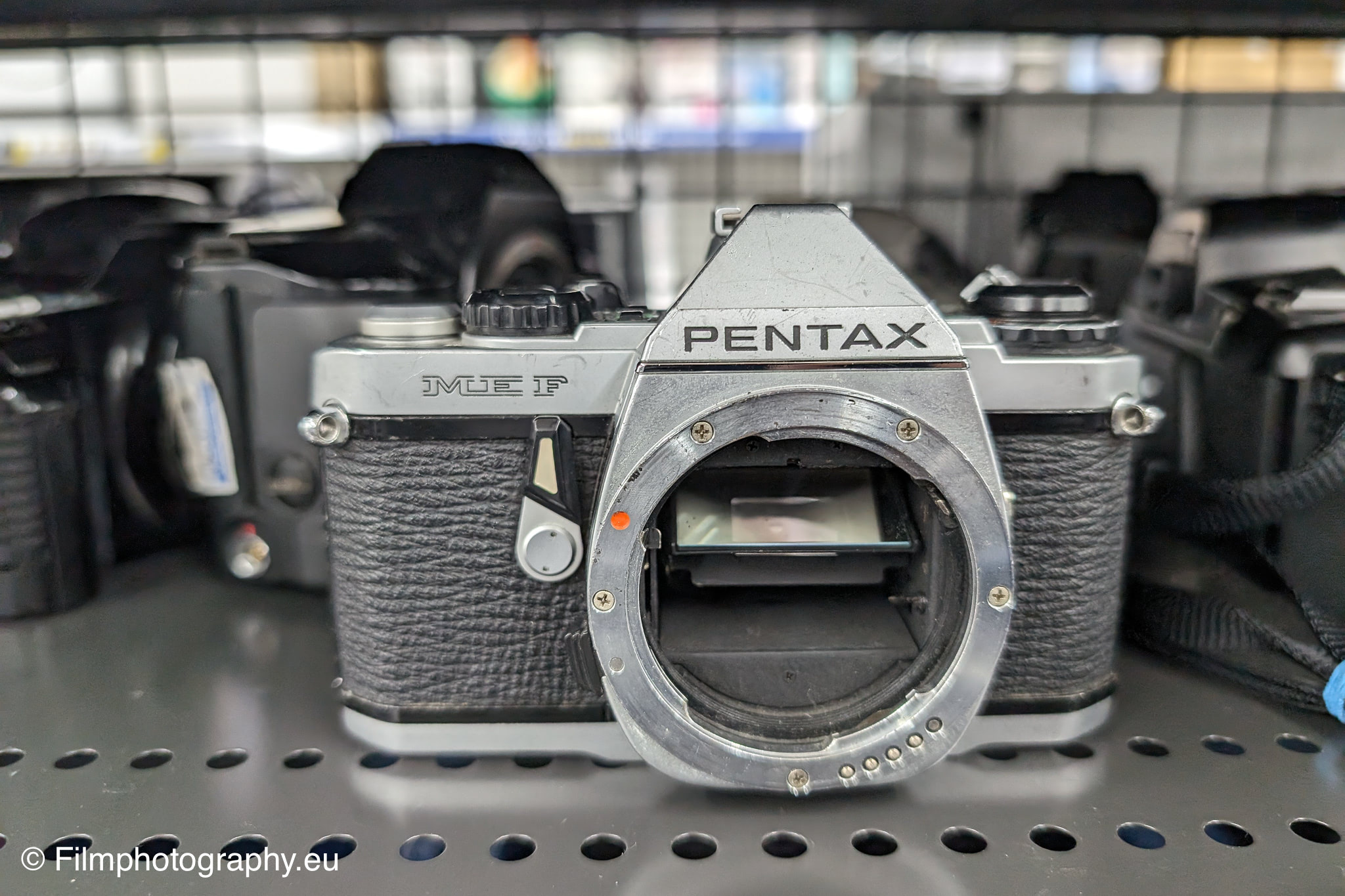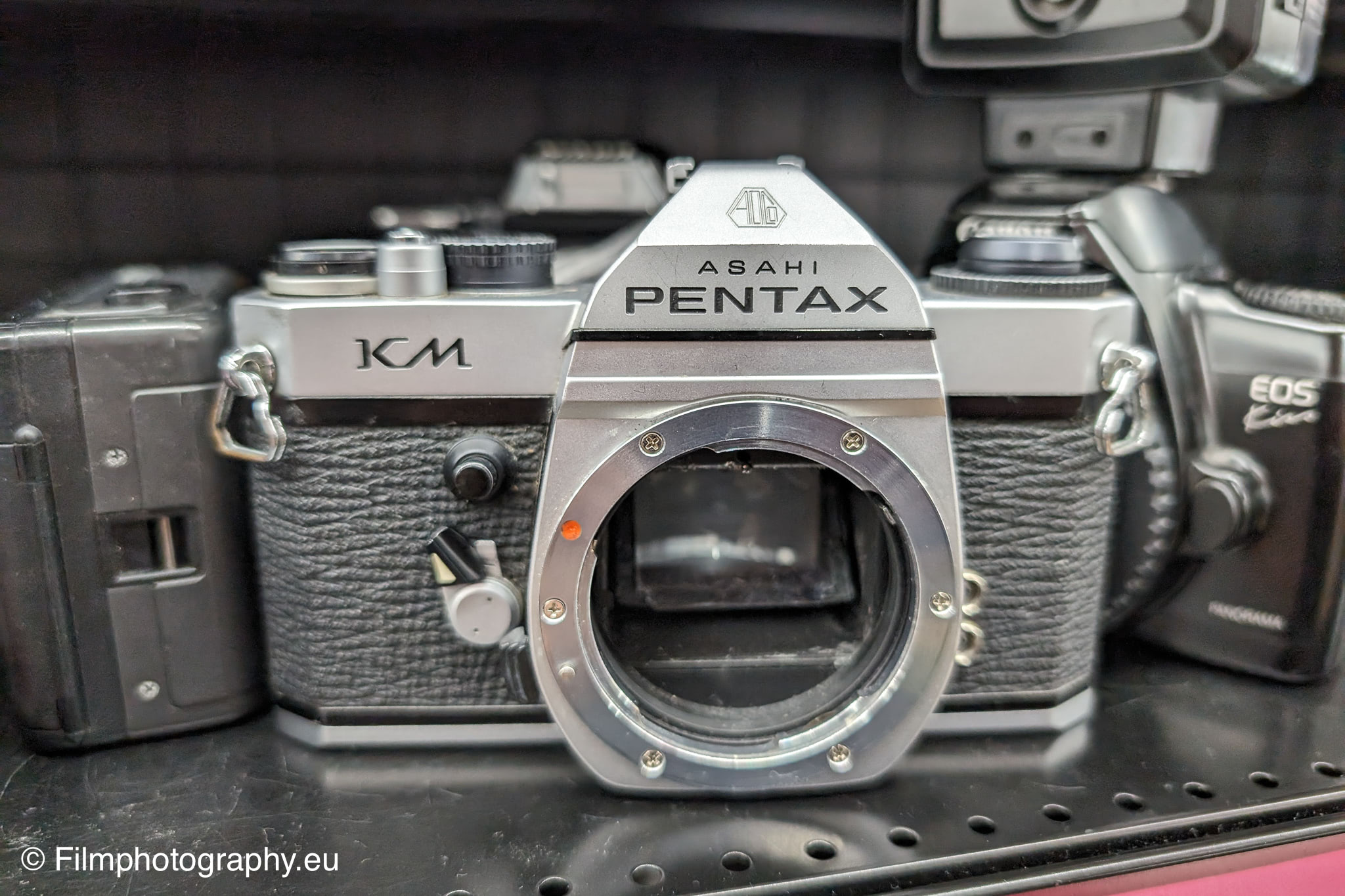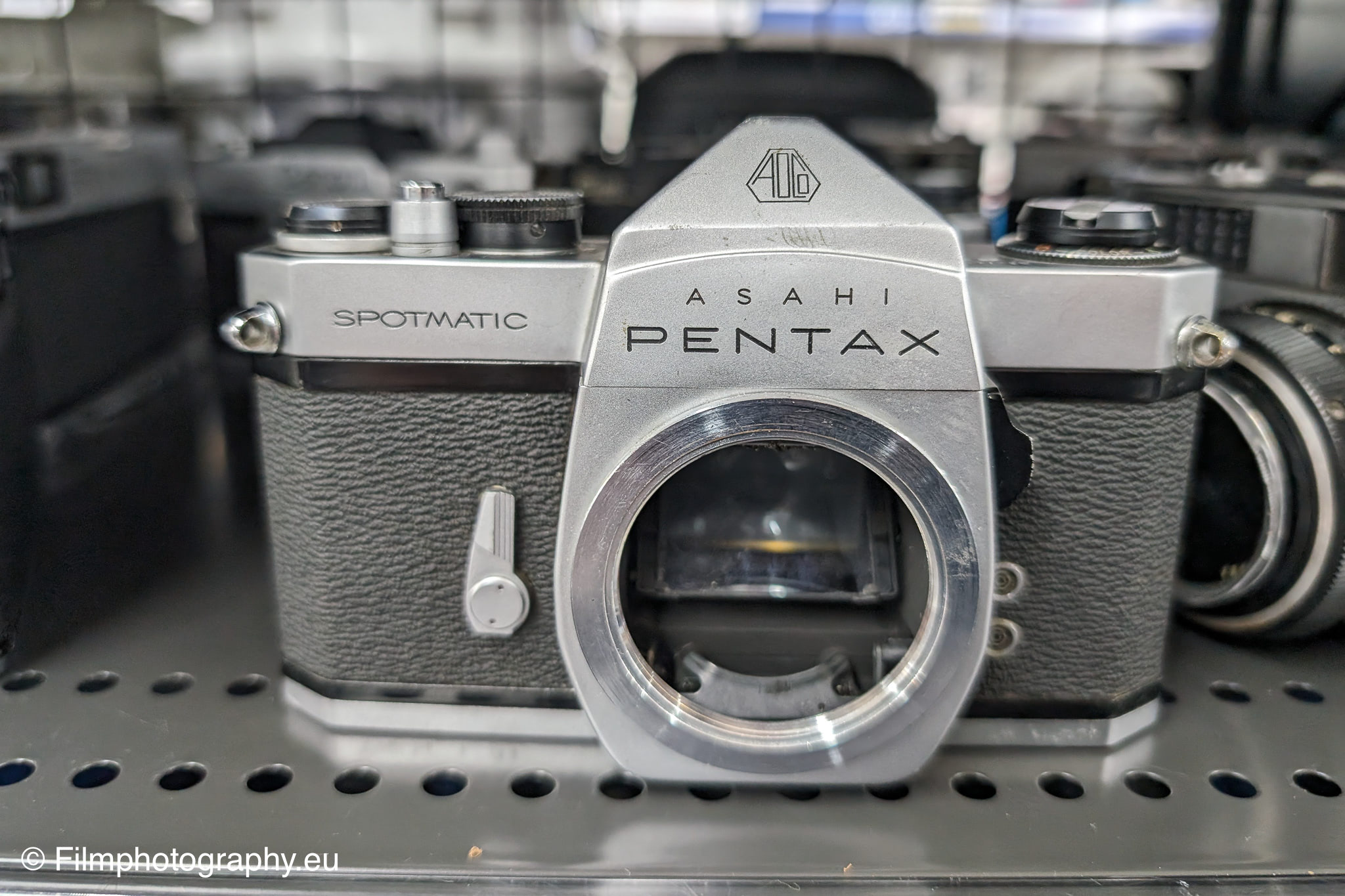

The Pentax Spotmatic (originally marketed as Asahi Pentax Spotmatic) is a 35mm single-lens reflex camera (SLR) introduced in 1964 by the Japanese Asahi Optical Co. (later Pentax Corporation). It is historically considered one of the most significant cameras of the 1960s, as it significantly contributed to the worldwide popularization of through-the-lens (TTL) light metering.
The SP model was the first in a series of Spotmatic models produced until 1976 and was the first SLR series to exceed the production mark of over one million sold units.
Development History and Naming
The technical concept of the camera was already presented to the public in 1960 at the Photokina trade fair in Cologne as a prototype. Four years of intensive development and testing followed before the model went on sale at the end of 1964.
The name "Spotmatic" derives from the original design of the prototype, which was designed for spot metering (selective metering). However, for the production model, Asahi Optical chose center-weighted average metering, as it was more universally applicable and more forgiving for amateurs and professionals in everyday photography. The catchy name was nevertheless retained for the retail version.
Lens Mount and Takumar Optics
The Pentax Spotmatic uses the classic M42 screw mount, originally developed by Zeiss Ikon and Praktica. Since Asahi Optical used this mount very successfully for many years, the M42 thread is often also referred to as the Pentax thread in photography.
As standard lenses, high-quality lenses under the brand name Takumar were offered, typically the Super-Takumar 50mm f/1.4 or the Super-Takumar 55mm f/1.8. These lenses featured a fully automatic diaphragm. The photographer focuses at open aperture and thus maximum viewfinder brightness; only at the moment of release does the aperture mechanically close to the preselected value.
Shutter and TTL Light Metering
The fully mechanically controlled cloth focal-plane shutter runs horizontally and offers shutter speeds from 1 second to 1/1000 second, as well as a setting for arbitrarily long exposures (B). A mechanical self-timer is integrated into the body.
Light metering is performed by two highly sensitive cadmium sulfide (CdS) cells located inside the body next to the pentaprism, measuring the light directly on the focusing screen. Since the camera does not have electronic transmission of the aperture value from the lens to the body, the system works with stop-down metering.
To take a measurement, the photographer moves a mechanical slide switch on the left side of the lens mount upward. This mechanically closes the lens aperture to the value set on the aperture ring and simultaneously activates the circuit of the light meter. In the viewfinder, a needle becomes visible on the right edge.
By turning the aperture ring or the shutter speed dial, the needle must be brought into alignment with a central index mark to achieve correct exposure. After metering, the switch is pushed back down, which opens the aperture fully again for a bright viewfinder image.
Viewfinder System and Power Supply
The camera's optical pentaprism viewfinder offers 0.88x magnification. Focusing is aided by a microprism focusing screen with a central microprism ring as a focusing aid.
To operate the light meter, the camera requires a PX400 button cell with an original nominal voltage of 1.35 volts on a mercury basis. Since these batteries are no longer manufactured for environmental reasons, users of the Spotmatic benefit from a special feature of the internal electronics: the camera has a bridge circuit that automatically compensates for voltage differences. This allows modern silver oxide button cells with a voltage of 1.55 volts to be used without any loss of metering accuracy. Since the camera otherwise operates fully mechanically, it remains usable at all shutter speeds even with a completely discharged battery.
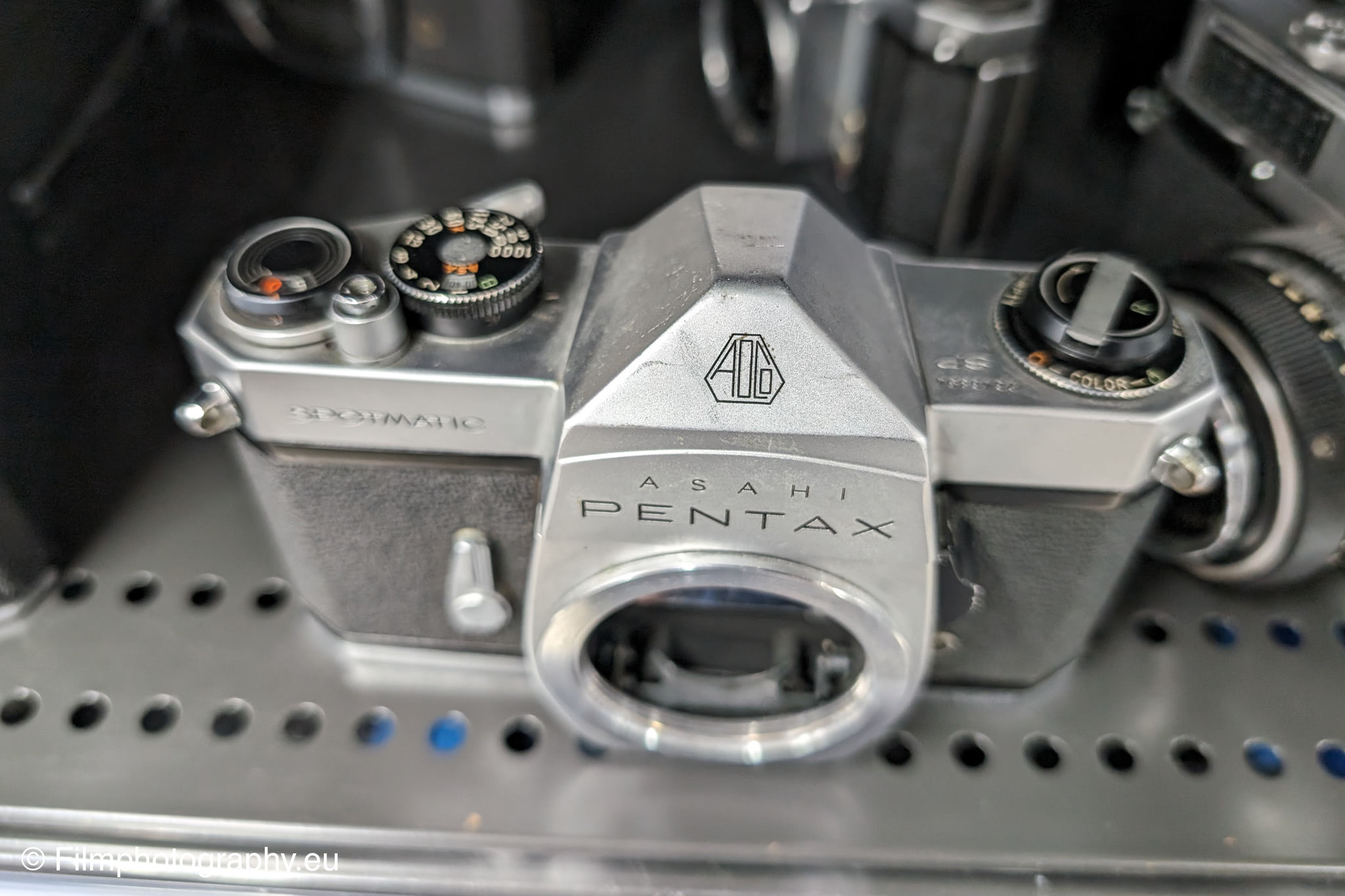
Body and Dimensions
The body of the Spotmatic SP is made of all-metal construction and was available in either a classic chrome (silver) or black painted finish. On the front are separate FP and X sync sockets for flash units; the flash sync speed is 1/60 second. A fixed accessory shoe was not fitted on the original SP version; flash units had to be mounted via an optional cold shoe bracket that attached to the viewfinder eyepiece.
The body measures 143mm in width, 92mm in height, and 88mm in depth (with standard lens) and weighs 621 grams without lens. Due to its high reliability and simple, functional design, the Pentax Spotmatic SP remains a popular tool in analog photography to this day.
Films for the Pentax Spotmatic SP
Reading the manual of the Pentax Spotmatic SP, you will find that the camera needs 35mm film to take pictures. This type of film is still produced and can be processed without problems by most photo labs.
A recommendation for color shots is, for example, the Kodak Ultramax 400*. If you prefer to stay monochrome, the Kodak T-Max 100* is not bad. Test reports show that both films are suitable for a wide range of applications. Besides this manufacturer, many other companies produce films for this format.