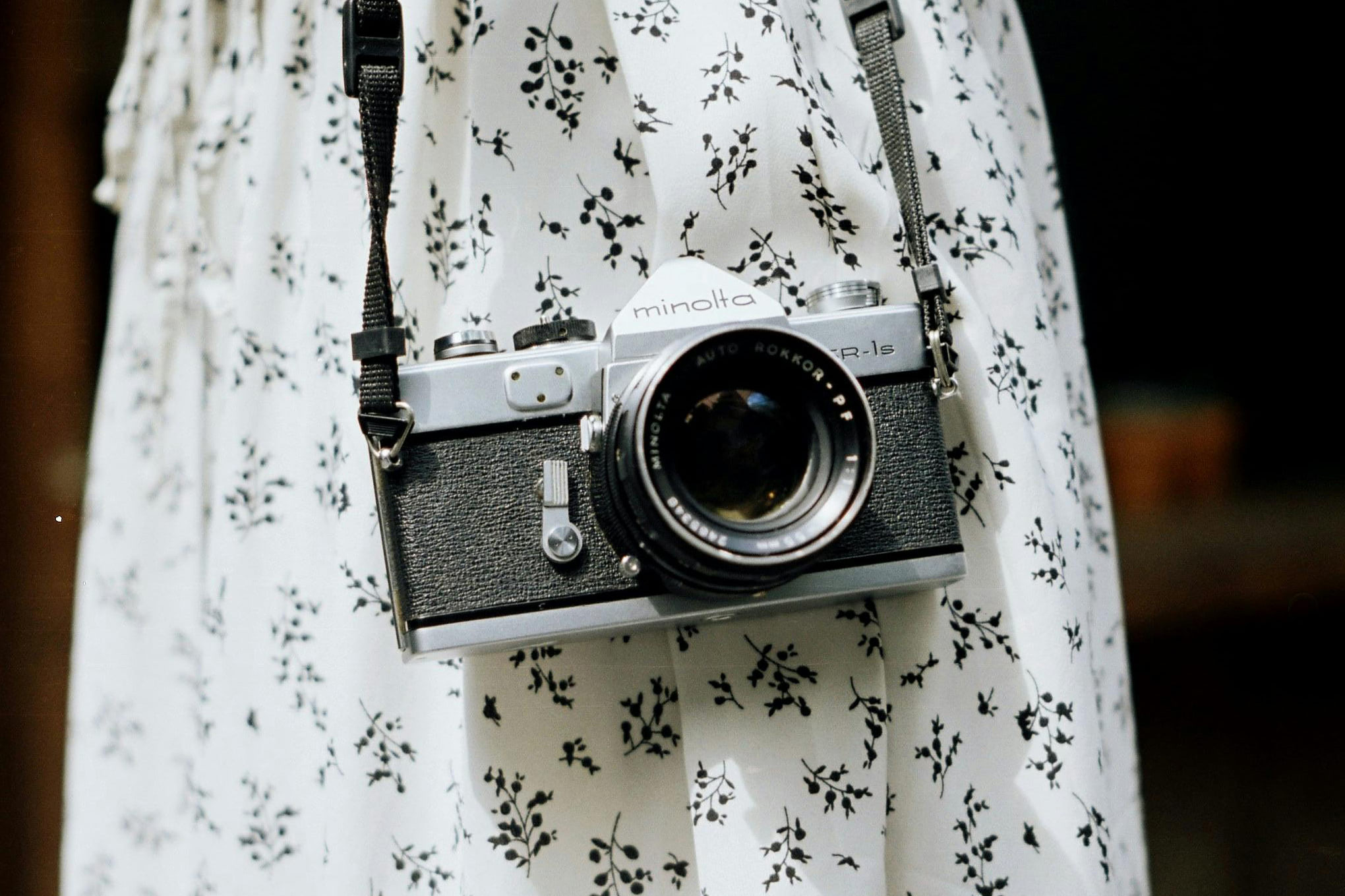
The Minolta SR-2 was the first SLR camera from Chiyoda Kogaku, later Minolta. It was introduced in 1958 and produced in Japan.
The lenses of the 35mm photo camera can be changed. This is made possible by the Minolta SR bayonet. The Minolta Auto Rokkor-PF 1:1.8 f=55mm is often found on the 35mm camera. The Japanese camera does not have an autofocus. Focusing is manual. The open aperture is used for focusing. Only when the shutter release is pressed, the aperture jumps to the set value. Pressing the quick-release lever after shooting resets the mirror and the aperture.
The correct exposure cannot be measured by the photo camera because it does not have a light meter. Exposure time and aperture can be set completely manually. The shutter allows times from 1/1000 second to 1 second. A bulb mode is available for long exposures.
The use of an external flash unit is possible via the PC flash socket. The flash can be attached to the hot shoe. The flash sync speed is 1/50 second.
A tripod can be connected to the thread on the bottom. A cable release can also be used with the camera. Additionally, the self-timer can be used for taking pictures. Power is not needed for taking pictures.
Films for the Minolta SR-2
Photographic films are exposed in the Minolta SR-2, more precisely 35mm films. 35mm films are still manufactured today. The negatives of the Minolta SR-2 are 24 mm x 36 mm in size. So about 36 pictures fit on one roll of film. The film must be manually rewound by the photographer after each photo. Rewinding into the cartridge is also done manually with a crank.
Possible films for the Minolta SR-2 are the Fujifilm Superia 400* for color photos and the Kodak T-Max 100* for B&W images. Other suitable films are also offered by Foma, Ilford, Rollei and Adox, among others.