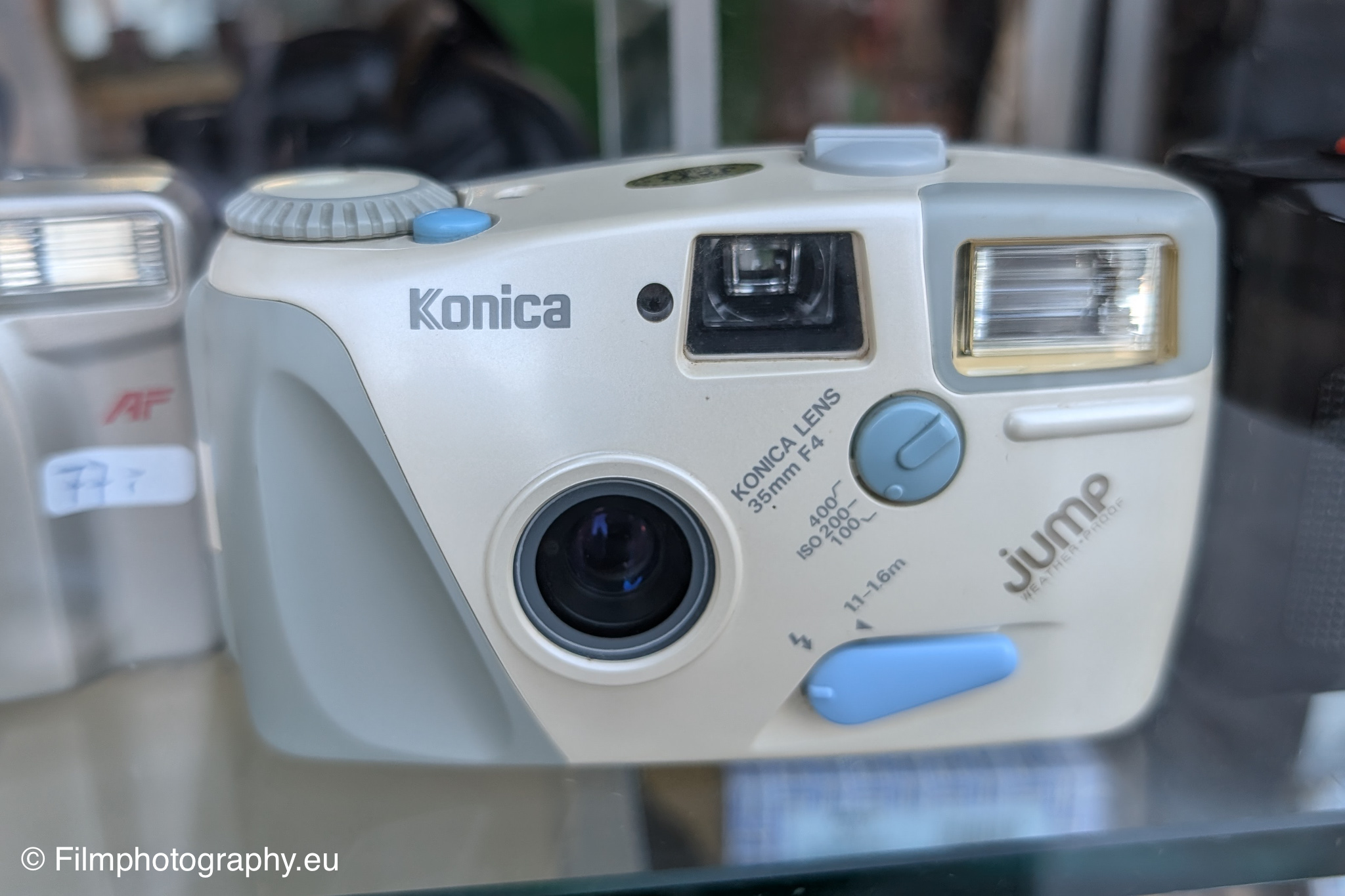
The Konica Jump is a weatherproof 35mm compact camera that is characterized by its robust design and ease of use. It is aimed at amateur photographers who are looking for a straightforward camera for everyday life and outdoor activities. In Japan, there was a model with the same functionality under the name Konica Manbow.
Technical features
The Konica Jump is equipped with a fixed-focus 35mm lens with a maximum aperture of f/4. The automatic exposure control ensures that even inexperienced photographers can achieve good results. An integrated flash that can be switched on manually enables shots to be taken in poor lighting conditions.
For close-ups between 1.1 and 1.6 meters, there is a special "close-up" button that adjusts the aperture for flash shots accordingly.
The film speed can be set manually to ISO 100, 200 or 400. Film transport and rewinding are done manually.
Design and handling
The Konica Jump is characterized by its weatherproof housing, which protects it from splashes of water and dust. The compact and lightweight design makes it an ideal companion for on the go. The simple operation with few controls allows even beginners to quickly get to grips with the camera.
Background to the 35mm camera
The Konica Jump is part of a series of compact cameras that Konica launched in the 1990s. It shares many of its features with the Konica Pop-10, but differs in its weatherproof housing and slightly more robust design.
Film recommendations for the Konica Jump
35mm film is necessary for the Konica Jump. Although digital cameras are widespread, the 35mm format remains relevant, and various manufacturers continue to offer films for it. For example, the Kodak Portra 400* is suitable as a color film for the Konica Jump.
If you prefer black and white photos, the Ilford Delta 400* is a good choice. Both films are considered to be versatile, which has also been confirmed in various tests. There are also smaller brands such as Rollei, Lomography and Foma that offer suitable films for this camera.
Color films are usually developed using the C-41 process. Almost every photo lab offers this service. Most drugstore chains in Germany also develop color films.