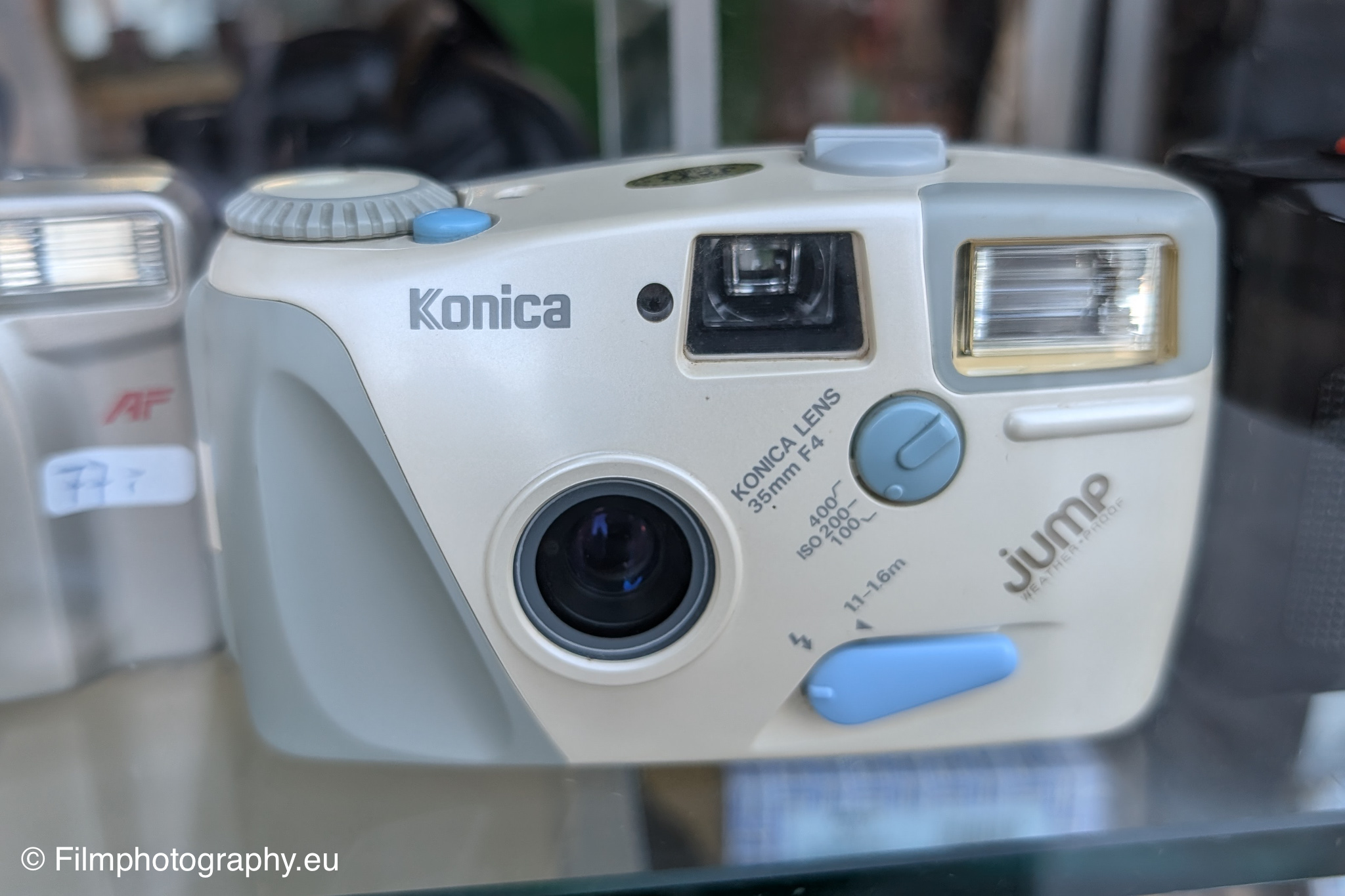
In 1987, the Japanese manufacturer Konica presented its first weatherproof camera, the Manbow. This compact model was characterized by its robust construction and ease of use, making it ideal for use in a wide variety of conditions. Apart from flash photography, the Manbow worked largely mechanically and could therefore also be used without a battery.
In 1989, it was replaced by the Manbow Woo, which had extended electrical functionality. In some markets, the original camera was also sold under the name Konica Jump.
Functions of the camera
The camera's lens is a permanently installed Konica lens with a focal length of 35mm and a light intensity of f/4. Focusing is done via a fixed focus system that guaranteed sharpness from 1.1 meters to infinity.
The exposure control is also fixed, with the aperture selected according to the set film sensitivity. For example, at ISO 100, an aperture of f/8. The mechanical shutter works with a fixed shutter speed of 1/125 second.
The Manbow offers a manual film sensitivity setting for ISO 100, 200 and 400. Film transport and rewinding are also done manually. The viewfinder is an Albada viewfinder with bright lines. For taking pictures in low light, the camera has a built-in flash with a guide number of 14 (at ISO 100) and two distance levels.
The flash is powered by a single AA battery (eBay / Amazon*). The camera is weatherproof according to JIS standards (4th class) and is therefore protected against splashes and dust. With a data back, the camera allows the recording time to be imprinted on the pictures.
With its compact dimensions of 128mm x 74mm x 49mm and a weight of 230 grams (without battery), the Konica Manbow is a handy and reliable companion for anyone looking for an uncomplicated camera for on the go.
The Konica Manbow was available in a variety of colors, including black, white/yellow, and white/blue.
Films for the Konica Manbow
The Konica Manbow uses the widely used 35mm format, for which there is still a good selection of films available today. For color shots, the Kodak Gold 200* is an excellent choice, while the Ilford Delta 400* is ideal for black and white photography. In addition, smaller manufacturers such as Rollei, Adox, or Foma offer interesting alternatives for this format.
Color films are developed using the C-41 process, which is offered by most professional photo labs. Many drugstores also have corresponding development facilities. Black and white films can even be developed at home if necessary, provided you have the necessary equipment.