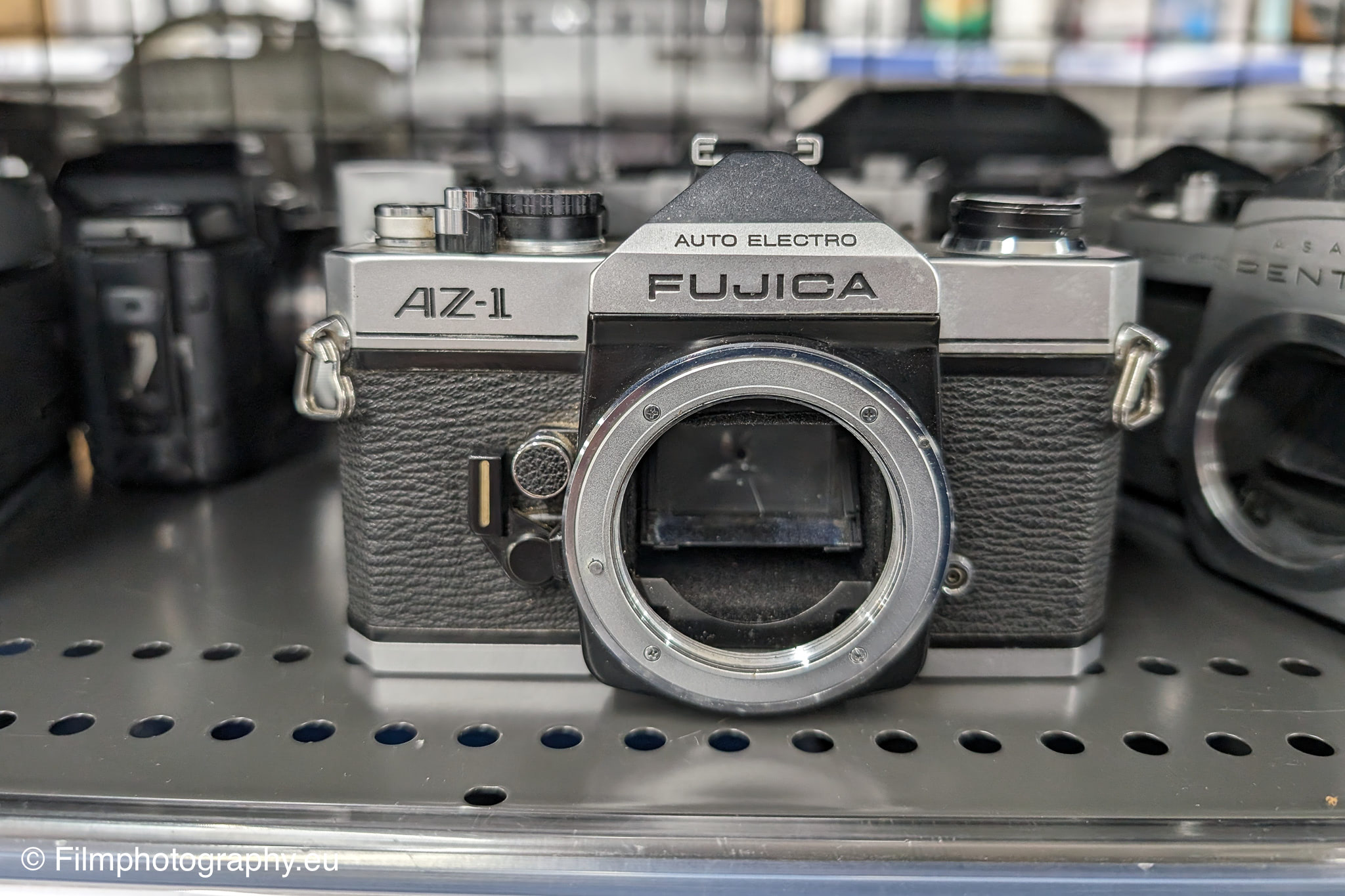
The Fujica AZ-1 is a 35mm single-lens reflex camera (SLR) introduced in 1978 by the Japanese manufacturer Fuji Photo Film Co. (now Fujifilm). It holds a special significance in the manufacturer's history, as it represents the last camera model produced by Fuji with the classic M42 screw mount, before the company switched to its own X-mount.
Development history and market positioning
The Fujica AZ-1 came onto the market at a time when the M42 thread, which had been considered a universal standard for decades, was nearing the end of its relevance. Many manufacturers were switching to more modern bayonet mounts at this time to allow faster lens mounting and easier transmission of exposure data.
Fuji developed the AZ-1 as a technologically advanced camera within this waning system by integrating modern electronic components. A special feature at the point of sale was that the camera was often offered in a package with a compact standard zoom lens, which was still unusual for SLR cameras at the time.
Exposure control and shutter
The camera features a hybrid shutter system that can be controlled both electronically and mechanically. In automatic operation, the camera works with aperture-priority auto exposure. In this mode, the electronically controlled cloth focal-plane shutter provides stepless shutter speeds from 1/2 second to 1/1000 second.
If the power supply fails, the camera has a mechanical emergency mode. In this case, the photographer has the fixed mechanical shutter speeds of 1/60 second (also the flash sync speed), 1/250 second, 1/1000 second, as well as manual long exposure (B). This selection allows reliable manual exposure using the classic estimate rule even without battery power.
Exposure metering and viewfinder system
Exposure metering is done through the lens (TTL) using highly sensitive silicon photodiodes. The system measures brightness with center-weighted integral metering at full aperture. A special feature of the exposure control is the exposure memory lock (AE-Lock). By partially pressing the shutter button, the camera stores the measured light value as long as the finger remains on the shutter button. This facilitates shots in strong backlight or high contrast. Additionally, an exposure compensation dial is available, allowing corrections of plus or minus two stops.
The optical pentaprism viewfinder offers 0.96x magnification and covers approximately 90 percent of the field of view vertically and 92 percent horizontally (measured with a 55mm standard lens). Focusing is supported by a three-part focusing screen featuring a split-image rangefinder, a microprism ring, and a matte surrounding area. The determined shutter speed is displayed in the viewfinder via a vertical scale illuminated by seven red light-emitting diodes (LEDs).
Lens mount and the standard zoom lens
The lens mount is the widely used M42 screw thread. To use the camera's full-aperture metering, original Fujinon lenses must be used, which have a small mechanical transfer lug on the aperture ring. M42 lenses from other manufacturers can also be mounted, but require stopped-down metering by manually stopping down the aperture.
As the standard kit lens, alongside the classic prime lenses (such as the Fujinon 50mm f/1.4 or 55mm f/1.8), the newly developed Fujinon-Z 43-75mm f/3.5-4.5 zoom lens was often supplied. This compact and lightweight zoom lens covered the most frequently used focal length range and was mechanically very short, making it barely larger than a standard prime lens.
Accessories and power supply
The Fujica AZ-1 is prepared for the attachment of a motor film advance. The separately available Fujica Auto Winder allows automatic sequence shooting at up to two frames per second after attachment.
For flash photography, the camera has an accessory shoe with center contact as well as a classic PC sync socket. When using the special system flash Fujica Auto Strobo 300X, the camera automatically sets the shutter speed to the sync speed of 1/60 second when the switched-on flash unit is slid into place.
Power for the exposure meter and electronic shutter control is supplied by three button cells of type LR44 or SR44 (eBay / Amazon*), which are located in a compartment on the back next to the viewfinder eyepiece.
Size and weight
The camera's robust metal body was available by default in a silver-black finish and in a rarer all-black lacquered variant. The body dimensions are 133 mm in width, 87 mm in height, and 50 mm in depth, with a weight of 580 grams without lens and batteries.
Brief film recommendation
One option for color images is the Kodak Ultramax 400* and the Ilford XP2 Super* for black-and-white photos.