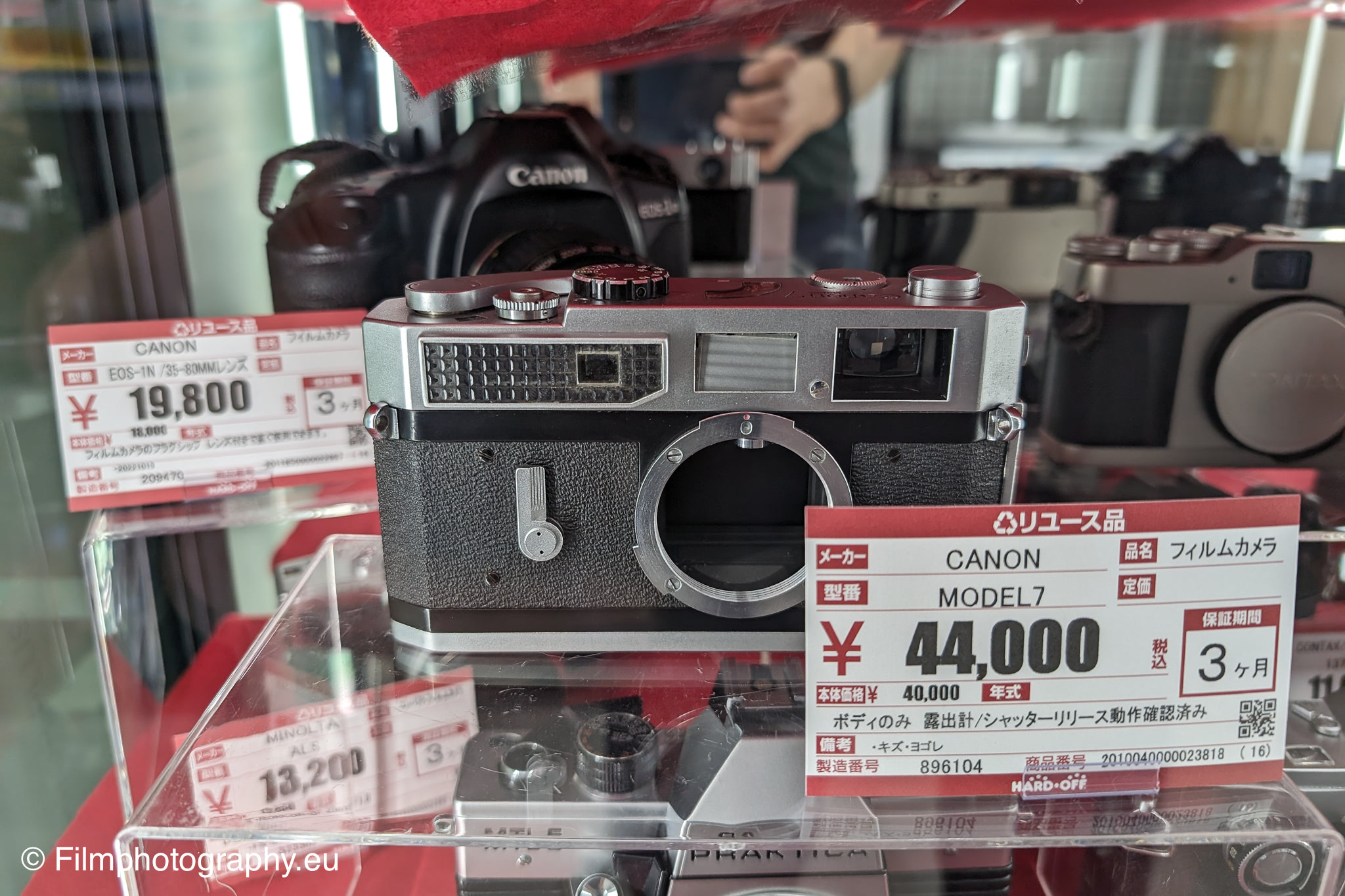
The Canon 7 hit the market in September 1961 and was presented alongside the well-known Canonet at photokina. As the successor to the Canon VI series, it was the first model from the Japanese manufacturer to bear an Arabic numeral in its name.
At the beginning of the sixties, SLR cameras were gaining noticeable popularity, yet Canon continued to rely on the proven concept of a fast and quiet rangefinder camera for reportage photography. Until production ended in 1964, when it was finally replaced by the Canon 7s, it enjoyed great popularity.
A central feature of the camera is its versatile lens mount. In addition to the classic M39 screw thread, the Canon 7 has an additional external bayonet with three claws. This design was specially developed to securely attach particularly large optics such as the fast Canon 50mm f/0.95 and the Mirror Box 2 to the body.
Since the camera operates purely mechanically, focusing is done manually via the integrated split-image rangefinder with an effective measuring base of 47.2 millimeters.
The viewfinder offers 0.8x magnification and features adjustable bright-line frames for focal lengths of 35 mm, 50 mm, 85 mm, or 100 mm, as well as 135 mm. The selected frames automatically correct parallax error when focusing, which noticeably facilitates precise image composition in close-up ranges.
On the front of the body, the large selenium light meter immediately catches the eye. This measuring cell converts incoming light directly into electricity, which is why the entire camera works without a single battery.
The light meter covers film speeds from ISO 10 to ISO 400 and can be switched between two sensitivity ranges for bright and subdued light. Based on the measuring needle on the top of the body, shutter speed and aperture can be adjusted fully manually.
The horizontal focal-plane shutter with robust metal curtains allows exposure times from a full second to 1/1000 second. For long exposures, the Bulb and Time settings are available. Flash units can be connected via the side PC socket with a sync speed of 1/60 second. Because the internal metering mechanism takes up a lot of space, Canon omitted the classic accessory shoe on this body.
With dimensions of 140 x 81 x 31 millimeters and a weight of 865 grams in combination with the 50mm f/0.95, the rangefinder camera sits comfortably and stably in the hands.
The transport lever advances the film to the next frame with a short 140-degree throw, while the mechanical frame counter automatically resets to zero when the back is opened. A practical locking ring on the shutter release protects against accidental shots in the pocket.
For shake-free images from a tripod, photographers can use both the integrated tripod socket and the mechanical self-timer or a conventional cable release.
Films for the Canon 7
The Canon 7 is fed with conventional 35mm film, on which it exposes negatives in the standard format of 24 x 36 millimeters. The range of film material is still diverse today.
For colorful subjects, for example, the Fujifilm Superia 400* is suitable. If you prefer the classic black-and-white look, you can opt for the Ilford Delta 400*.
Both films offer a wide latitude for changing light conditions and typically provide 36 exposures per cartridge. After exposure, the film is rewound into the cartridge using a fold-out crank. Color negative films can be easily developed in almost any photo lab using the standardized C-41 development process.
Today, the Canon 7 is only found on the used market. Before purchasing, it is advisable to take a close look at the responsiveness of the selenium cell and the condition of the delicate metal shutter blades.
If the body shows no major damage, this classic continues to deliver reliable analog image results many decades after its introduction.