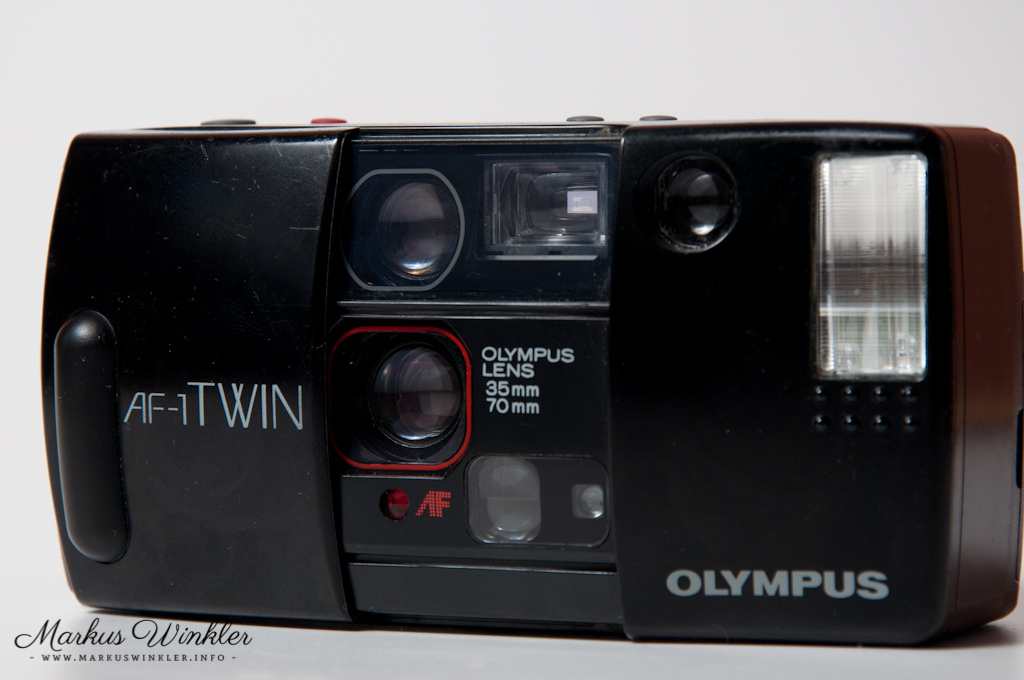
The Olympus AF-1 Twin is a compact camera. It was presented by Olympus in the late 80s and sold under the name “Olympus Infinity Twin” in the USA.
The Olympus AF-1 Twin is designed for 35mm film. It is black in color and its design is strongly inspired by the Olympus AF-1.
The special feature of the camera is its lens, or rather the two lenses. It has two superimposed lenses with different focal lengths (35 mm f3.5 and 70 mm f6.3).
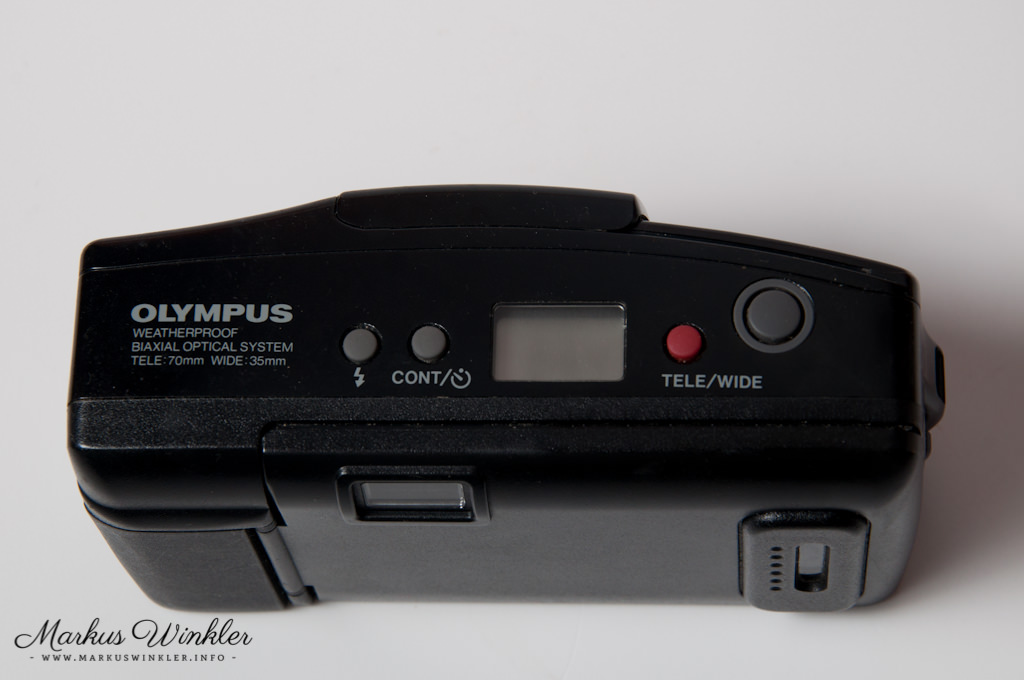
Now, if you want to shoot a distant subject, you switch to the 70 mm lens. In short, a very simple zoom. Another special feature at the time was the water resistance of the Olympus AF-1 Twin.
Otherwise, it is very similar to other compact cameras of the time. Thus, it works practically without much intervention from the photographer. It finds out the film speed by DX coding, then it sets the exposure by itself and the film is also transported automatically.
A CR123 3V battery (eBay / Amazon*) serves as the power source. A tripod mount is used for low-light shooting, and a self-timer can also be turned on.
When you’re done shooting, a cover, like the one on the Olympus XA, slides in front of the lenses and viewfinder. The Olympus AF1 Twin was manufactured in Japan.
In principle, all available 35mm film can be used in the Twin. However, the camera only recognizes the sensitivity for films between ISO 50 and ISO 3200. A good color film for the camera is the Kodak Ultramax 400*. If you’re more into black and white, you can go for the solid Kentmere 100*. Both films are a good choice for the camera. You can usually fit 36 images on a roll, so in some cases even one or two images more.
The Olympus AF-1 Twin also has a little sister, the Olympus AF-10 Twin.
Technical datasheet
| Attribute | Specification |
|---|---|
| Type of Camera | Viewfinder camera |
| Film format | 35mm |
| Film transport | Automatic |
| Film transport mechanism | Motor |
| Picture format | 24 mm x 36 mm |
| Focal length | 35 mm |
| Widest aperture | f/3.5 |
| Focus | Autofocus |
| Exposure times | 1/730 second to 1/15 second |
| Light meter | Yes |
| Supported film speeds | ISO 50 to 3200 |
| Exposure modes | Program automatic |
| Manual exposure settings | No |
| Auto DX (Film sensitivity) | No |
| Date imprinting | No |
| Flash | Integrated flash |
| Tripod mount | Yes |
| Cable release thread | No |
| Self-timer | No |
| Power supply | 1x CR123A battery |
| Names in other markets | USA: Olympus Infinity Twin |
| Country of production | Japan |
| Estimated value / Used price | 71,22 Euro Estimate based on used prices of 96 offers (possibly with different scope of delivery and/or condition). As of June 15, 2026 |
| Average used price in the year 2023 | 90,03 Euro (97.42 US-Dollar) |
| Average used price in the year 2024 | 81,44 Euro (87.67 US-Dollar) |
| Average used price in the year 2025 | 72,88 Euro (77.93 US-Dollar) |
FAQ about the Olympus AF-1 Twin
What kind of film does this Olympus camera use?
The Olympus AF-1 Twin uses 35mm film. It automatically detects the film speed using DX coding, simplifying the shooting process. You can use various 35mm films, but the camera optimally reads ISO 50-3200.
How does the zoom function on the camera work?
This compact camera has a unique dual-lens system. It features two lenses: a 35mm and a 70mm. You simply switch between them for different focal lengths, acting like a basic zoom.
Does the camera have any special features?
Yes! The Olympus AF-1 Twin is known for its water resistance, a notable feature for its time. It also has a self-timer and a tripod mount for low-light photography.
What kind of battery does the small camera need?
The Olympus AF-1 Twin runs on a CR123 3V battery. This battery type is quite common and readily available.
Is the camera easy to use?
Absolutely! The camera is designed for ease of use. It automatically sets the exposure and advances the film, requiring minimal user intervention. It's a great point-and-shoot.