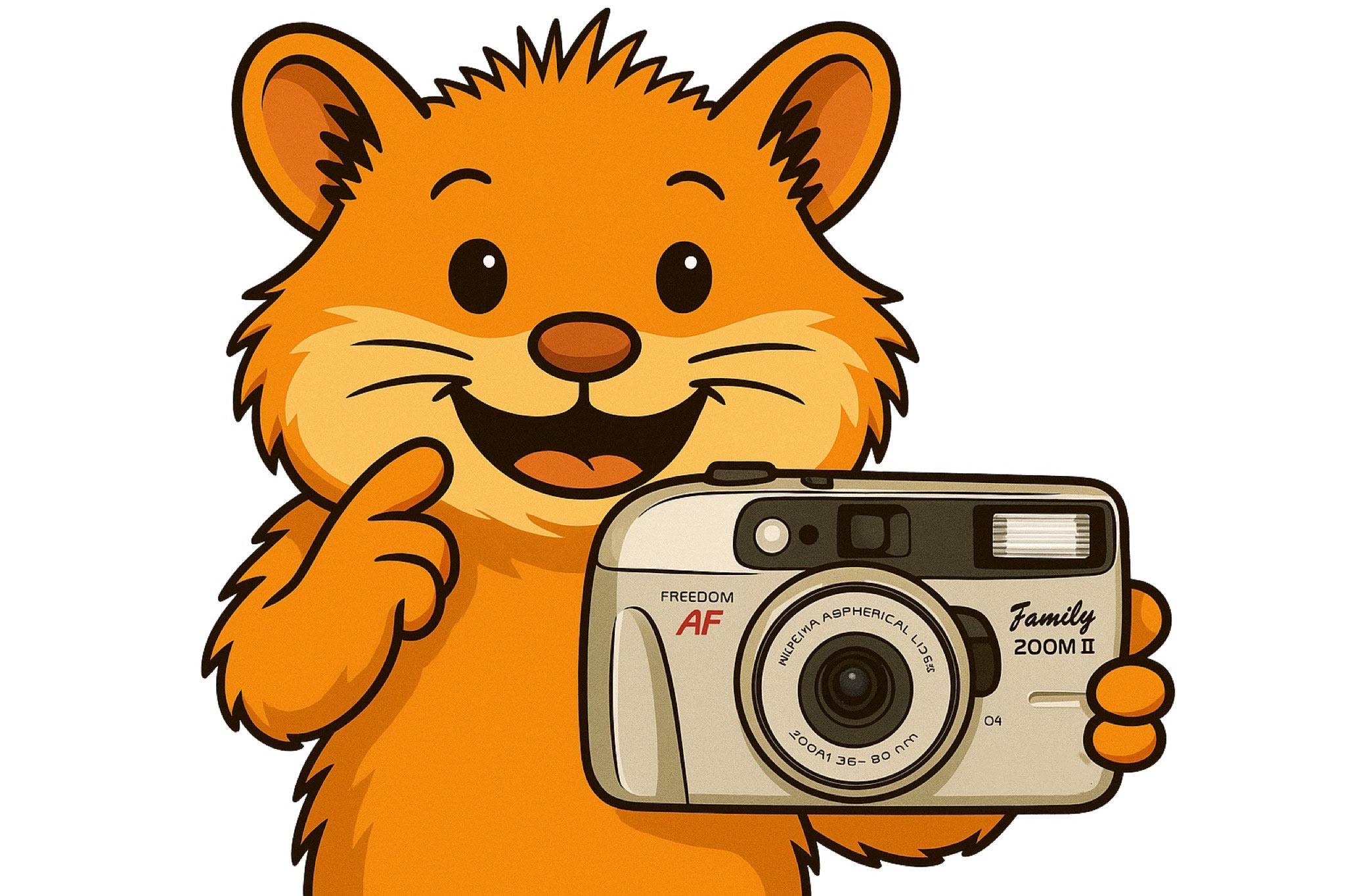
The Minolta Freedom Family Zoom II is a 35 mm camera. It belongs to the group of point-and-shoot cameras. It was introduced by the Japanese manufacturer in the early 2000s and sold on the American market. The 35mm camera was also sold under the name "Minolta Freedom Action Zoom 60".
The 35mm photo camera comes with a zoom lens. The zoom range, controlled by a toggle switch, goes from 35mm to 60mm. The maximum aperture is f/5.3 (35mm) and f/8.4 (60mm). The 35 mm camera has autofocus. The closest focusing distance of this lens is 130 cm. At 60 mm, you have to keep at least 160 cm away from the subject.
Taking pictures is made easier by the built-in light meter. The light meter was built for films with a sensitivity of ISO 100, ISO 200 or ISO 400. The Minolta Freedom Family Zoom II determines the correct film speed via the DX code. Exposure is set automatically by the camera. Shutter speed or aperture cannot be selected by the photographer. There are also no exposure modes for the user to choose from.
A flash is installed for pictures in low light. According to the manual, the power of the flash reaches up to 3 meters at ISO 100. The flash comes with an automatic for red-eye reduction. Additionally, there is a fill-in flash and the option to turn the flash off completely.
The 35mm camera has a built-in self-timer and a thread for a tripod. A camera strap can also be attached to the side of the camera.
The dimensions of the model are 12.8 x 7.3 x 4.9 cm. At the same time, it weighs 235 grams with its plastic housing. The camera requires a CR123A battery (eBay / Amazon*). This type of battery is still easy to get today. The batteries last for about 360 pictures.
In addition to the normal version, there was a Quartz Date model. This model can additionally imprint the recording time in a corner of the pictures if desired. The function can also be disabled if desired.
Films for the Minolta Freedom Family Zoom II
The Minolta Freedom Family Zoom II requires 35mm film. These films are still manufactured and can be specified at almost any provider of development work. The film is transported by a motor. The film is rewound either automatically at the end or by pressing the small button on the top of the camera.
One possibility for B&W images is the Ilford XP2 Super*. A possible film for color images is the Kodak Ultramax 400*. The two can convince in test reports and are well suited for everyday use.
The color film is a color negative film and is developed in the C-41 process. This is offered by almost every photo lab.