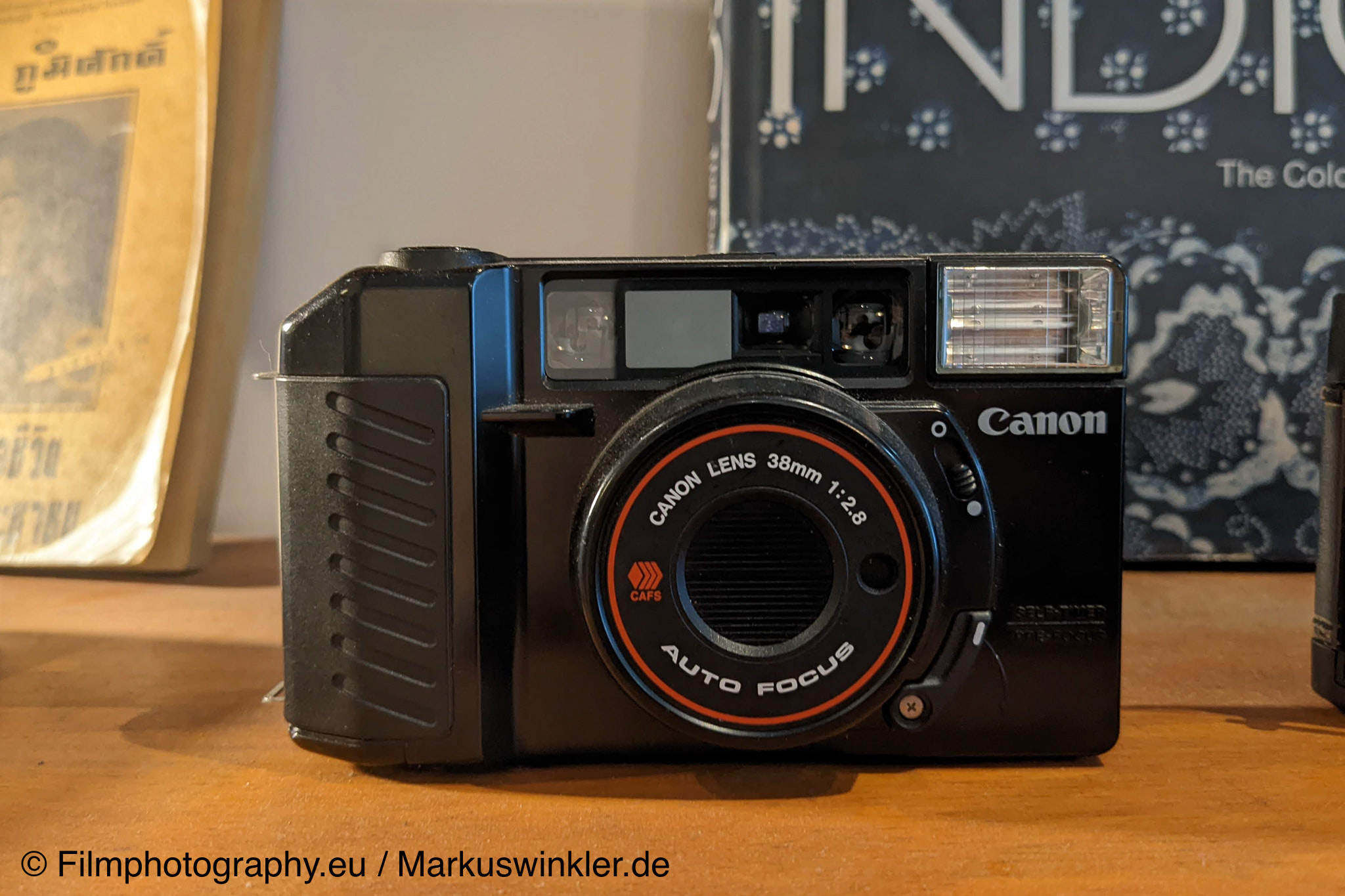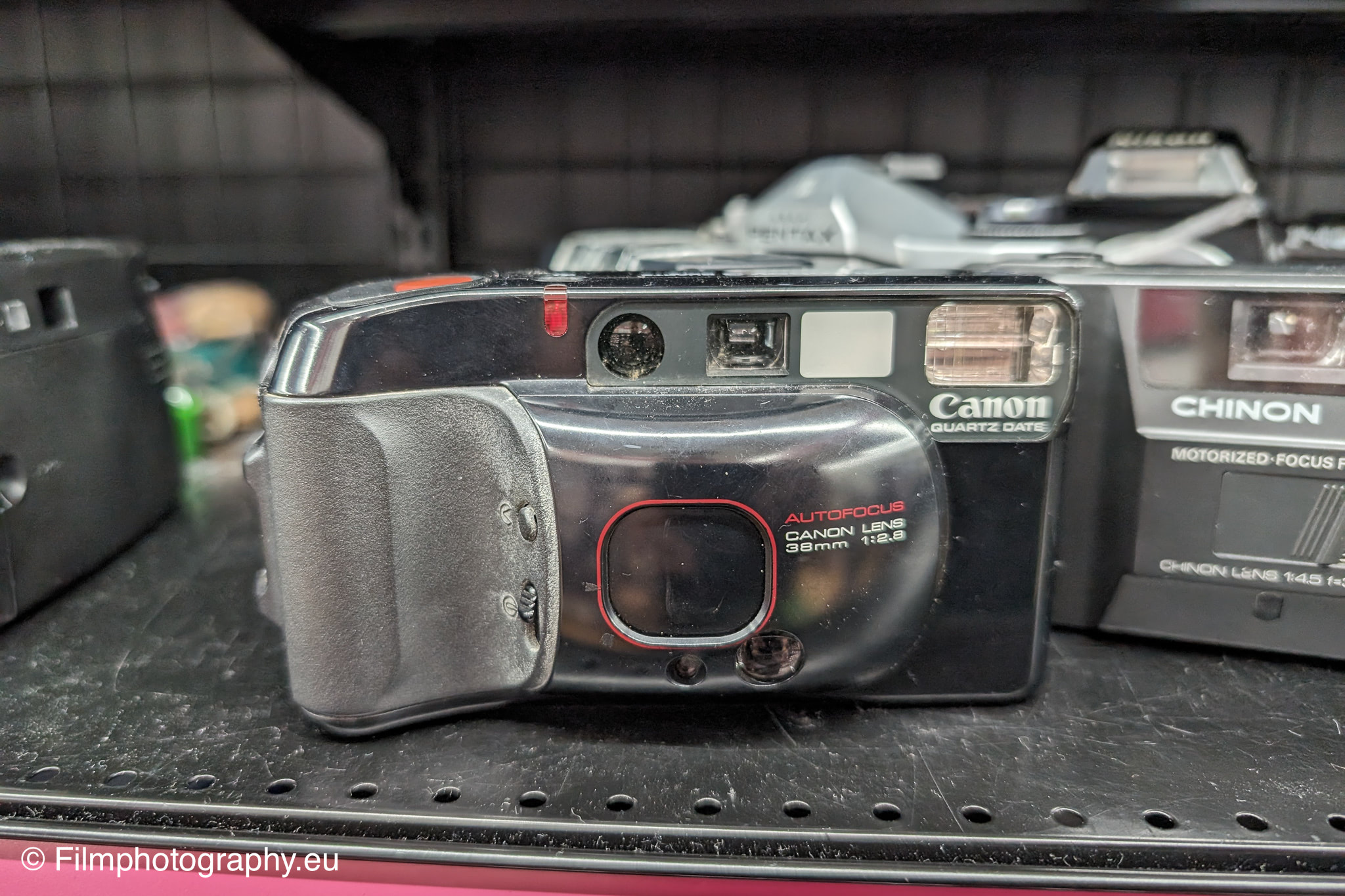
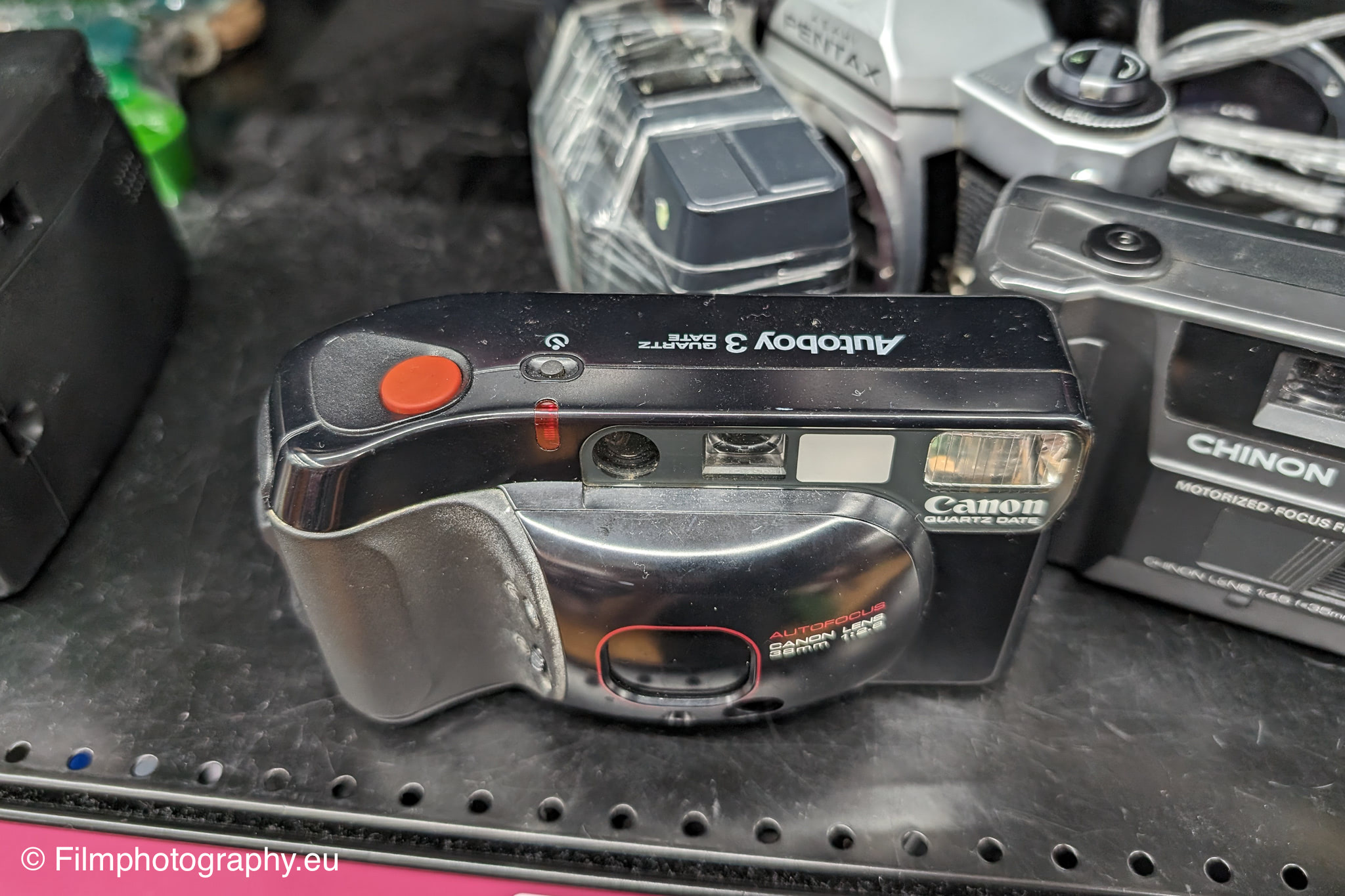
The Canon Autoboy 3 is an analog compact camera for the 35mm format. It was introduced on the Japanese market in June 1986. As the successor to the Autoboy 2, it represents the 3rd generation of this product line.
Canon designed the model as a fully automatic camera with a fixed lens. A distinctive feature is the curved body with a slightly inclined grip on the right side. This shape is intended to support a natural posture when taking photos and prevent cramping of the hand.
In Japan, the launch price was 39,800 yen for the standard version and 44,800 yen for the version with an integrated data back. The latter version offers the additional possibility of immortalizing the shooting date in the photos.
The technical equipment includes a Canon lens with a focal length of 38 mm and an aperture of f/2.8. The optical construction consists of 4 lenses in 4 groups. Focusing is done via an active infrared autofocus system with triangulation measurement.
Exposure is controlled by an electronic program shutter that selects speeds between 1/8 second at aperture f/2.8 and 1/500 second at aperture f/16. Film sensitivity is read via the DX code in the range of ISO 50 to ISO 1600.
The built-in flash switches on automatically in insufficient light or backlight. There is also a self-timer on the 35mm camera.
The power supply of the Canon Autoboy 3 is provided by a 2CR5 battery (eBay / Amazon*). This type of battery can still be bought today.
Films for the Canon Autoboy 3
According to the instruction manual of the Canon Autoboy 3, 35mm films are exposed. 35mm films are still available and can be developed without any problems at most external photo labs.
A color film for the 35mm camera would be the Fujifilm Superia 400*. A possible film for black and white images is the Ilford XP2 Super*.