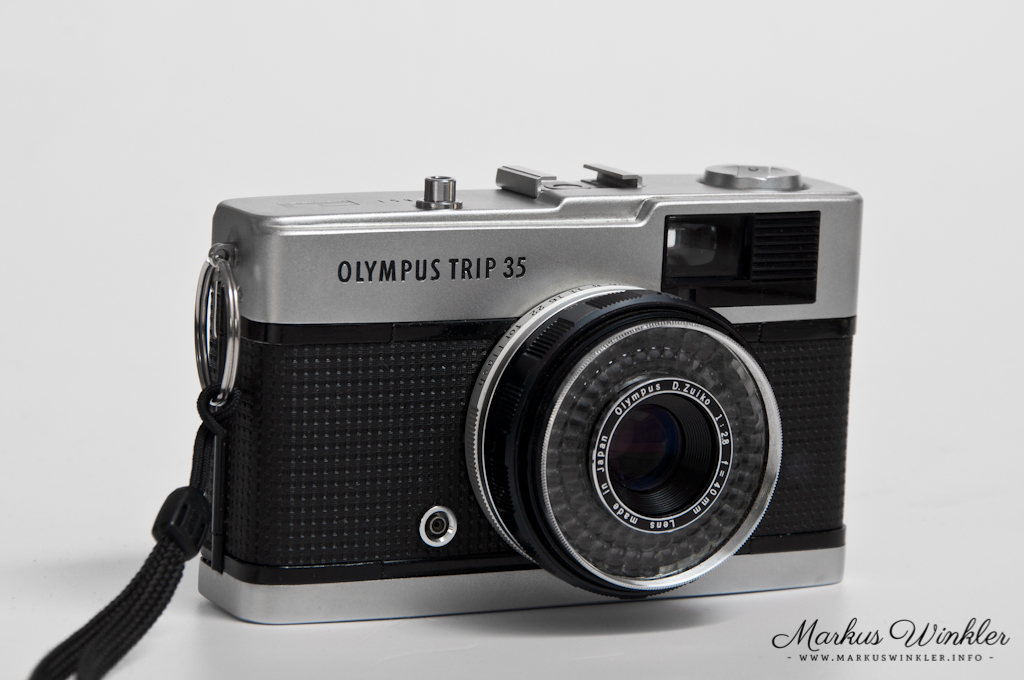
The Olympus Trip 35 is a 35mm camera. It was launched in 1968 and was built over a long period of time. In the more than 15 years until the end of production, Olympus produced more than 10 million Trip 35s.
As you can infer from the name, the 35mm camera was aimed at users who were looking for a good compact camera for their vacation.
The body is largely made of metal, which makes it a bit heavier, but also more robust. It weighs around 400 grams with a size of 116 x 57 x 70 mm. The design of the viewfinder camera is black and chrome. However, it was also available completely in black.
The viewfinder camera is equipped with a 40 mm fixed focal length. Filters can be screwed to the 43.5 mm mount. The coated four-lens (4 elements in 3 groups) has a maximum aperture of f/2.8 and delivers a surprisingly good image quality.
The aperture can be controlled either manually from f/2.8 to f/22 or automatically. A light meter is built into the Trip 35 for this purpose. The light is measured with the help of soul cells, which are mounted around the lens. The big advantage of these is that they don’t need batteries and you don’t have to buy rare batteries. The disadvantage is that they measure somewhat incorrectly over time and eventually stop working altogether.
If you set the aperture wheel to “A”, the camera sets the aperture itself. If it is too dark and f/2.8 and 1/40 s are no longer sufficient, the shutter locks and a warning appears in the viewfinder.
Focusing is also manual using zone focus, for which there are meter and feet indications around the lens. You can get up to 1 meter close to your subject with the Olympus Trip 35. The viewfinder is not connected to the lens, but you can see the pictograms for focusing through it, so you don’t have to take the camera away from your eye.
The Olympus Trip 35 is loaded with standard 35mm film. The ISO value of the film is set on the lens, the possible range is from ISO 25 to ISO 400. Earlier models only went up to ISO 200. How many pictures you have taken is displayed on the top of the camera.
Multiple and double exposures are not possible, as the Trip 35 has a double exposure lock. You can, of course, expose a film, rewind it, and then expose it again.
A flash can also be used with the Olympus. There are two options here, either normal via hot shoe or via PC flash connection. The Olympus Trip 35 has a connection for a tripod and a cable release.
Technical datasheet
| Attribute | Specification |
|---|---|
| Type of Camera | Viewfinder camera |
| Film format | 35mm |
| Film transport | Manual |
| Picture format | 24 x 36 mm |
| Lens name | Olympus D.Zuiko 1:2.8 f = 40 mm Lens |
| Focal length | 40 mm |
| Widest aperture | f/2.8 |
| Minimum focus distance | 100 cm / 3.28 ft |
| Focus | Manual |
| Filter thread | 43.5 mm |
| Lens design | 4 elements in 3 groups |
| Exposure times | 1/200 second, 1/40 second |
| Light meter | Yes |
| Double and/or multiple exposure function | No |
| Built-in flash | No |
| Flash Connection | Hot Shoe, PC-Flash |
| Tripod mount | Yes |
| Cable release thread | Yes |
| Self-timer | No |
| Power supply | Not necessary |
| Size | 11,6 x 5,7 x 7 cm |
| Dimensions in inches | 4.57 x 2.24 x 2.76 inches |
| Weight | 400 Grams |
| Country of production | Japan |
| Estimated value / Used price | 95,69 Euro Estimate based on used prices of 100 offers (possibly with different scope of delivery and/or condition). As of June 15, 2026 |
| Average used price in the year 2023 | 69,69 Euro (74.69 US-Dollar) |
| Average used price in the year 2024 | 68,48 Euro (73.60 US-Dollar) |
| Average used price in the year 2025 | 81,46 Euro (87.67 US-Dollar) |
FAQ about the Olympus Trip 35
How heavy is the Olympus Trip 35 camera, and what are its dimensions?
The Olympus Trip 35 weighs approximately 400 grams. Its dimensions are 116 x 57 x 70 mm, making it a compact and portable camera.
Does this compact camera need batteries to work?
No, the Olympus Trip 35 uses selenium cells for light metering. This means it doesn't require batteries for exposure measurement, though the accuracy can decrease over time.
How do I focus the camera, and what's the closest focusing distance?
The Olympus Trip 35 uses zone focusing with meter and feet markings around the lens. You can focus as close as 1 meter to your subject.
Can I use a flash with the Olympus Trip 35?
Yes, you can use a flash with this 35mm camera. It offers two options: a standard hot shoe or a PC flash connection.
What is the lens's focal length and aperture range?
The Olympus Trip 35 has a fixed 40mm lens with a maximum aperture of f/2.8. The aperture can be adjusted manually from f/2.8 to f/22 or automatically using the built-in light meter.