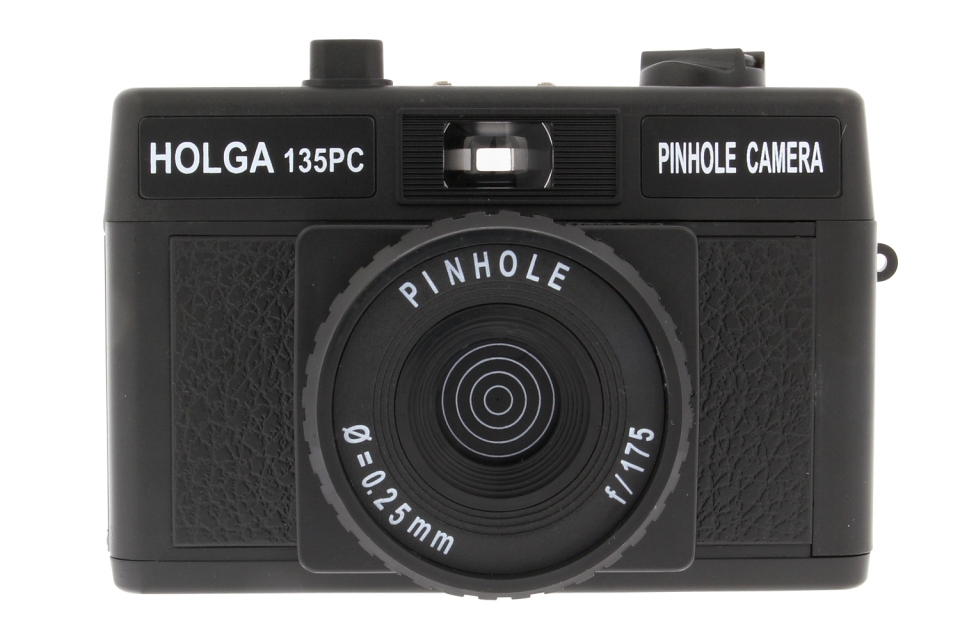
The Holga 135 PC is a 35mm camera made of plastic. It is almost identical to the Holga 135 in terms of functions and appearance. The big difference is that it is a pinhole camera. That is, instead of passing through a lens, the light passes through a tiny hole.
The Holga 135 PC only has a bulb mode. In this, the shutter stays open and light falls on the film as long as the shutter release button is pressed. For blur-free shooting, it also has a standard tripod mount and a port for a cable release.
The pinhole aperture has a diameter of 0.25 mm. The aperture is specified as f/172. Batteries are not needed for the mechanical camera. The camera uses normal 35mm film (eBay / Amazon*).
Technical datasheet
| Attribute | Specification |
|---|---|
| Type of Camera | Pinhole camera |
| Film format | 35mm |
| Film transport | Manual |
| Film transport mechanism | Thumbwheel |
| Picture format | 24 mm x 36 mm |
| Focal length | - |
| Widest aperture | f/172 |
| Focus | Fixed |
| Exposure times | Bulb |
| Bulb mode | Yes |
| Manual exposure settings | No |
| Date imprinting | No |
| Built-in flash | No |
| Flash Connection | Hot Shoe |
| Tripod mount | Yes |
| Cable release thread | Yes |
| Self-timer | No |
| Power supply | Not necessary |
FAQ about the Holga 135 PC
Is the Holga 135 PC a difficult camera to use?
No, it's quite simple. It only has a bulb mode, meaning you hold down the shutter button to take a picture. There are no complex settings to adjust.
What kind of lens does this little camera have?
It's a pinhole camera, so it doesn't have a traditional lens. Instead, light enters through a tiny hole, creating a unique photographic effect.
Does the camera need batteries?
No, the Holga 135 PC is entirely mechanical. It doesn't require batteries to operate.
How do I take sharp pictures with this plastic camera?
Because it's a pinhole camera, you'll need to use a tripod for sharp images. The long exposure times in bulb mode make it essential to avoid camera shake.
What's the aperture size on this device?
The pinhole aperture has a diameter of 0.25 mm, resulting in a very small aperture of f/172. This creates a large depth of field.