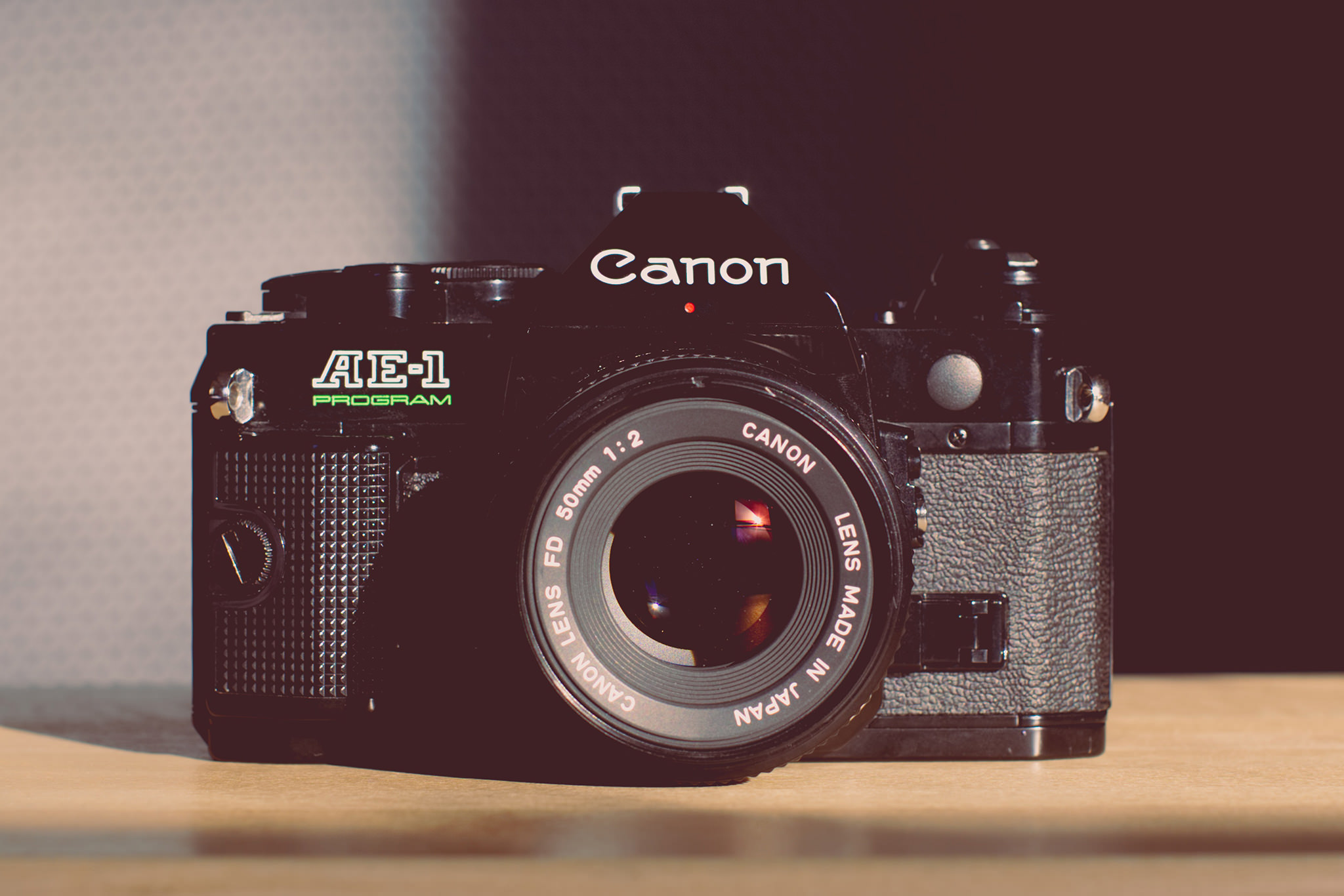
The Canon AE-1 Program is an SLR camera. It is the successor to the Canon AE-1 and was introduced five years after the extremely successful Canon model. The biggest innovation was, as the name suggests, the program automatic, which was adopted from the Canon A-1.
The lens of the Canon AE-1 Program is interchangeable. Lenses with a Canon FD bayonet (New FD) can be used. The Canon New FD 50mm f/1.4 SSC is often found with the 35mm camera. But also the Canon New FD 50mm f/1.8 SC is not an uncommon combination. The camera or the lenses do not have an autofocus.
The Canon AE-1 Program is equipped with a built-in light meter. This is designed for an ISO range of 12 to 3200. The metering of the exposure takes place through the lens on the SLR camera. The Canon AE-1 Program can set the aperture and exposure time automatically (program automatic). There is also a time preselection (photographer = exposure time; camera = aperture) and a completely manual mode for taking pictures.
The camera comes with a Bulb mode. This allows the shutter to remain open for a variable amount of time to expose the film. An external flash can be connected to the hot shoe. In addition, there is a PC flash socket.
Films for the Canon AE-1 Program
What kind of films are needed for the Canon AE-1 Program? You have to buy 35mm films for the camera. 35mm film is still produced today and can be developed in most labs. A 35mm film for color photography is the Fujifilm Superia 400. A possible black and white film is the Ilford XP2 Super.
The color film is designed to be developed in the C-41 process. The C-41 process is performed by almost all photo labs. For example, you can take your film to most drug stores for development.
The Canon AE-1 Program has a built-in self-timer and a connection option for a cable release. In addition, there is a thread for a tripod. The dimensions of the housing are 14.1 x 8.8 x 4.8 cm. It weighs in at 565 grams. The camera requires an LR44 battery .