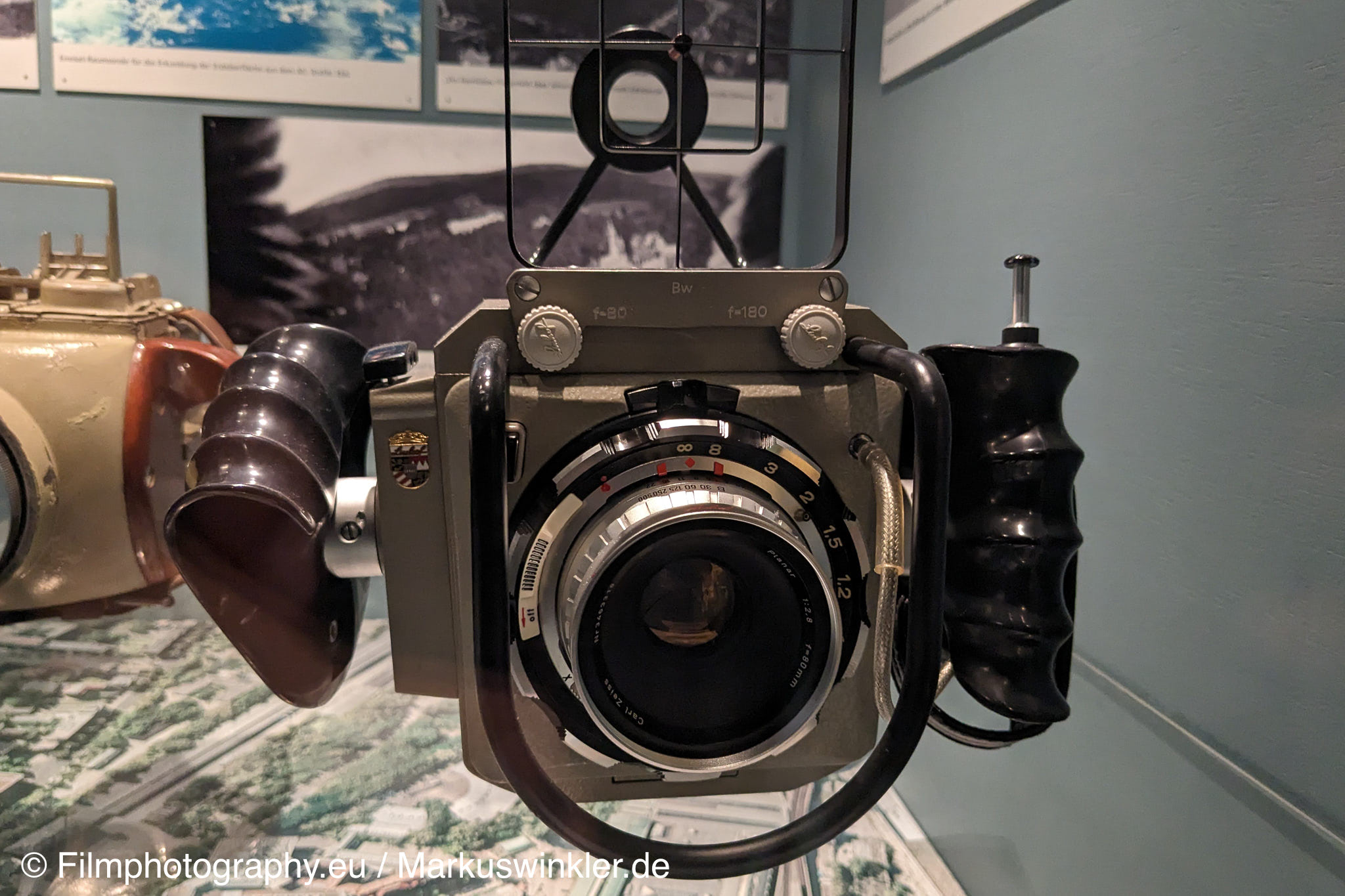
The analog aerial camera, a technological marvel of its time, played a crucial role in the development of aerial photography. These specialized cameras, designed to capture images from a bird's-eye perspective, were the heart of this fascinating field of photography until the introduction of digital systems.
The history of aerial photography dates back to the 19th century, long before the airplane saw the light of day. Photography pioneers experimented with balloons and kites to capture breathtaking images from the air.
1858: The visionary French photographer Nadar, whose civil name was Gaspard-Félix Tournachon, ascended in a hot air balloon over Paris and took the first aerial pictures of the city, astonishing the world.
1860: James Wallace Black, another pioneer of aerial photography, followed Nadar's example and photographed the city of Boston in the USA from a balloon, opening a new perspective on the city.
1903: Julius Neubronner, an ingenious pharmacist and amateur photographer, developed a revolutionary method to attach small cameras to carrier pigeons. These feathered photographers delivered unique aerial images from a perspective previously unimaginable.
With the invention of the airplane at the beginning of the 20th century, a new era in aerial photography began. The airplane provided a stable platform for aerial cameras, enabling photographers to cover larger areas and achieve higher resolutions. During World War I, the military recognized the immense potential of aerial photography for reconnaissance purposes.
1914-1918: In World War I, aircraft were systematically used for aerial reconnaissance. Aerial photographs provided valuable information about enemy positions, troop movements, and strategic targets.
1920s and 1930s: After the war, aerial photography was increasingly used for civilian purposes. It revolutionized mapping, urban planning, and archaeological research by providing detailed and accurate images of landscapes and historical sites.
Analog aerial cameras were masterpieces of engineering. They featured large film formats to produce detailed images, fast shutter speeds to freeze motion, and special lenses to minimize distortions caused by perspective and the movement of the aircraft.
Some of the most famous models of analog aerial cameras are:
Zeiss RMK: A series of modular aerial cameras that could be configured for different applications. They were characterized by their high precision and reliability.
Wild RC10: This precision camera was specially designed for photogrammetric mapping, where aerial images are used to create maps and 3D models.
Fairchild K-17: This widely used aerial camera was employed by the US Air Force for a variety of missions, from mapping to reconnaissance.
In the 1990s, the transition from analog to digital aerial photography began. Digital cameras offered higher resolution, faster image processing, and the ability to integrate images directly into geographic information systems (GIS).