In the golden era of photography, in July 1953 to be precise, a new star in the Olympus camera line was born - the Olympus 35 IV a. This model, which was produced until 1955, carried the legacy of its predecessors with pride while introducing some subtle but notable changes that made it an outstanding choice for photography enthusiasts of the time.
Externally, the camera retained much of the aesthetics and design of its predecessor, the Olympus 35 IV. But one noticeable change was the updating of the embossing from "MADE IN OCCUPIED JAPAN" to the modernised and politically adjusted "MADE IN JAPAN", reflecting the burgeoning restoration of Japan as a sovereign nation.
The camera also underwent a reconfiguration in terms of flash synchronisation. While the first version retained the flash connector on the body, similar to the 35 IV, the second version moved the flash contact directly to the shutter. This was a strategic improvement that further optimised the camera's operability.
Features
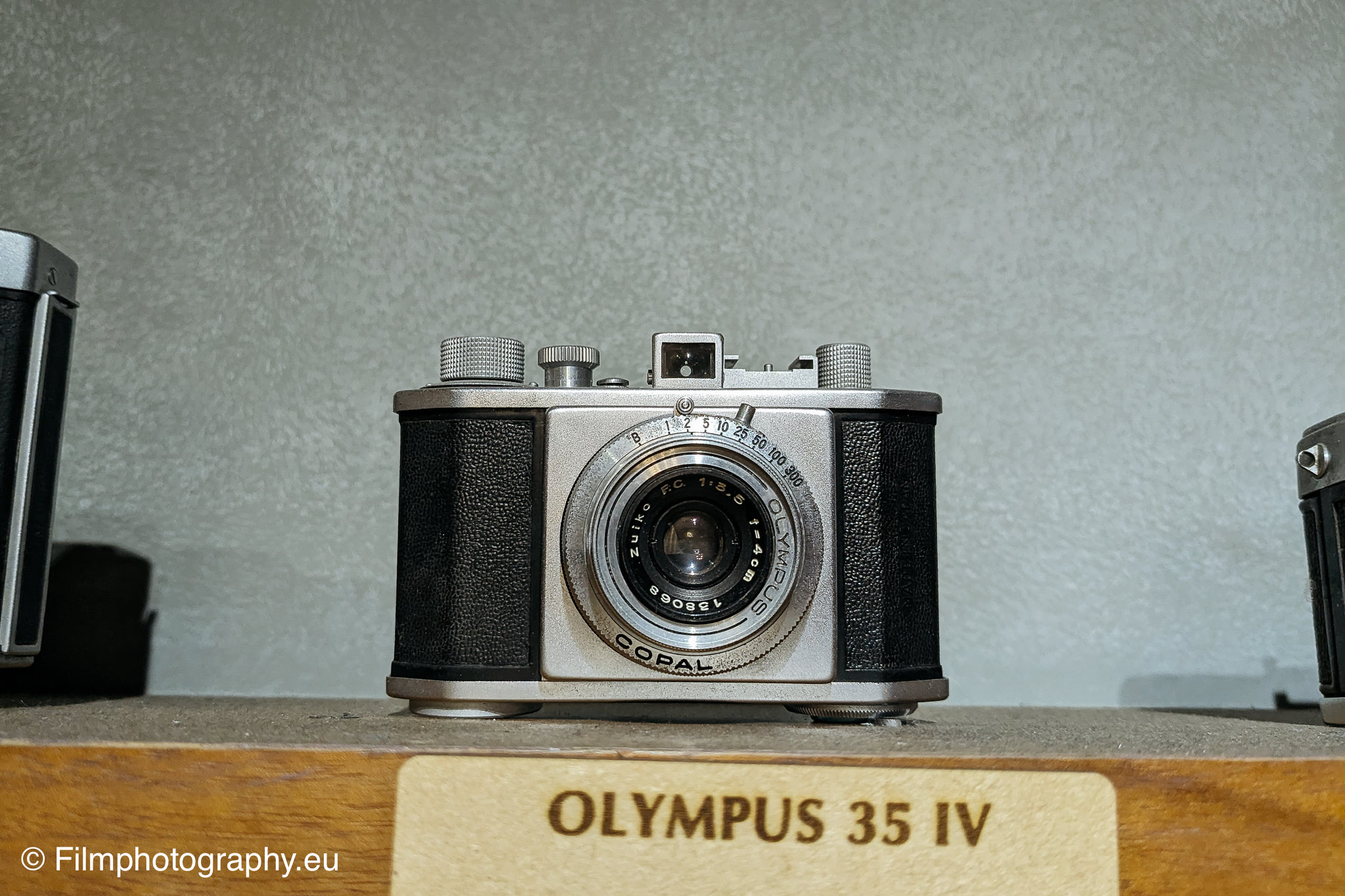
This camera model is equipped with a fixed Zuiko F.C. 1:3.5/4 cm lens that must be manually focused to obtain optimal images. It is advised to maintain a minimum distance of 90 cm from the subject to be photographed to guarantee crisp shots. The maximum aperture is f/3.5 and the focal length measures 40 mm. The smallest aperture value is f/16.
Unfortunately, the unit does not have an included light meter, so an additional device is needed for accurate metering. However, it does offer the option of shooting in Bulb mode, where the exposure time is determined by holding down the shutter button.
In addition, an external flash unit can be connected via the PC flash interface. The Olympus 35 IV a can be easily mounted on a tripod and can be operated with a cable release, with corresponding fixtures on the underside of the housing.
Weighing 530 grams and measuring 11.5 x 8 x 6.6 cm, the camera does not require batteries for operation.
Available films for the Olympus 35 IV a
The Olympus 35 IV a requires 35mm film for operation, a format that continues to play a significant role in the photographic world, which explains the continued production by some manufacturers.
Films currently available that are compatible with this camera include the Kodak ColorPlus 200* for colour images and the Ilford XP2 Super* for black and white images. These films have proven to be versatile, as confirmed by numerous reviews. Of course, there are also many other films that harmonise with this camera model.
The camera exposes an area of 24 mm x 36 mm and can accommodate about 36 exposures on a standard film (135-36). Manual film advance is an essential part of the photographic process with this 35 mm camera.