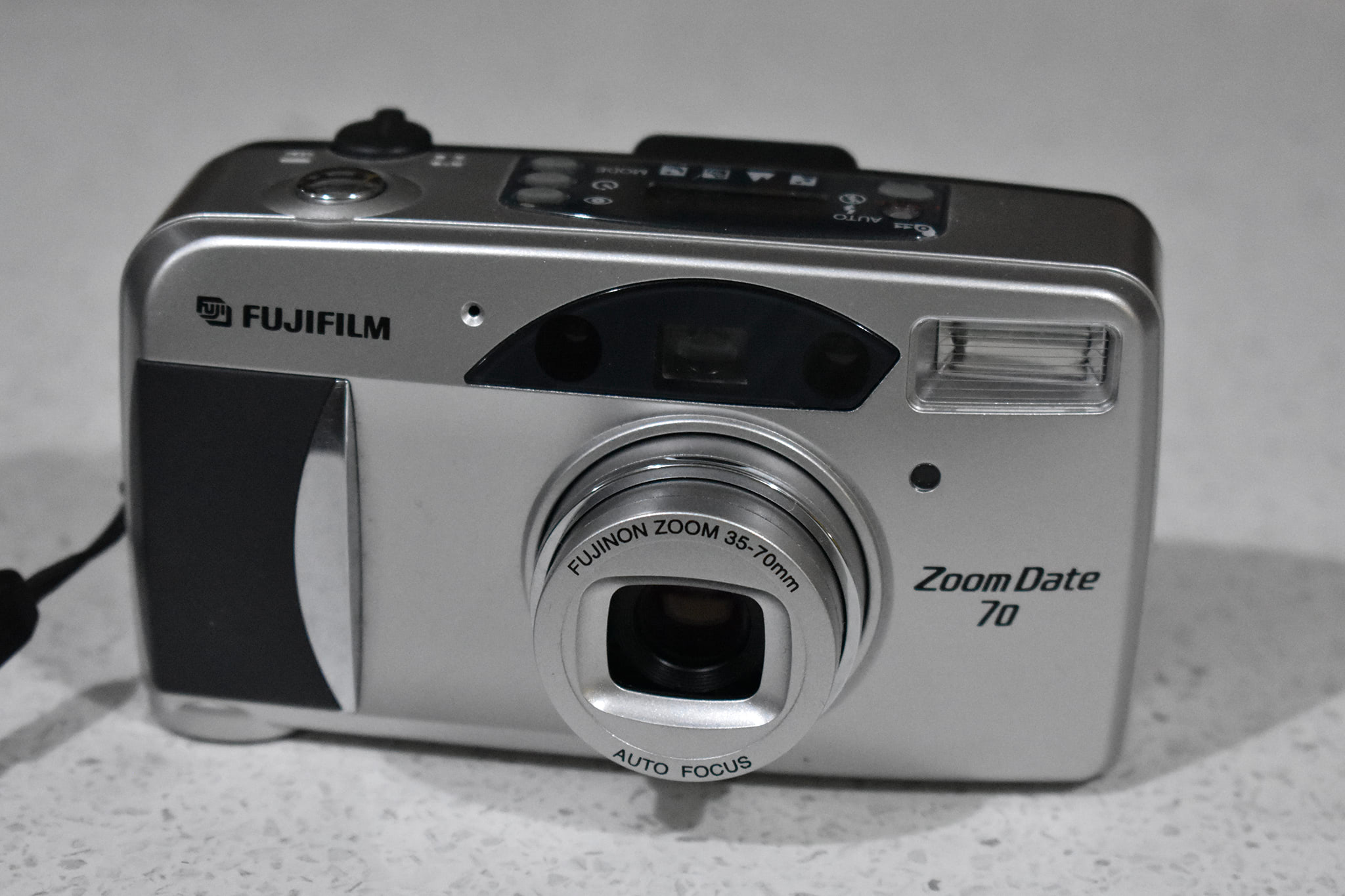
The Minolta Zoom 60 Date is a camera from the 2000s. It is a variation of the Zoom 60. The Date model has the ability to imprint the date the picture was taken. This was a popular feature especially with photographers of snapshots and family gatherings, as you always knew when the picture was taken without having to keep a record. The camera was built in a factory in China.
The camera is equipped with a fixed zoom lens. The zoom range is from 35 mm to 60 mm, hence the model name. This focal length range corresponds to a zoom factor of 1.7. The largest available aperture is f/6.3 (35 mm) or f/10.3 (60 mm). Manual focusing is not required with the 35 mm camera. The camera is equipped with an infrared autofocus system and the close focus limit of the lens is 90 cm.
The 35-mm photo camera has a built-in light meter. It is designed for films with a sensitivity of ISO 100 or ISO 400. The camera determines the correct film speed using the DX code on the film's cartridge. There is automatic exposure control. Aperture and exposure time cannot be selected by the photographer, but are set automatically by the camera's metering system.
In low light conditions, the built-in flash can be used. The flash range is up to 2.2 meters with an ISO 100 film and the widest focal length of 35 mm. The charging time for the flash is about eight seconds. Automatic red-eye prevention is built into this model.
Measuring 11.5 x 6.7 x 3.9 cm, the camera body weighs 185 grams according to the manual. Power for the Minolta Zoom 60 Date is supplied by two AA batteries (eBay / Amazon*). These usually last for 12 rolls of film without any problems. Since AA batteries are very easy to come by, you will rarely be embarrassed to have an empty camera.
The point-and-shoot camera does not have a tripod connection. Instead, there is an automatic self-timer. This has a ten-second lead time that expires after the shutter button is pressed.
Films for the Minolta Zoom 60 Date
What kind of films does the Minolta Zoom 60 Date need? It requires 35mm film. These films are still manufactured and can be specified by almost any developing dealer.
The film is automatically spooled by the camera to the next free frame after each shot. The current number of pictures taken is shown on a display on the top of the camera, along with the battery charge level. When the end of the roll is reached, the film is automatically rewound into the cartridge. This process can also be triggered manually.
Good 35mm films for color and black and white shooting, respectively, are the Kodak Ultramax 400* and the Ilford HP5*. The color film is designed to be developed using the C-41 process. This process is offered by most professional photo labs. The black and white film must go into a developer such as ID-11 or D-76. Of course, you can use other films with your camera. The important thing is that you use a film with ISO 100 or ISO 400 that also has DX encoding.