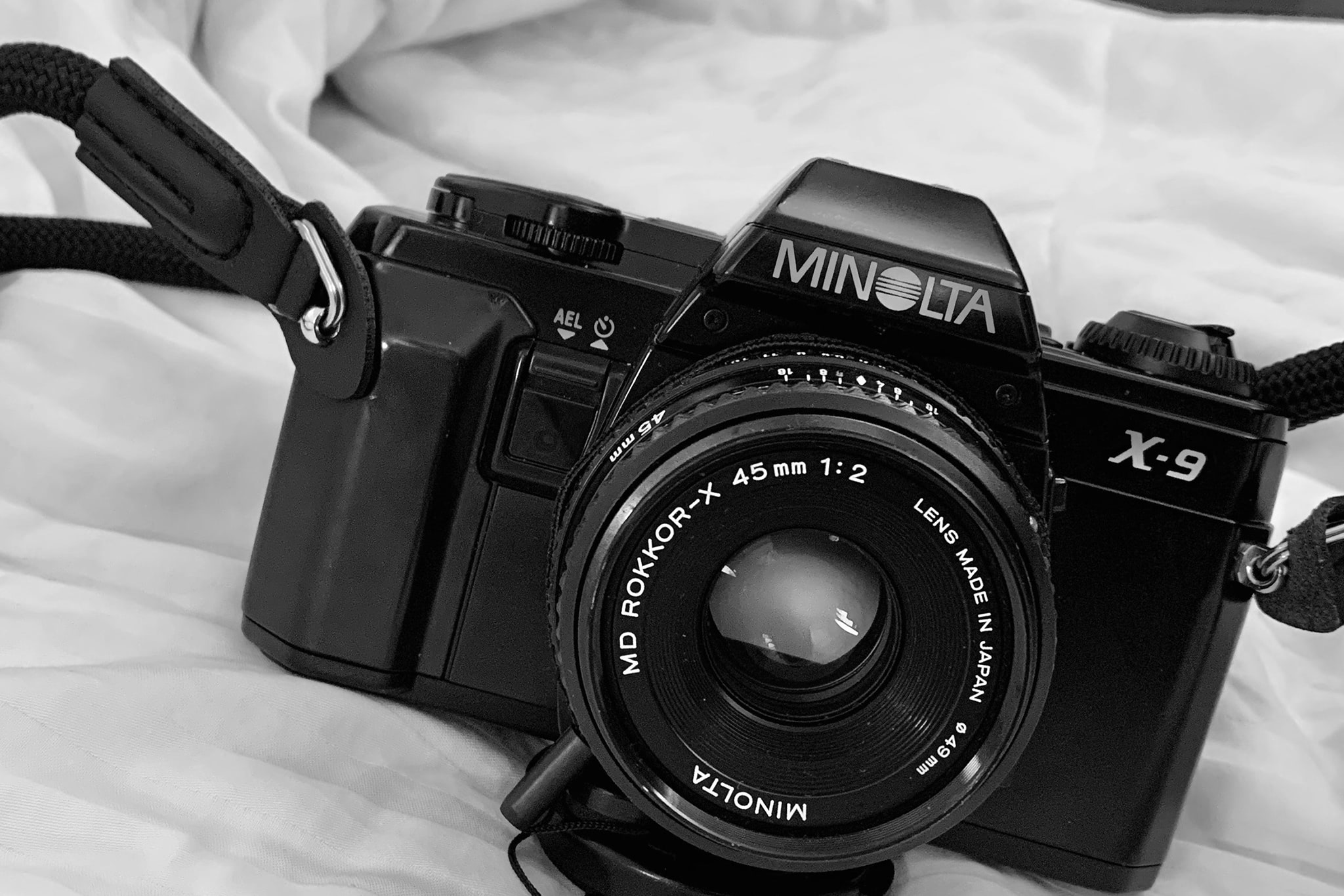
The Minolta X-370N is a 35mm camera from the 1990s. It belongs to the group of SLR cameras and was built in a factory in Japan. The model was sold under the name "X-370N" in Canada and the USA. Outside of North America, the camera was sold as the Minolta X-300s.
The lens of the 35mm camera is interchangeable. There are a variety of different lenses available for the Minolta SR bayonet. Most commonly, this model is found with a 50mm lens. The 35 mm camera does not have an autofocus. Focusing is done manually by hand.
The Minolta X-370N has a built-in light meter. It is designed for films in a range from ISO 12 to ISO 3200. The film speed can be set freely. Aperture and shutter speed can also be freely selected. For shutter speeds, you can choose between values from 1/1000 second to 1 second. There is also an automatic exposure mode. Here, the aperture is selected by the user and the camera technology selects the appropriate shutter speed. In this mode, the longest exposure time is four seconds.
In addition to the normal exposure times, there is also a Bulb mode. This mode is particularly suitable for long exposures, for example at night. When taking night shots with little light, you should mount the camera on a tripod. A corresponding thread is located on the bottom of the camera.
There is also a thread for a cable release on the camera. So is a self-timer with a lead time of ten seconds. A flash can also be connected with the SLR.
According to the manual, the dimensions of the Minolta X-370N are 14 x 9 x 5.15 cm. It weighs 490 grams without lens and film. The camera requires two LR44 batteries (eBay / Amazon*). These batteries power the light meter, among other things. The batteries are easy to obtain.
Films for the Minolta X-370N
Available photo films for the Minolta X-370N that are easy to get are the Kodak Gold 200* for color shooting and the Kodak T-Max 400* for B&W shooting. Both films are well suited for everyday use with the SLR and can convince is test reports. Adox, Foma, Rollei and Co. of course also offer suitable films for this format, which can be used with the Japanese camera.
The film transport is manual. After each shot, the film has to be transported further with a lever. An electric motor was offered as an accessory.